
TL;DR:
- Smart vacation budgeting involves planning travel expenses as a fixed percentage of your annual income before booking to avoid credit card regret. By allocating funds to transportation, accommodation, food, and activities with an added contingency buffer, travelers can spend intentionally and reduce financial stress. Tracking expenses daily with apps or cash limits ensures staying within limits and enhances trip enjoyment.
Smart vacation budgeting is the practice of treating your travel expenses as a planned line item in your annual finances, allocated before you book a single flight or hotel. Most people approach vacation spending as an afterthought, which is exactly why so many trips end with credit card regret. When you plan your travel budget the same way you plan rent or groceries, you gain control over costs without sacrificing the experience. Financial planners recommend allocating 5 to 10% of your annual income toward vacations, and some families plan trips 18 months in advance to maximize flexibility and deal opportunities. The result is travel that feels earned, not anxious.
What is smart vacation budgeting and why does it matter?
Smart vacation budgeting, known in personal finance as travel expense management, means deciding how much you will spend on a trip before you start spending it. The distinction sounds obvious, but most travelers do the opposite. They book first, then discover the real cost.

Effective vacation budgeting matters because daily on-the-ground surprises are the leading cause of budget overruns on trips. A taxi you didn't expect, a restaurant that was pricier than the menu suggested, or a museum entrance fee you forgot to factor in can each chip away at your remaining funds. Multiply those moments across seven days and you have a problem.
The payoff for planning ahead is real. Travelers who treat vacation savings as a non-negotiable budget category report less financial stress during trips and are more likely to take the trips they actually want, rather than settling for whatever they can afford last minute. Affordable vacation planning is not about spending less. It is about spending intentionally.
What are the core components of a smart vacation budget?
Planning spending in four categories gives you the clearest picture of where your money goes: transportation, accommodation, food, and activities. Think of it as a travel wallet with four pockets. Each pocket gets a fixed allocation before you leave, and you tighten the pockets that matter less to fund the ones that matter more.

Here is how a typical budget breakdown looks across those categories:
| Category | Typical % of Total Budget | Notes |
|---|---|---|
| Transportation | 30–40% | Flights, trains, local transit, car rental |
| Accommodation | 25–35% | Hotels, vacation rentals, hostels |
| Food and dining | 20–25% | Restaurants, groceries, coffee |
| Activities and entertainment | 10–15% | Tours, museums, experiences |
Beyond the four main pockets, your budget needs secondary line items that most travelers forget entirely. Travel insurance, tips, souvenirs, visa fees, and a contingency fund all belong in the plan. A contingency buffer of 10 to 15% of your total budget covers the unexpected without derailing your finances. Skipping this buffer is the single most common reason travelers overspend.
The risk of underestimating daily expenses is not just financial. It creates decision fatigue mid-trip, where every purchase becomes a small source of stress. When your budget is fully mapped before departure, you spend freely within your limits and enjoy the trip more.
- Transportation: include airport transfers, rideshares, and fuel if driving
- Accommodation: factor in resort fees, parking, and taxes not shown in the headline rate
- Food: budget separately for one or two nicer meals rather than averaging everything
- Activities: research entrance fees in advance since popular attractions rarely offer discounts at the door
- Contingency: treat this as a locked pocket, not a slush fund
How to create and fund your vacation budget effectively
Defining the purpose of your trip is the first step in any budgeting workflow, and it is the step most people skip. Are you going for relaxation, adventure, culture, or family connection? Your answer determines where your money should go and where you can cut without noticing.
Follow this workflow to build a budget that actually holds:
- Define your trip purpose. Write down the one or two experiences that will make this trip feel worthwhile. Everything else is negotiable.
- Set a total trip budget. Use your annual income as a guide. A 5 to 10% allocation gives you a realistic ceiling.
- Open a dedicated savings account. Keep vacation funds separate from your checking account so they are not accidentally spent.
- Automate your transfers. Automating vacation savings removes the temptation to redirect that money elsewhere and builds your fund steadily without requiring willpower.
- Start saving at least 6 months out. For international trips, 9 to 12 months is better. Earlier savings give you more flexibility on flights and accommodations.
- Build your contingency buffer. Add 10 to 15% on top of your estimated total before you finalize the number.
- Talk to your travel companions. Budget conversations before booking prevent conflict during the trip. Agreeing on a daily food budget or activity spend upfront keeps everyone aligned.
- Decide on cash versus credit. Credit card rewards can offset costs, but credit card spending causes budgeting failure when you lose awareness of your total spend. Use rewards for fixed costs like flights, then switch to cash or a debit card for daily expenses.
Pro Tip: Apps like Trail Wallet, TravelSpend, and Splitwise let you set a daily budget, log expenses in real time, and split costs with travel companions. Logging purchases the moment they happen takes under 10 seconds and eliminates end-of-day guesswork.
For a deeper look at how different budgeting systems for travel compare, the approach you choose should match your spending personality, not just your destination.
What strategies make your travel dollars go further?
Value-weighting your budget is more effective than cutting costs across the board. The idea is simple: allocate more money to the one or two categories that define your trip, and tighten spending everywhere else. A food-focused traveler in Italy should spend more on dining and less on accommodation. An adventure traveler in Costa Rica should invest in guided experiences and stay in budget guesthouses.
Flexibility on dates and destinations produces some of the largest savings available to any traveler. Booking flights on Tuesdays and using fare alert tools like Google Flights or Hopper can save $200 to $400 per person on airfare alone. That is a meaningful amount redirected toward experiences. Domestic flights booked 6 to 8 weeks ahead and international flights booked 2 to 3 months ahead consistently yield the best prices.
Accommodation choices carry more budget leverage than most travelers realize. Staying one or two neighborhoods outside a city center can cut hotel costs by 20 to 30% with minimal impact on your experience. Vacation rentals on platforms like Vrbo work especially well for groups or trips longer than five days, where the per-night cost drops and access to a kitchen reduces food spending significantly.
Free and low-cost activities deserve a dedicated spot in your itinerary. Most major cities offer free museum days, public markets, walking tours, and parks that deliver genuine cultural value at zero cost. Pairing one paid experience per day with free alternatives keeps your activity budget lean without making the trip feel sparse.
Pro Tip: Plan one deliberate splurge per trip, a single meal, experience, or upgrade that you genuinely want. Research shows that one high-quality experience creates stronger memories than several mediocre ones. It also gives you permission to say no to impulse spending the rest of the time.
For travelers interested in budget-friendly travel ideas that do not require sacrificing quality, the key is knowing which trade-offs you will not notice and which ones you will.
How do you track and manage spending during your trip?
Setting a daily spending limit is the most practical tool for in-trip expense management. Divide your total discretionary budget by the number of trip days. A $1,200 discretionary budget over 7 days gives you approximately $170 per day. Tracking spending in real time reduces mid-trip financial stress and keeps you from discovering a problem on day five that you cannot fix.
Here is a comparison of the most practical tracking methods:
| Method | Best for | Limitation |
|---|---|---|
| Cash envelopes | Solo travelers, short trips | Inconvenient for large purchases |
| Budgeting apps (TravelSpend, Trail Wallet) | All trip types | Requires consistent logging |
| Spreadsheet (Google Sheets) | Detail-oriented planners | Manual entry, less portable |
| Splitwise | Group travel | Focused on splitting, not total budget |
Using cash for discretionary spending physically limits what you can spend in a day. When the cash is gone, the decision is made for you. This is not about restriction. It is about removing the mental load of constant calculation. Reserve your credit card for fixed, pre-planned costs like accommodation and transportation.
For group trips, transparency is the biggest challenge. Designating one person to track shared expenses daily, or using Splitwise to log costs as they happen, prevents the awkward end-of-trip accounting that strains relationships. Agree on a shared daily food budget before you leave, and check in on it each evening. You can also find useful guidance on tracking travel spending to keep every dollar accounted for across the whole trip.
Key takeaways
Smart vacation budgeting requires treating travel as a planned financial category, allocating funds before booking, and tracking spending daily to stay within limits.
| Point | Details |
|---|---|
| Define purpose first | Knowing your trip's priority shapes every spending decision and prevents waste. |
| Use the four-pocket framework | Allocate budget to transportation, accommodation, food, and activities before departure. |
| Automate your savings | Set up automatic transfers to a dedicated vacation account at least 6 months out. |
| Value-weight your spending | Invest more in the 1 to 2 categories that matter most; cut freely everywhere else. |
| Track daily with a limit | Divide discretionary funds by trip days and log expenses in real time to avoid overruns. |
Why budgeting changed how I travel, not just what I spend
The conventional advice on travel budgeting focuses almost entirely on cutting costs. Book cheaper flights. Stay in hostels. Skip the fancy dinners. That framing treats budgeting as deprivation, and it is why so many people abandon their travel budgets by day three.
What actually works is the opposite approach. When I started treating my vacation fund as a non-negotiable savings category, the same way I treat my emergency fund, my travel improved. Not because I spent more, but because I spent with intention. I stopped making impulsive booking decisions and started making choices aligned with what I actually wanted from a trip.
The value-weighting principle changed my trips most dramatically. I used to spread my budget evenly across every category, which meant mediocre food, mediocre accommodation, and mediocre activities. Once I decided that food was my priority on a trip to Portugal, I booked a modest guesthouse outside Lisbon's center, skipped the tourist-trap restaurants, and spent that saved money on two extraordinary meals and a cooking class. The trip cost the same. The memories were incomparably better.
The mistake I see most often is waiting until you have "enough" to start planning. You do not need a large budget to start budgeting well. You need a clear purpose, a dedicated savings account, and the discipline to automate the rest. Start now, even if your trip is 18 months away. The travelers who plan furthest ahead consistently get the most for their money, and they arrive at the airport without financial dread.
— Helen
Let Destlist do the planning while you focus on the experience
Knowing how to budget for vacation is one thing. Building a complete, cost-conscious itinerary that actually fits your priorities is another challenge entirely.
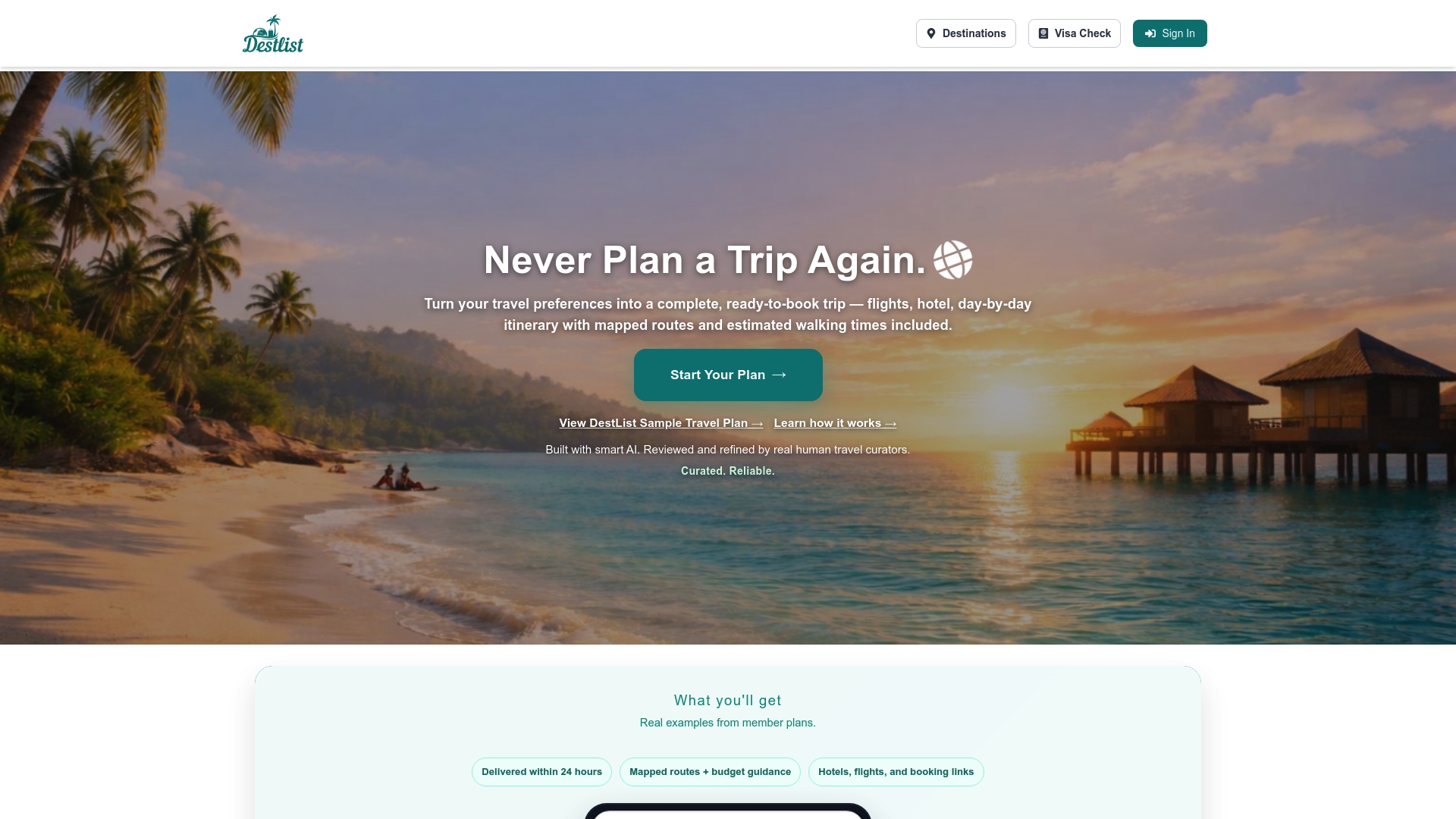
Destlist combines AI-driven planning with real human travel expertise to deliver personalized travel itineraries that match your budget, travel style, and schedule. Every plan includes budget-conscious flight and hotel matching, day-by-day activities, mapped routes, and estimated walking times, delivered within 24 hours. You set the budget ceiling. Destlist builds the trip around it. Browse curated travel plans across dozens of destinations and find the one that fits what you want to spend and experience.
FAQ
What is smart vacation budgeting?
Smart vacation budgeting is the practice of allocating travel expenses as a planned line item in your annual budget before booking anything. It treats vacation spending as a financial priority, not an afterthought, to keep total costs within defined limits.
How much of my income should I budget for vacation?
Financial planners generally recommend allocating 5 to 10% of your annual income toward vacation spending. The exact amount depends on your income, savings goals, and how central travel is to your priorities.
How far in advance should I start saving for a trip?
Start saving at least 6 months before a domestic trip and 9 to 12 months before an international one. Some families plan and save up to 18 months in advance to access better deals and greater flexibility.
What is the best way to track spending during a trip?
Divide your total discretionary budget by the number of trip days to set a daily limit, then log expenses in real time using an app like TravelSpend or Trail Wallet. For group travel, Splitwise keeps shared costs transparent and prevents end-of-trip disputes.
Should I use cash or a credit card while traveling?
Use credit card rewards for fixed, pre-planned costs like flights and hotels, then switch to cash for daily discretionary spending. Cash physically limits what you can spend and removes the risk of losing track of your total outlay.