
TL;DR:
- Tracking travel spending helps prevent hidden costs and improves budget control for all travelers. Digital tools increase accuracy, reduce administrative hassles, and support better compliance with policies and taxes. Using real-time expense data enables smarter planning, cost forecasting, and improved travel performance over time.
Most travelers leak hundreds of dollars every trip without realizing it. A coffee here, a taxi upgrade there, an overpriced airport meal that somehow never made it onto any list. By the time you land back home, the trip cost far more than you planned, and you have no clear picture of where the money actually went. Tracking travel spending fixes that problem, not just for road warriors filing expense reports, but for anyone who wants to travel more, stress less, and get genuinely better at managing money on the move.
Table of Contents
- The hidden benefits of tracking travel spending
- How tracking simplifies reimbursements and reduces headaches
- Policy compliance, audit readiness, and tax advantages
- Forecast, optimize, and outperform with smart tracking
- Why most travelers underestimate the power of tracking — and how to do it right
- Plan smarter, save more: How DestList can help you optimize every trip
- Frequently asked questions
Key Takeaways
| Point | Details |
|---|---|
| Save money easily | Tracking uncovers spending leaks, helping you stick to your travel budget and save more for each trip. |
| Reimburse faster | Digital tools ensure smooth reimbursements, saving time and reducing stress after your travels. |
| Stay compliant | Proper tracking means you avoid tax problems and meet work policies with less hassle. |
| Improve trips over time | Reviewing your tracked data lets you optimize future travel costs and trip experiences. |
The hidden benefits of tracking travel spending
Once you realize that tracking is for everyone, the specific benefits it delivers become hard to ignore.
Most people still associate expense tracking with corporate road warriors or accountants. That framing costs them real money. Whether you are planning a solo weekend getaway or managing a team attending an industry conference, the same principle applies: you cannot control what you do not measure.
Tracking travel spending enables better cost control and budget monitoring, helping you identify overspending patterns before they spiral. The moment you start recording expenses in real time, spending habits that seemed invisible become obvious. You might discover that dining out accounts for 40% of your trip budget, not the 20% you assumed. That single insight can reshape how you plan food for your next trip.
The numbers behind this are striking. The average business trip costs $1,128, up 35% year over year, and organizations using integrated travel and expense platforms report 21% annual savings alongside 26% higher policy compliance. Those are not marginal gains. That is the difference between a budget that works and one that quietly drains your finances trip after trip.
For personal travelers, the benefits map directly onto travel budgeting systems that help you plan smarter each time. When you track a family vacation, you build a real data set: what cities cost per night, which activities eat into your budget, and where you consistently overspend. Use that data on your next trip and you will make better decisions faster.
Here is a quick look at what tracking delivers versus what guessing costs you:
| Approach | Budget accuracy | Savings potential | Stress level |
|---|---|---|---|
| No tracking | Low | Minimal | High |
| Manual tracking (spreadsheet) | Moderate | Moderate | Moderate |
| Digital app tracking | High | Up to 21% annually | Low |
| Integrated T&E platform | Very high | 21%+ with 26% higher compliance | Very low |
Key benefits that most travelers overlook include:
- Spending pattern visibility: You see exactly where money goes, not where you think it goes.
- Smarter pre-trip estimates: Past trip data makes future budgets far more accurate.
- Negotiation power: Patterns show you which vendors or booking habits cost the most, giving you leverage to switch.
- Tax and reimbursement readiness: Every receipt is already documented before you need it.
- Reduced financial anxiety: Knowing your numbers live, not at checkout, removes a massive source of travel stress.
Following budget-friendly travel steps becomes significantly easier once you have real spending data backing your decisions rather than rough guesses.
How tracking simplifies reimbursements and reduces headaches
With tracking's benefits in mind, consider how much simpler life becomes when handling reimbursements and the paperwork that follows every work trip.
Lost receipts are the single biggest reason reimbursements get delayed or denied. When you rely on memory and crumpled paper slips, the administrative burden compounds fast. You spend more time hunting for records than you did actually traveling. Digital tracking eliminates that entirely.
Real-time documentation and digital expense tools speed up reimbursements and cut administrative burden for professionals significantly. Apps that auto-scan receipts the moment you receive them mean there is nothing to lose, forget, or reconstruct later. Cloud storage ensures those records exist whether you are online or offline, whether you are at the airport or in a rural area with spotty signal.

For travelers managing flexible travel planning scenarios where itineraries shift mid-trip, tracking in real time means your expense records keep up with your actual movements. You never return home with a pile of loose receipts that no longer match any clear context.
Here is a step-by-step process for smooth expense documentation on any trip:
- Before you leave: Set up your app or spreadsheet with budget categories (transport, accommodation, meals, activities, incidentals).
- At point of purchase: Scan or photograph the receipt immediately. Do not wait until the end of the day.
- Add context instantly: Tag the expense with a category and a short note if it is billable to a client or project.
- Review daily: Spend five minutes each evening checking the day's totals against your budget categories.
- Export at trip end: Pull a clean report from your app before you even board the flight home.
- Submit promptly: Send reimbursement claims within 24 hours of returning, while context is fresh.
This kind of system also supports customizing trips efficiently because you can see in real time whether you are running over budget in one category and can shift spending accordingly.
Pro Tip: Use an app with optical character recognition (OCR) receipt scanning. It reads the merchant name, date, and total automatically so you are not typing anything. Many also connect directly to your credit card for a double-verification layer.
Employers and clients increasingly require AI itinerary tips and digital documentation as part of standard submission. A clean, timestamped digital trail removes every point of friction from that process.
| Documentation method | Receipt loss risk | Reimbursement speed | Policy compliance |
|---|---|---|---|
| Paper receipts only | Very high | Slow (days to weeks) | Low |
| Manual spreadsheet | Moderate | Moderate | Moderate |
| App with OCR scanning | Very low | Fast (same day possible) | High |
| Integrated T&E platform | Near zero | Real-time | Highest |
Policy compliance, audit readiness, and tax advantages
Beyond saving time, proper tracking shields you from serious headaches at tax season and audit time.
This is where most casual travelers leave significant money on the table. They track loosely or not at all, then scramble at year-end or when a reimbursement is questioned. Tracking ensures policy compliance and audit readiness, protects your tax deductions, and prevents penalties that come from poor or incomplete records.
For business and hybrid travelers (those who mix work and personal travel), the stakes are especially high. The IRS and most corporate finance teams require documentation that shows the business purpose, date, amount, and location for every claimed expense. Without tracking, reconstructing that information weeks or months later is nearly impossible.
Key areas where tracking protects you:
- VAT reclaims: International business travelers can often reclaim VAT on expenses, but only with proper digital records submitted within strict time windows.
- Taxable reimbursements: If your expense report is incomplete or late, some reimbursements get reclassified as taxable income by your employer's payroll system.
- Audit documentation: A clean expense history with timestamped receipts and categorized records is your best defense in any internal or external audit.
- Policy ceiling violations: Most companies set per-diem limits on meals and lodging. Tracking in real time helps you stay within those limits and avoid uncomfortable conversations.
- Mixed-use trip deductions: When a trip is partly personal and partly business, the portion split must be clearly documented or the entire deduction can be disallowed.
"Failing to track business travel expenses properly doesn't just create paperwork problems. It creates tax liability, compliance violations, and in worst cases, penalties that far exceed the cost of the trip itself."
The solution is not complicated. It is consistent. Build a habit of capturing receipts the moment they happen, categorize them accurately, and store them in a format that survives a laptop crash. Good budget travel planning practices naturally feed into better compliance because the same discipline that keeps you on budget also keeps your records clean.
Pro Tip: For hybrid trips, use a color-coded tagging system in your expense app: one color for business expenses, another for personal. When tax time arrives or when your employer requests documentation, you can filter and export each category separately in seconds.
Understanding how to choose the right travel budget type for your situation also affects which expenses are trackable and deductible, so aligning your budget structure with your tracking system from the start saves considerable effort later.
Forecast, optimize, and outperform with smart tracking
Finally, let's move from basic compliance to proactive optimization, which is where tracking truly pays dividends over time.
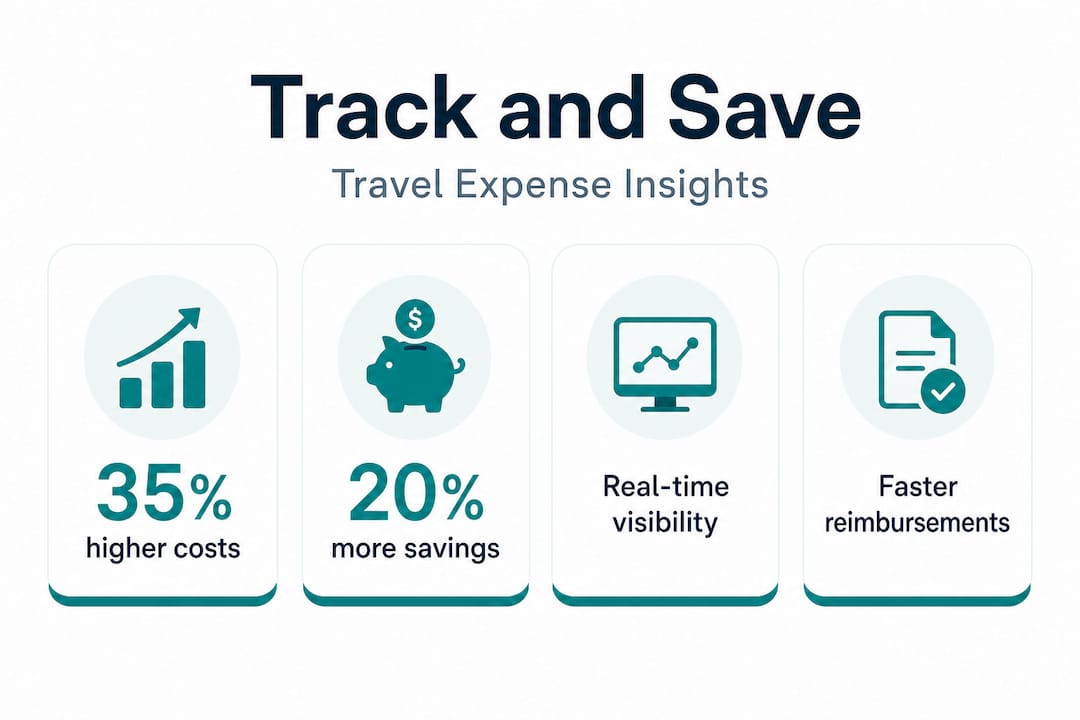
Tracking expenses during a trip is valuable. Using that data to forecast and improve future trips is where the real power sits. Expense data collected consistently across multiple trips becomes a performance tool, not just a record-keeping exercise.
Smart tracking provides data for forecasting, analytics, and optimizing future trips with real-time visibility into budgets. That means you can walk into a trip knowing, based on actual history, that your last three trips to cities of similar size cost an average of $180 per night on accommodation and $65 per day on food. That is not guessing. That is data-driven planning.
The business case is equally compelling for frequent travelers and organizations. A 1% increase in managed travel spend is associated with a 0.20% revenue rise, and companies using strategic tracking see up to 30% outperformance compared to those relying on ad-hoc expense management.
Here is how to turn raw expense data into actionable insights after each trip:
- Categorize and export your full trip report within 48 hours of returning, while details are still fresh.
- Compare actuals to your pre-trip budget across every category. Note where you were over, under, and on target.
- Identify your top three overspend categories. These are your action areas for the next trip.
- Build a destination cost profile. Create a simple file or note for each city or region you visit that records average daily costs by category.
- Adjust your default budget template. Update your go-to planning spreadsheet or app template based on what you actually spent, not what you assumed you'd spend.
- Track ROI for work trips. Note the revenue, leads, or outcomes generated by each trip and map them against total cost.
This process directly supports customization in travel planning because your preferences and spending patterns shape a genuinely personalized budget, not a generic one.
| Tracking maturity level | Forecasting accuracy | Savings potential | Time to insights |
|---|---|---|---|
| No tracking | Very low | Minimal | Never |
| Post-trip manual review | Low to moderate | 5 to 10% | Weeks |
| Real-time digital tracking | High | 15 to 21% | Hours |
| Integrated platform with analytics | Very high | 21 to 30% | Real-time |
For multi-trip planning strategies, this approach scales naturally. Each trip feeds the next, and over a year, you build a reliable cost model that removes guesswork from annual travel budgets entirely.
Why most travelers underestimate the power of tracking — and how to do it right
Here is what most guides on this topic never tell you about tracking travel spending.
Most people treat tracking as a post-trip chore, something you do to file an expense report or reconcile a credit card statement. That mindset misses the point entirely. The real value of tracking is behavioral. When you see your numbers in real time, you make different decisions. You order differently at dinner. You pick a different taxi option. You reconsider that optional tour when you see you are already 15% over your activity budget.
Tracking changes how you travel, not just how you report on it.
There is another thing most articles skip: offline and manual tracking still matters. Remote destinations, international SIM card issues, and app crashes are real. Having a simple backup habit, even just a note on your phone or a small pocket notebook, ensures you never lose a transaction to a technology failure. The best tracking systems are the ones that survive imperfect conditions.
Split expenses are another source of chaos that tracking solves quietly. Group travel, shared accommodations, and team business trips create messy cost splits that become genuinely difficult to untangle without records. A simple shared tracking doc or an app with split-expense features prevents disputes and confusion weeks later.
The insiders who do this well share one habit: they automate what they can and create a trigger for what they cannot. That means receipt scanning the moment a transaction happens, not at the end of a long day when memory is unreliable and receipts have traveled through three jacket pockets.
Following expert tips for trip planning consistently shows that the travelers who enjoy trips most are not necessarily the ones spending the most. They are the ones who know what they are spending, feel in control, and can make real-time adjustments without stress or guilt.
Plan smarter, save more: How DestList can help you optimize every trip
If you want your next trip to be both enjoyable and budget-smart, here is how DestList can help you put the strategies above into practice.

DestList builds custom travel itineraries that include budget-conscious flight and hotel matching, so your spending estimates are built into the plan from day one, not added as an afterthought. Every itinerary comes with detailed day-by-day activity flows, mapped routes, and estimated walking times, giving you the structure you need to track time and money in parallel. Instead of piecing together a trip from a dozen browser tabs and hoping the budget holds, you get a ready-to-book plan that already accounts for your financial limits. Explore curated travel plans and see exactly how much control you can have over your next trip before you even pack a bag.
Frequently asked questions
Is tracking travel spending only useful for business travelers?
No, tracking helps anyone avoid overspending and maximize savings on both personal and business trips. Better cost control and budget monitoring through tracking benefits every type of traveler, regardless of purpose.
What tools are best for tracking travel expenses?
Digital apps with real-time photo receipts, cloud storage, and automated reports save the most time and prevent lost records. Real-time documentation and digital tools speed up reimbursements and cut administrative burden significantly compared to paper-based methods.
How can tracking travel spending increase savings?
Tracking identifies spending leaks, helps you compare options, and has shown to save over 20% annually for frequent travelers using integrated platforms, alongside 26% higher policy compliance rates.
What happens if I don't track my travel expenses properly for work?
Missing records can delay reimbursements, cause policy violations, or make your reimbursement taxable. Poor expense documentation prevents you from claiming deductions and leaves you exposed during audits or internal finance reviews.