
TL;DR:
- Human-Aided trip design combines AI efficiency with human judgment to create personalized travel itineraries. It improves accuracy and relevance by incorporating local knowledge, relationships, and contextual preferences. This collaboration results in higher traveler satisfaction and fewer errors compared to AI-only planning.
What human-aided trip design actually means
Human-aided trip design is the practice of combining AI tools with human expertise to build travel itineraries that are both fast and genuinely personalized. AI handles the heavy lifting of data retrieval: scanning flight options, generating route structures, pulling hotel availability. Human curators then apply the judgment layer that no algorithm can replicate.
According to the 2026 'State of Artificial Intelligence in Travel' report, 40% of travelers use AI tools when planning trips, but 62% still rely on traditional websites found through search engines. That split tells you something real: AI is a useful layer, not the whole system.
What humans contribute that AI structurally cannot:
- Local timing knowledge — knowing that late September in Santorini means meltemi winds, cancelled ferries, and stranded travelers, not just "shoulder season"
- Relationship-based access — a table at a twelve-seat Lisbon restaurant that takes no online reservations, or a room upgrade because a hotel GM remembers a past guest
- Editorial judgment — removing stops, not adding them, because a trip with fewer obligations often lands better than a packed one
- Contextual preference reading — understanding what a traveler actually wants versus what scores well in aggregate reviews
Why AI-only planning falls short
AI is genuinely good at a narrow set of tasks: generating route options, comparing prices, building packing lists, and surfacing general best-time-to-visit guidance. The problem is that many travelers treat the AI's first draft as a finished plan.
It isn't. An AI-generated itinerary is unreviewed, and the gaps show up on the ground, not in the planning phase. A restaurant that closed two years ago still holds a five-star rating in the training data. A museum that requires advance booking three months out gets listed as a casual afternoon stop.
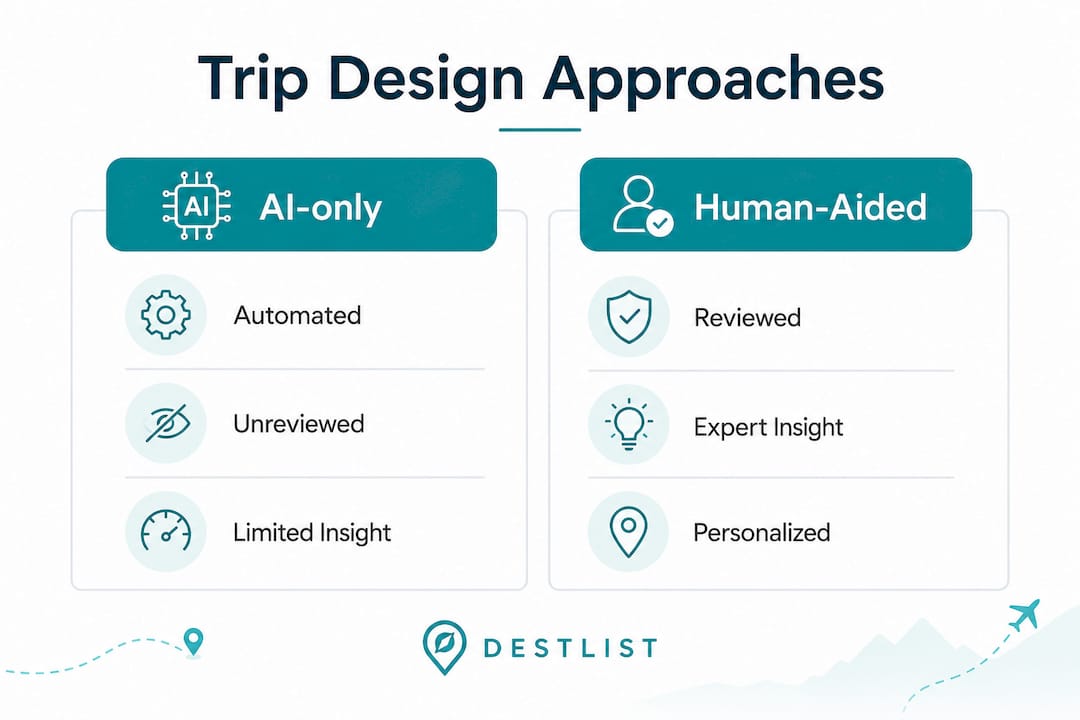
Expert travel planners describe this as the "hard 20%" of trip decisions: timing nuances, relationship-based perks, and knowing what to cut. AI has commoditized much of the easier planning tasks, which means the value has shifted entirely to the parts it cannot do. A 2026 survey confirms travelers accept AI for friction-reducing tasks but prefer human judgment for complex or critical decisions.
Where AI-only planning consistently fails:
- Timing exceptions that require lived experience, not aggregate data
- Access that depends on relationships no AI tool has built
- Outdated information that looks current because it was never flagged as stale
- Generic density bias, packing in every highly-rated attraction rather than editing for pace
Pro Tip: Before booking any AI-generated itinerary, ask three questions the AI skipped: What would ruin this trip if it went wrong? What would make it memorable? What are you willing to cut to protect both?
How human-AI collaboration works as a co-creation process
Research published in the Journal of Travel Research frames travel planning as a co-performance between the traveler (the digital guest) and the AI system (the digital host). That framing matters because it shifts the model from "AI generates, human approves" to something more interactive.
The study identifies six roles AI can play: mentor, pathfinder, partner, acquaintance, butler, and implementer. Each role reflects a different level of traveler control and AI involvement. A traveler who wants to explore open-endedly might use AI as a pathfinder. Someone with a fixed itinerary might use it as a butler to handle logistics. The point is that the human stays in control of which role the AI plays.
Co-creation quality, measured across customization, responsiveness, and user control, has a statistically significant positive impact on traveler satisfaction with AI-assisted planning. That finding, confirmed through Pearson Correlation and Structural Equation Modeling, suggests the design of the human-AI interaction matters as much as the AI's raw capability.
What effective co-creation looks like in practice:
- Travelers input specific preferences, not just destination names
- AI generates a structured draft with options, not a single locked itinerary
- Human curators or the traveler themselves apply contextual filters before anything gets booked
- The final plan reflects both AI efficiency and human editorial judgment
How Destlist applies human-aided planning in practice
Destlist is built on exactly this division of labor. The platform uses AI to handle the research-intensive groundwork: matching flights and hotels to budget, generating day-by-day activity structures, calculating walking times, and building mapped routes. Human curators then review those drafts before delivery.

The result is a ready-to-book itinerary delivered within 24 hours, covering flights, hotels, curated daily plans, weather alerts, packing lists, and private travel perks. The AI draft is the starting point. The human review is what makes it reliable.
Helen, the travel expert behind the Destlist blog, describes the approach as applying an "operator mindset": use AI to compress the routine research, then route every decision that actually matters through a human judgment filter. That means checking timing exceptions, confirming access realities, and cutting stops that look good on paper but don't fit the traveler's actual pace.
| Feature | Generic AI plan | Destlist human-aided plan |
|---|---|---|
| Itinerary generation | Automated, unreviewed | AI draft plus human curator review |
| Timing accuracy | Based on aggregate data | Verified against current local conditions |
| Personalization | Preference inputs only | Contextual judgment applied to preferences |
| Access and perks | Publicly available options | Relationship-based and curated additions |
| Delivery | Instant, unfiltered | Within 24 hours, reviewed and refined |
Destlist also offers a free destination discovery tool for travelers still deciding where to go, and a smart packing list generator that runs alongside the itinerary. These tools reflect the same logic: AI handles the repeatable tasks, human curation handles the judgment calls.

Ready to see what a human-reviewed itinerary actually looks like? Destlist builds customized travel itineraries that combine AI speed with expert human review, delivered within 24 hours.
Why human involvement still determines trip quality
The "operator mindset" that expert trip designers use treats AI as one layer in a deliberate system, not the whole system. AI compresses the time it takes to build a structural draft. Human judgment determines whether that draft is actually right for this traveler, this trip, and this moment.
Local knowledge and cultural insight are the clearest examples. A human who has traveled extensively through a region knows which neighborhoods feel different at night, which local food traditions are worth building a half-day around, and which "must-see" attractions are genuinely worth the line. Gastronomy is a good example: local food culture shapes the rhythm of a destination in ways that aggregate review scores rarely capture.
Human involvement also catches errors before they become problems. Outdated restaurant listings, closed attractions, and impractical transit connections are common in AI-generated plans because the model has no way to know what changed last month. A human reviewer with current knowledge of a destination catches those before the traveler is standing outside a locked door.
The personalized trip plans that consistently get the best traveler feedback share one trait: they were edited, not just generated. Something was cut. A timing adjustment was made. A stop was swapped for something less famous but more fitting. That editorial layer is what separates a plan that looks complete from one that actually works.
Key Takeaways
Human-aided trip design outperforms AI-only planning because human judgment handles the timing nuances, relationship-based access, and editorial decisions that AI structurally cannot make.
| Point | Details |
|---|---|
| AI covers the easy tasks | AI handles fast research, route generation, and logistics; human curation handles the rest. |
| Many travelers still use traditional search methods alongside AI tools. | 40% of travelers use AI tools, but 62% continue to rely on traditional websites through search engines. |
| Co-creation quality drives satisfaction | Customization, responsiveness, and user control each have a statistically significant impact on traveler satisfaction. |
| Human review prevents costly errors | Outdated info and impractical timing in AI drafts require human validation before booking. |
| Destlist delivers within 24 hours | AI-generated drafts reviewed by human curators produce ready-to-book itineraries in under a day. |