
TL;DR:
- Spontaneous travel planning involves making quick, flexible decisions with minimal preparation and firm anchors. It appeals to over 78% of travelers and is especially popular among Millennials and Gen Z. This approach emphasizes booking a home base, using digital tools, and maintaining one main activity daily for joyful, adventure-filled trips.
Spontaneous travel planning is defined as the practice of preparing just enough to launch a last-minute trip confidently, without locking yourself into a rigid schedule. It sits between total improvisation and full itinerary planning, giving you a safety net while keeping your days open. Over 78% of travelers find spontaneous travel appealing, and more than 75% of Millennials and Gen Z have booked at least one last-minute trip. That number tells you this is not a fringe habit. It is how a generation travels.
What is spontaneous travel planning, really?
Spontaneous travel planning is the intentional act of making fast, flexible decisions about a trip while keeping one or two anchors in place to prevent chaos. The industry often calls this "strategic freedom," a term that captures the balance between confidence and adventure. You are not winging it completely. You are choosing what not to plan.

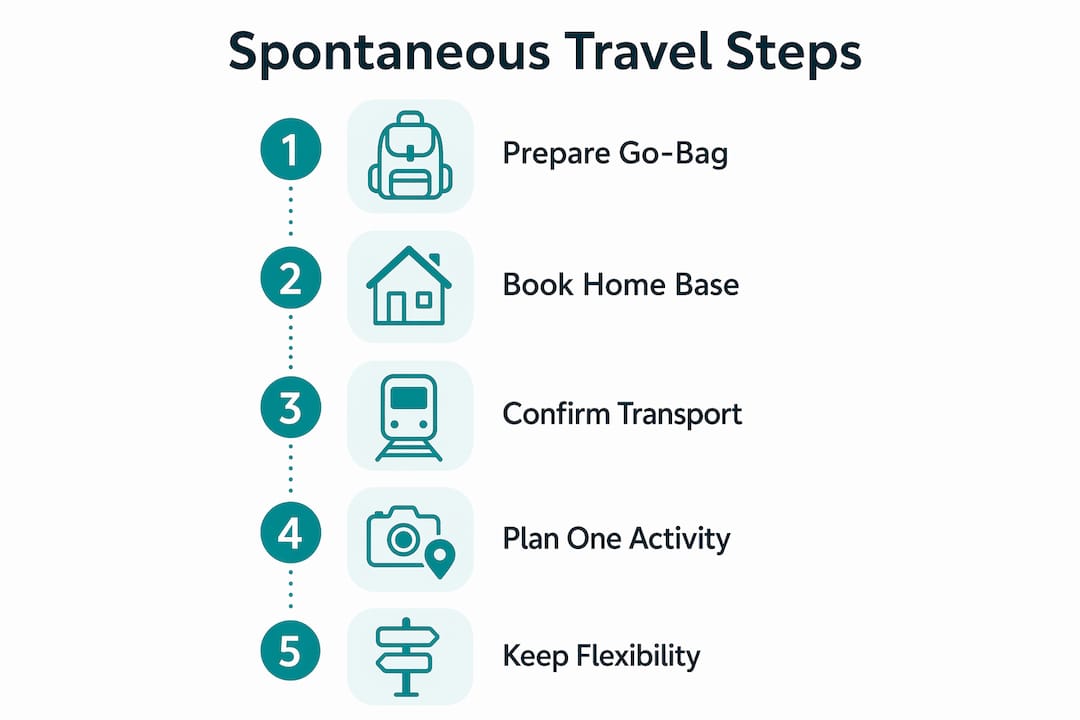
The core elements are simple: book a home base, confirm your transport, and leave the rest open. This approach works especially well for short trips, weekend getaways, and familiar destination types. It is the opposite of the overplanned vacation where every hour is scheduled and any deviation causes stress.
Impulsive travel ideas become real trips when you treat spontaneity as a skill, not a personality trait. Anyone can learn it. The key is knowing which decisions matter and which ones you can make on arrival.
What are the essential components of spontaneous travel planning?
Effective last-minute travel planning comes down to a handful of non-negotiable building blocks. Get these right and the rest takes care of itself.
- A tight planning window. 20–30 minutes is enough to check transport options, book a home base, and sketch a loose activity list. More time than that and you risk overplanning.
- A home base booked first. Securing one central accommodation gives you a physical anchor. Everything else can stay flexible.
- An idea list, not an itinerary. Write down 8–10 things you might want to do. Pick from the list each morning based on your mood and energy.
- Digital readiness. Offline maps and eSIMs are mandatory for spontaneous travel. Connectivity problems kill momentum faster than any missed booking.
- All-in budget math. The cheapest headline price rarely means best value. A budget room far from the city center can cost more overall once you add transport. Always calculate the full picture.
- A ready go-bag. Seasoned spontaneous travelers keep a pre-packed bag with travel essentials permanently ready. This removes the single biggest friction point: packing anxiety.
Pro Tip: Set up your go-bag once and refresh it after every trip. Include your chargers, a travel adapter, a day's worth of medication, and a printed copy of your passport. You will leave faster and stress less.
The technology layer matters more than most travelers realize. Apps like Google Maps in offline mode, Airalo for eSIM data, and Booking.com's instant confirmation filter give you real-time options without requiring Wi-Fi. These tools turn a vague idea into a confirmed plan in under 30 minutes.
How does spontaneous travel planning balance freedom and practicality?
The biggest misconception about quick getaway planning is that it means zero preparation. It does not. Spontaneity is a form of strategic freedom that balances confidence with adventure. The goal is to plan enough to avoid genuine problems, then stop.
"Overplanning can make trips feel like chores. Moderate structure enhances joy and discovery." — Cultural Daily
The practical application of this philosophy is the "one major activity per day" rule. Limiting yourself to one planned anchor activity per day keeps the trip joyful and leaves room for the unexpected detours that become the best stories. Book a cooking class in the morning. Let the afternoon find itself.
Idea lists replace rigid itineraries in this model. You arrive with a menu of options rather than a schedule. If it rains, you skip the outdoor market and visit the museum instead. If you meet interesting people at breakfast, you follow their recommendation instead of your plan. This mood-based approach reduces decision fatigue and keeps the trip feeling alive.
Leaving one full open day or at least a half-day in any trip longer than two nights is the structural move that separates good spontaneous travelers from great ones. That open space is where the real adventure happens.
What are the best tips for successful spontaneous trips?
Practical execution separates a great impulsive travel idea from a stressful scramble. These steps work whether you are planning a weekend in Nashville or a week in Lisbon.
- Prioritize flexibility above everything else. Flexibility on destination, dates, and times is the single most important factor for finding affordable last-minute deals. Flying Tuesday instead of Friday can cut airfare significantly.
- Use apps built for speed. Google Flights' "Explore" feature shows you the cheapest destinations from your airport on any given weekend. Booking.com and Hostelworld both offer instant-confirmation filters so you know your room is confirmed before you close the app.
- Book transport and accommodation only. Resist the urge to pre-book restaurants, tours, or attractions. Those decisions are better made on the ground with current information.
- Install your eSIM before you land. Services like Airalo or Holafly let you activate a local data plan from your phone before you board. You step off the plane connected and ready.
- Download offline maps for your destination. Google Maps and Maps.me both allow full offline downloads. Do this on your home Wi-Fi before you leave.
- Carry local currency for the first hour. ATMs at airports charge high fees and sometimes run out. Withdraw a small amount before you travel or use a Wise or Revolut card to avoid conversion markups.
Pro Tip: For adventure travel planning on short notice, check Iceland Direct Tours for flexible custom itineraries that can be adjusted right up to departure. Some destinations are easier to explore spontaneously when a local expert handles the logistics.
The single biggest mistake spontaneous travelers make is treating the planning window as optional. Twenty to thirty minutes of focused preparation prevents 90% of the problems that make last-minute trips stressful.
How does spontaneous travel compare to fully planned travel?
The difference between spontaneous and fully planned travel is not just about preparation time. It is about what kind of experience you are optimizing for.
Spontaneous travel activates dopamine and forms stronger, richer memories than heavily planned trips. Novelty and uncertainty increase engagement. Your brain pays more attention when it does not know what comes next. That is why the random afternoon in a city you stumbled into often outshines the meticulously planned museum tour.
For a clear comparison, here is how the two approaches stack up:
| Feature | Spontaneous Travel | Fully Planned Travel |
|---|---|---|
| Planning time | 20–30 minutes | Days to weeks |
| Flexibility | High, daily choices open | Low, schedule fixed |
| Cost control | Requires active monitoring | Easier to pre-budget |
| Memory quality | Higher novelty, stronger recall | Predictable, lower surprise |
| Best for | Short trips, familiar regions | Complex international trips |
| Main risk | Availability gaps in peak season | Rigidity, missed opportunities |
Fully planned travel wins when the stakes are high. A two-week trip through Japan with bullet train reservations, ryokan bookings, and cherry blossom timing requires advance planning. Trying to do that spontaneously in peak season is not strategic freedom. It is a recipe for sold-out everything.
Spontaneous planning works best for trips of one to four nights, destinations you have visited before, or cities with abundant accommodation and transport options. For flexible travel planning that blends both styles, the hybrid approach is worth exploring: book flights and accommodation in advance, then leave all activities unscheduled.
Key takeaways
Spontaneous travel planning works because it combines one or two firm anchors with total daily flexibility, giving you freedom without the chaos of zero preparation.
| Point | Details |
|---|---|
| Define your anchors | Book transport and a home base first; leave everything else open. |
| Use the 20–30 minute rule | Focused short planning prevents most last-minute travel problems. |
| One major activity per day | This keeps trips joyful and leaves room for unexpected discoveries. |
| Digital readiness is non-negotiable | Install eSIMs and offline maps before you land to stay connected and mobile. |
| Match the approach to the trip | Spontaneous planning suits short trips; complex international travel needs more structure. |
Why strategic spontaneity changed how i travel
I used to think spontaneous travel meant brave people who just showed up somewhere with a backpack and figured it out. That image kept me over-planning every trip for years. I had color-coded spreadsheets for four-day weekends. I was exhausted before I left.
The shift happened on a trip to Porto, Portugal. My original plan fell apart when a flight got canceled. I rebooked to Lisbon instead, spent 20 minutes on my phone finding a central apartment, and showed up with nothing scheduled. That trip became one of the best I have ever taken. Not because nothing went wrong, but because I stopped treating uncertainty as a threat.
What I have learned since is that most travelers fear spontaneous trips because they conflate "unplanned" with "unprepared." They are not the same thing. Booking a home base and confirming your transport takes 20 minutes. Everything after that is just living. For anyone new to this style, I recommend starting with a destination you already know. The familiarity removes the cognitive load and lets you practice the flexibility muscle without real risk.
The travelers I see struggling with last-minute trips are almost always the ones who try to replicate a fully planned trip on a shorter timeline. That is the wrong frame entirely. Spontaneous travel is a different product. It rewards curiosity, not efficiency. Once you accept that, the stress-free travel you have been chasing becomes much easier to find.
— Helen
How Destlist makes your next spontaneous trip easier
Spontaneous travel planning is only as good as the tools behind it. Destlist combines AI-powered planning with real human travel curators to build ready-to-book itineraries in under 24 hours. You get a full trip plan including flights, hotels, day-by-day activities, and mapped routes without spending hours researching.
For travelers who want the freedom of spontaneous travel without the risk of arriving unprepared, Destlist delivers the safety net. The platform matches your budget, flags weather alerts, and gives you a curated base to work from. You keep the flexibility. Destlist handles the groundwork. Explore adventure destinations and launch your next trip in minutes.
FAQ
What is spontaneous travel planning in simple terms?
Spontaneous travel planning is the practice of making fast, minimal travel decisions while keeping one or two key anchors, like accommodation and transport, confirmed in advance. It gives you freedom without the risk of arriving completely unprepared.
How much time does last-minute travel planning actually take?
20–30 minutes is enough to cover transport, book a home base, and outline a loose activity list. More time than that often leads to overplanning and decision fatigue.
What are the biggest benefits of spontaneous travel?
Spontaneous travel forms stronger memories and increases engagement because novelty activates dopamine. Travelers also report higher satisfaction from unexpected discoveries than from pre-scheduled activities.
When does spontaneous travel planning not work well?
Spontaneous planning is a poor fit for complex international trips, peak-season destinations with limited availability, or itineraries requiring advance reservations like safaris, bullet train routes, or popular national parks.
What tech tools do spontaneous travelers rely on most?
Offline maps via Google Maps or Maps.me, eSIM services like Airalo or Holafly, and instant-confirmation booking apps are the core digital tools for spontaneous travelers. These keep you connected and flexible from the moment you land.