
TL;DR:
- A step-by-step travel budget review involves planning, tracking, and analyzing expenses to prevent overspending and enhance financial control during trips. Consistent monitoring at pre-trip, mid-trip, and post-trip stages helps travelers stay within their budget, with tools like spreadsheets and AI apps improving accuracy and efficiency. Implementing accurate categories, strategic bookings, and mid-trip adjustments significantly reduces overspending and makes travel budgeting more effective.
A step by step travel budget review is the process of systematically planning, tracking, and analyzing every travel expense before, during, and after a trip to prevent overspending and improve financial control. Travelers who skip this process routinely underestimate costs by 15 to 22%, according to detailed budget analysis. The good news: with the right framework, a few tools like Google Sheets or AI-powered expense apps, and a consistent review habit, you can take full command of your travel finances. This guide walks you through every stage of that process.
What are the essential components of a travel budget?
Travelers using predefined budget categories spend on average 23% less than those who figure it out as they go. That number reflects a simple truth: structure beats intuition when money is on the line. Before you can review a travel budget, you need to build one with the right categories.

The core expense categories
A solid travel budget covers at least these six areas:
- Transportation: Flights, trains, buses, car rentals, airport transfers, and local transit passes
- Accommodation: Hotels, hostels, vacation rentals, or direct property bookings
- Food and drink: Restaurants, groceries, coffee, and street food
- Activities: Tours, museum entries, excursions, and entertainment
- Admin costs: Visas, travel insurance, vaccinations, and passport fees
- Miscellaneous: Souvenirs, laundry, tips, and unexpected purchases
The category most travelers miss is the hidden cost layer. Hidden costs add 15 to 22% to the actual trip total, covering items like local resort taxes, currency conversion fees, and gratuities. Ignoring this layer is the single most common reason travelers blow their budgets.
The emergency buffer rule
Add a buffer of 10 to 15% on top of your total estimated spend. This is not a slush fund for extras. It covers genuine surprises: a missed connection, a medical co-pay, or a hotel that charges a mandatory cleaning fee at checkout. Think of it as the financial equivalent of travel insurance for your spreadsheet.
| Category | Typical % of Total Budget |
|---|---|
| Transportation | 30 to 40% |
| Accommodation | 25 to 35% |
| Food and drink | 15 to 20% |
| Activities | 10 to 15% |
| Admin and hidden costs | 15 to 22% |
Pro Tip: When booking accommodation, direct bookings with property owners can save 15 to 25% by cutting out platform commissions. That saving alone can fund an extra day of activities.
Which tools best support travel budget tracking?
The right tool depends on how much manual work you want to do. Google Sheets remains the most flexible option because you control every formula, column, and category. A well-built template includes an "Estimated" column and an "Actual" column for each category, so variance is visible at a glance. You can find free templates designed specifically for this purpose, or build your own in under an hour.
For travelers who prefer automation, AI-driven expense tools reduce claim preparation from 30 minutes to under 5 minutes by automatically analyzing receipts and itineraries. That time saving matters most on multi-week trips where manual logging becomes a chore. Tools in this category scan photos of receipts, categorize spending, and flag anomalies without you touching a spreadsheet. For a deeper look at how AI is reshaping travel planning, the Destlist guide on AI travel planning tools covers the current options in detail.
Sinking funds: the underused savings method
A sinking fund is a dedicated savings account where you deposit a fixed amount each month toward a specific goal. Setting up a sinking fund 7 to 8 months in advance lets you spread a $1,400 trip budget into $200 monthly payments. This approach removes the financial shock of paying for a trip all at once and makes your budget more accurate because you know exactly what you have saved before you book anything.
| Tool | Best For | Manual Effort |
|---|---|---|
| Google Sheets | Full customization and control | High |
| AI expense apps | Automated receipt capture | Low |
| Sinking fund account | Pre-trip savings discipline | Medium |
| Daily cash envelope | Impulse spending control | Low |
Pro Tip: Set a daily cash allowance for discretionary spending like food and souvenirs. Physical cash creates a psychological limit that spreadsheet entries simply do not.
How to perform a step-by-step review of your travel budget
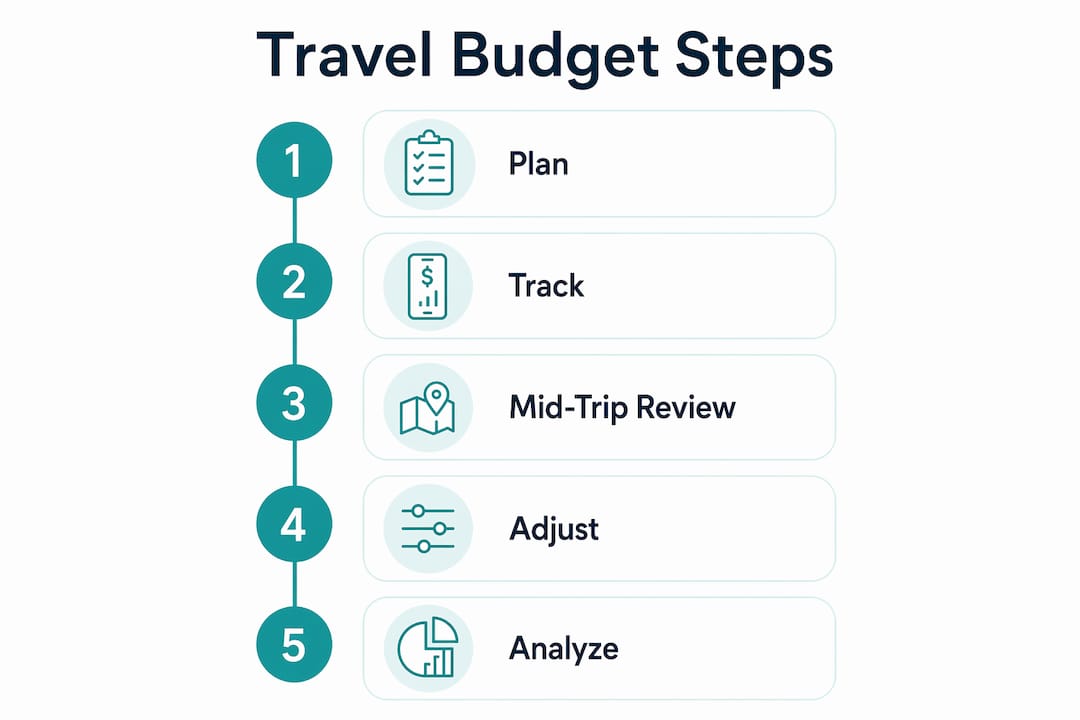
This is the core of the travel budget breakdown process. The review happens in three distinct phases: before the trip, during the trip, and after you return.
Phase 1: Pre-trip budget setup
- Set your total budget ceiling. Decide the maximum you will spend, including the 10 to 15% buffer. Write this number down before you research anything else.
- Allocate by category. Use the percentage ranges in the table above as starting points, then adjust for your specific destination and travel style.
- Research actual costs. Look up real prices for flights, hotels, and activities. Do not estimate from memory. Use current data.
- Book accommodation at the right time. Booking 3 to 4 weeks in advance secures better rates while keeping date flexibility to avoid weekend price surges.
- Lock in your template. Set up your Google Sheets tracker or expense app before departure, not on day one of the trip.
Phase 2: Mid-trip tracking and adjustment
Daily logging is the single habit that separates travelers who stay on budget from those who do not. Log every expense at the end of each day, even small ones. A $4 coffee logged daily becomes a visible $28 weekly line item that you can consciously reduce.
A mid-trip review at the halfway point allows timely adjustments before overspending becomes irreversible. On a 7-day trip, that means reviewing your actuals versus estimates on day 4. If food spending is running 30% over, you shift to grocery stores for two dinners. If accommodation came in under budget, you have room to add a paid activity. This is the flexibility that makes the process worth doing.
Pro Tip: For budget-conscious itinerary planning, map your highest-cost days in advance so you can plan lower-spend days around them. Knowing your expensive days are covered removes the anxiety of daily tracking.
Phase 3: Post-trip analysis
After you return, compare every estimated figure to every actual figure. Document the variances and write one sentence explaining each major gap. This post-trip record becomes your most accurate data source for the next trip. Travelers who do this consistently build a personal cost database that makes future budgets far more precise than any generic online calculator.
What are common pitfalls in travel budget review?
Even structured travelers make predictable mistakes. Recognizing them in advance is the fastest way to avoid them.
- Underestimating food costs. Most travelers budget for restaurants but forget coffee, snacks, and drinks, which can add $15 to $25 per day.
- Ignoring currency conversion fees. Using a standard debit card abroad can add 2 to 3% to every transaction. Over a two-week trip, that compounds into a meaningful sum.
- Setting budgets based on outdated information. Prices from a blog post written two years ago are not reliable. Always verify current costs.
- Skipping the mid-trip check-in. Without a halfway review, you only discover overspending at the end, when nothing can be done.
- Treating the buffer as spending money. The 10 to 15% emergency buffer is not a bonus category. Spending it on extras defeats its purpose entirely.
Traveling mid-week or off-season reduces accommodation costs by up to 50% due to dynamic pricing. This single scheduling decision can free up enough budget to cover your entire activities category. If your dates are flexible, this is the highest-leverage cost management move available.
"Budgeting is not about restricting your trip. It is about knowing exactly what you have so you can spend it confidently on what matters most."
For travelers managing longer or more complex trips, running parallel budgets matched to travel pace, one for lean periods and one for high-mobility periods, prevents lifestyle creep and keeps financial control intact across changing conditions.
Pro Tip: Before departure, check whether your destination charges local accommodation taxes or resort fees separately from the listed room rate. In cities like Las Vegas, these fees can add $30 to $50 per night to your actual cost.
Key takeaways
A structured travel budget review, built on accurate categories, consistent daily tracking, and a mid-trip check-in, reduces overspending by an average of 23% compared to unstructured approaches.
| Point | Details |
|---|---|
| Build with real categories | Cover all six expense areas plus a 10 to 15% emergency buffer before booking anything. |
| Use the right tool for your style | Google Sheets for control, AI expense apps for automation, sinking funds for pre-trip savings discipline. |
| Review at three stages | Pre-trip setup, mid-trip adjustment, and post-trip analysis each serve a distinct and necessary purpose. |
| Book accommodation strategically | Book 3 to 4 weeks out and consider direct bookings to save 15 to 25% on room rates. |
| Document every post-trip variance | Written variance notes become your most accurate data source for future trip budgets. |
Why I stopped trusting my gut on travel budgets
I used to plan trips the way most people do: a rough number in my head, a few bookmarked hotel pages, and a vague sense that it would "work out." It worked out, in the sense that I always got home. But I also consistently arrived home with a credit card bill that surprised me, and a nagging feeling that I had spent money in the wrong places.
The shift came when I started treating travel budgets the way a small business owner treats a quarterly review. Not as a constraint, but as a feedback loop. The first time I did a proper post-trip variance analysis, I discovered I had spent nearly double my estimate on food, not because I ate at expensive restaurants, but because I had never accounted for daily coffee, bottled water, and afternoon snacks. Those small purchases, invisible in my mental model, were the real budget leak.
What I now believe, after years of doing this systematically, is that the mid-trip check-in is the most underused tool in travel budgeting. Most travelers either track obsessively from day one and burn out, or ignore their budget entirely until they land home. The halfway review is the middle path. It gives you real data at a point when you can still act on it, without turning every meal into a math problem.
The other mindset shift worth making: your post-trip notes are not a report card. They are raw material. A trip where you overspent on activities and underspent on food is not a failure. It is data that tells you exactly how to allocate the next budget. That reframe makes the whole process feel less like discipline and more like learning. You can explore different budget types to find the structure that fits your travel style best.
— Helen
Plan smarter trips with Destlist

Destlist combines AI-powered planning with human expertise to build personalized travel itineraries that match your budget from the start. Rather than spending hours cross-referencing flight prices, hotel rates, and activity costs, you get a ready-to-book trip plan delivered within 24 hours, complete with budget-conscious flight and hotel matching, day-by-day activities, and mapped routes. Every plan is built around your preferences and spending range, so the numbers in your budget tracker reflect reality before you even pack. Start your next trip with a custom travel itinerary from Destlist, or explore curated destination plans built to fit your budget and travel style.
FAQ
What is a step by step travel budget review?
A step by step travel budget review is a structured process of planning expense categories, tracking actual spending during a trip, and analyzing variances afterward. It gives travelers a clear picture of where money goes and how to improve accuracy on future trips.
How many expense categories should a travel budget include?
A thorough travel budget covers at least six categories: transportation, accommodation, food, activities, admin costs, and miscellaneous. Hidden costs like local taxes and currency fees add 15 to 22% on top of these, so a buffer is always necessary.
When should I do a mid-trip budget check-in?
Review your actuals versus estimates at the halfway point of your trip. On a 7-day trip, that means day 4. This timing gives you enough data to spot overspending and enough trip remaining to adjust your behavior.
What is the best tool for tracking travel expenses?
Google Sheets works well for travelers who want full control over their budget template. AI-powered expense apps are better for travelers who want automation, cutting expense logging from 30 minutes to under 5 minutes per session.
How do I reduce accommodation costs in my travel budget?
Book 3 to 4 weeks in advance to balance rate savings with date flexibility. Traveling mid-week or off-season cuts accommodation costs by up to 50%. Booking directly with property owners instead of through platforms saves an additional 15 to 25%.