
TL;DR:
- Traveler reviews combine emotional sentiment and specific details to guide safer trip decisions. They influence bookings more through feelings than star ratings and require cross-platform verification for credibility. Travelers benefit most when using recent, thematically consistent reviews tailored to their travel style.
Traveler reviews are defined as firsthand accounts from real visitors that combine numerical ratings with qualitative sentiment, and they function as the primary risk-reduction tool in modern trip planning. Unlike a hotel brochure or a destination marketing campaign, a review carries the weight of lived experience. Travel experiences are irreversible by nature, meaning a poor choice cannot be returned or exchanged the way a product can. That irreversibility is exactly why the role of traveler reviews in planning has grown from a convenience into a necessity. Platforms like TripAdvisor, Google Reviews, and Booking.com now sit at the center of how travelers research, compare, and commit to their choices.
How do traveler reviews influence booking decisions?
Traveler reviews shape booking decisions through sentiment, not just stars. Research shows that sentiment analysis outperforms numerical star ratings in predicting whether a traveler will recommend a destination or property, with sentiment scoring a regression coefficient of β = 0.51 versus β = 0.29 for ratings. That gap matters because it tells you that how a reviewer feels about an experience carries more predictive weight than the score they assign it.
The broader framework for understanding review influence comes from electronic word-of-mouth, or eWOM. Three dimensions of eWOM, namely quality, quantity, and sender expertise, account for 69.8% of variance in booking behavior, with quality as the dominant factor. Quality here means specificity: a review that describes the exact noise level on a hotel's street-facing floor, or the 20-minute wait at a popular restaurant on Saturday evenings, gives you something to act on.
Travelers also read reviews thematically rather than in isolation. A single complaint about slow check-in means little. A pattern of 15 reviews mentioning the same issue signals a structural problem. This thematic consistency check is one of the most underused skills in trip planning.
Key behaviors that drive review-based decisions include:
- Recency filtering: Reviews older than 12 months often reflect management or ownership changes. Prioritize reviews from the past 6 months for current accuracy.
- Reviewer profile scanning: A reviewer who has posted 200+ reviews across multiple countries carries more credibility than a first-time reviewer with a single post.
- Sentiment pattern matching: Look for emotional language that matches your own travel priorities. A solo traveler and a family of four will weight the same review differently.
- Volume thresholds: A property with 12 reviews and a 4.9 rating is statistically less reliable than one with 800 reviews and a 4.3 rating.
Pro Tip: Filter reviews by your traveler type when the platform allows it. TripAdvisor and Booking.com both let you sort by "solo," "couple," or "family," which surfaces feedback from people whose priorities match yours.
How do you evaluate the credibility of traveler reviews?
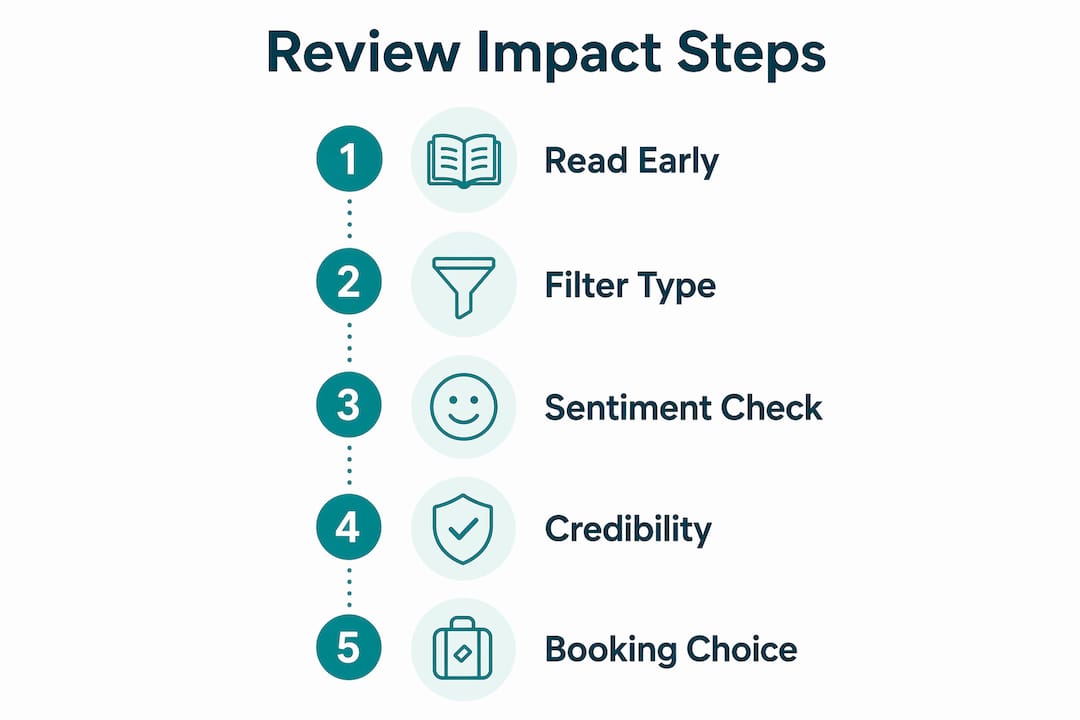
Review credibility depends on source quality, platform integrity, and review specificity. Not all reviews carry equal weight, and treating them as uniform data points leads to poor decisions.
Platform-level filtering is the first line of defense. Major review platforms implement automated systems to detect and remove counterfeit reviews, which reduces but does not eliminate the problem of fake content. Understanding what those systems catch, and what they miss, helps you read reviews more critically.
Cross-referencing across multiple platforms normalizes inconsistencies. A hotel that scores 4.6 on Google Reviews but 3.8 on TripAdvisor deserves closer inspection. The gap often reveals platform-specific reviewer demographics or a concentrated effort to inflate ratings on one channel.
A practical credibility framework works like this:
- Check the reviewer's history. A profile with reviews across multiple cities and property types is harder to fake than a one-review account.
- Read the one and two-star reviews first. Negative reviews reveal specific failure points. Generic complaints ("it was bad") signal low-quality feedback. Specific complaints ("the air conditioning unit in room 304 broke on day two and staff took 18 hours to respond") signal a real experience.
- Look for management responses. Properties that respond to negative reviews with specific, non-defensive replies demonstrate operational accountability.
- Assess review specificity. A review that mentions the name of a staff member, a specific dish, or a room number is almost certainly authentic.
- Weight recent reviews more heavily. Traveler reliance on review platforms varies by socio-demographic profile, but recency is a universal credibility signal regardless of who is reading.
Pro Tip: When a property has a suspiciously high volume of five-star reviews posted within a short window, that clustering pattern often indicates a solicited review campaign. Space out your reading across the full review timeline to spot it.
The role of customer reviews in hospitality extends beyond individual traveler decisions. As hospitality review analysis shows, hotels and tour operators increasingly treat review data as operational intelligence, not just reputation management.

Practical strategies for using reviews at every planning stage
Traveler feedback in trip planning works best when you apply it at the right moment. Reviews serve different purposes depending on where you are in the planning process.
Early research phase: Use reviews to eliminate options, not just confirm them. When narrowing a list of ten hotels to three, negative review patterns are more useful than positive ones. A property with consistent complaints about location or cleanliness drops off the list faster than one with mixed but specific feedback.
Pre-booking phase: Monitor recent reviews in the final two to four weeks before booking. Service quality at hotels and tour operators can shift quickly after ownership changes, staff turnover, or seasonal demand spikes. A property that looked strong three months ago may have slipped.
- Check the most recent 20 reviews before committing to a booking.
- Search for reviews mentioning the specific season you plan to travel. A beach resort in peak summer and the same resort in the shoulder season are often described very differently.
- Use reviews to build your itinerary's contingency options. If a restaurant appears in 30 positive reviews, add it. If a popular attraction draws consistent complaints about crowds on weekends, schedule it for a Tuesday.
During travel: Real-time review consumption on mobile devices now shapes on-the-spot decisions about restaurants, activities, and transport. Travelers consult reviews via their phones to make dynamic choices that no pre-trip plan fully anticipates. This behavior has pushed businesses to monitor and respond to reviews within hours rather than days.
Balancing reviews with other sources produces the most reliable plan. Reviews are one input, not the only one. Data-driven trip planning combines traveler feedback with weather data, pricing trends, and curated local knowledge to build itineraries that hold up under real conditions.
How travel businesses use reviews to improve and build loyalty
Travel businesses that treat reviews as strategic assets outperform those that treat them as reputation noise. The operational feedback loop, from collecting reviews to acting on them to communicating improvements, is where review data creates measurable business value.
Closing the feedback loop means telling travelers what changed as a result of their input. A hotel that posts a response saying "We replaced the mattresses in our standard rooms following guest feedback in march" builds more trust than one that simply thanks reviewers for their comments. That trust translates directly into rebooking rates.
The numbers behind satisfaction and loyalty are significant. Over 80% of travelers who give satisfaction ratings of 9 or 10 rebook within 24 months. Fewer than 15% of those who rate their experience 6 or below return. That gap represents the commercial stakes of ignoring review feedback.
| Feedback stage | Business action | Traveler benefit |
|---|---|---|
| Post-stay survey | Identify service gaps by department | Future guests receive improved service |
| Review response | Acknowledge specific complaints publicly | Builds trust before booking |
| Operational change | Fix recurring issues flagged in reviews | Reduces negative experiences |
| Loop closure | Communicate improvements to past reviewers | Increases rebooking likelihood |
Reviews have shifted from marketing tools into strategic management assets. Operators who customize trips efficiently for their guests use review data to refine every touchpoint, from airport transfers to checkout timing.
Key Takeaways
Traveler reviews are the most reliable risk-reduction tool in trip planning because they combine sentiment, recency, and specificity in ways that no marketing material can replicate.
| Point | Details |
|---|---|
| Sentiment beats star ratings | Reviews with emotional detail predict recommendations more accurately than numerical scores alone. |
| eWOM quality drives bookings | Review quality, quantity, and sender expertise together explain nearly 70% of booking behavior variance. |
| Credibility requires cross-referencing | Compare reviews across TripAdvisor, Google Reviews, and Booking.com to normalize inconsistencies. |
| Recency is a credibility signal | Prioritize reviews from the past 6 months to reflect current service quality accurately. |
| Feedback loops build loyalty | Businesses that act on reviews and communicate changes see rebooking rates above 80% among satisfied travelers. |
What I've learned about reading reviews the right way
Most travelers read reviews to confirm a decision they have already made. That is the wrong approach, and it leads to confirmation bias at exactly the moment when critical thinking matters most.
The travelers who get the most value from reviews use them to challenge their assumptions. They read the two-star reviews before the five-star ones. They look for patterns across dozens of posts rather than reacting to a single glowing or damning account. They pay attention to what reviewers do not say as much as what they do.
The shift I have noticed in 2026 is that travelers are becoming more sophisticated analysts. They understand that a 4.2 rating with 1,200 reviews is more trustworthy than a 4.9 with 11. They recognize that a review written by someone who has traveled to 40 countries carries different weight than one from a first-time international traveler. That analytical instinct is a skill worth developing deliberately.
Travel businesses are also changing. The operators who respond thoughtfully to negative reviews, who update their listings after fixing a problem, and who treat feedback as ongoing dialogue rather than a one-time report card are the ones building durable reputations. Travelers should reward that behavior by reading responses as carefully as they read the original reviews.
The uncomfortable truth is that no review platform is neutral. Algorithms, incentive structures, and demographic skews all shape what you see. The solution is not to distrust reviews but to read them with the same critical eye you would apply to any other source of information. Reviews are powerful. Used well, they are the closest thing to a trusted friend who has already been where you want to go.
— Helen
Destlist builds your trip around what real travelers know
Planning a trip means sorting through hundreds of reviews, ratings, and recommendations before you book a single flight. Destlist does that work for you.
Destlist combines AI with human travel expertise to build custom travel itineraries that reflect real traveler insights, not just promotional content. Every plan includes day-by-day activities, hotel and flight matching, mapped routes, and weather alerts, delivered within 24 hours. Whether you are planning 7 days in Bali or a city break in Istanbul, Destlist filters the noise and builds a trip that holds up in practice. You get a ready-to-book plan backed by the kind of detail that only comes from combining data with genuine traveler knowledge.
FAQ
Why do traveler reviews matter more than star ratings?
Sentiment analysis of traveler reviews predicts recommendations more accurately than numerical ratings, with a correlation of r=0.68 versus r=0.61 for star scores. Descriptive feedback reveals the emotional and practical details that a single number cannot capture.
How can I tell if a traveler review is fake?
Look for reviews with no reviewer history, generic language, and clustering within a short time window. Major platforms use automated filtering to remove suspicious content, but cross-referencing across multiple platforms remains the most reliable personal check.
When should I read reviews during trip planning?
Read reviews early to eliminate weak options, then check the most recent 20 reviews within four weeks of booking to confirm current service quality. During travel, real-time mobile reviews help you make on-the-spot decisions about restaurants and activities.
Do all travelers rely on reviews equally?
No. Research shows that review reliance varies by income and nationality, with lower-income travelers depending more heavily on review platforms while higher-income travelers supplement reviews with additional sources.
What makes a traveler review genuinely useful?
Specificity is the clearest marker of a useful review. Reviews that name staff members, describe exact room conditions, or reference specific dates give you information you can act on. A review that mentions itinerary-level detail about timing, crowds, or logistics is almost always more valuable than a generic rating.