
TL;DR:
- Trip plan forecasting predicts travel demand and conditions to create more effective itineraries. It combines data analysis with local insights to help travelers avoid crowding and optimize bookings. The most accurate forecasts are for two to four weeks ahead and should support flexible, well-informed planning.
Trip plan forecasting is the practice of predicting future travel demand, conditions, and resource availability to build more feasible, efficient itineraries. The term is widely used among travelers and planners, though the formal industry term is travel demand forecasting. Both individuals and groups use this approach to anticipate crowding, pricing shifts, and logistical constraints before they become problems on the road. Understanding what is trip plan forecasting gives you a real planning edge, whether you are booking a solo weekend away or coordinating a group trip across multiple cities.
What is trip plan forecasting and how does it work?
Trip plan forecasting combines quantitative models and qualitative inputs to predict how travel conditions will look during your trip. The goal is to turn uncertainty into a workable plan before you ever leave home.

The quantitative side relies on methods like time-series analysis and regression modeling. These techniques decompose demand into components: long-term trends, seasonal cycles, and irregular noise. That decomposition matters because it separates predictable patterns (summer crowds at beach destinations) from random disruptions (a last-minute festival). Regression models then layer in variables like pricing history and regional events to sharpen the picture.
Qualitative methods fill the gaps that number cannot cover. Expert panels, scenario planning, and local knowledge all feed into a complete forecast. A quantitative model might predict high hotel demand in Barcelona in july, but a local event calendar reveals that a major trade fair is the actual driver. Combining both approaches produces a forecast that is realistic, not just statistically tidy.
The data inputs that matter most include:
- Historical booking data: Past reservation patterns reveal seasonal peaks and troughs.
- Weather forecasts: Precipitation and temperature predictions affect both demand and activity feasibility.
- Event calendars: Public holidays, festivals, and sporting events create sudden demand spikes.
- Holiday schedules: School and national holiday windows drive predictable surges in family travel.
AI and machine learning have made this process faster and more accurate. AI-powered trip planning systems have achieved up to 97% success rates on standardized travel planning benchmarks, with a tenfold improvement in runtime efficiency compared to older models. That kind of performance means AI can process far more variables simultaneously than any manual method.
Pro Tip: Layer real-time weather and local event data on top of historical booking trends. Forecasts built only on past data tend to miss the wildcard events, like a cruise ship arrival or a local marathon, that reshape crowd patterns overnight.
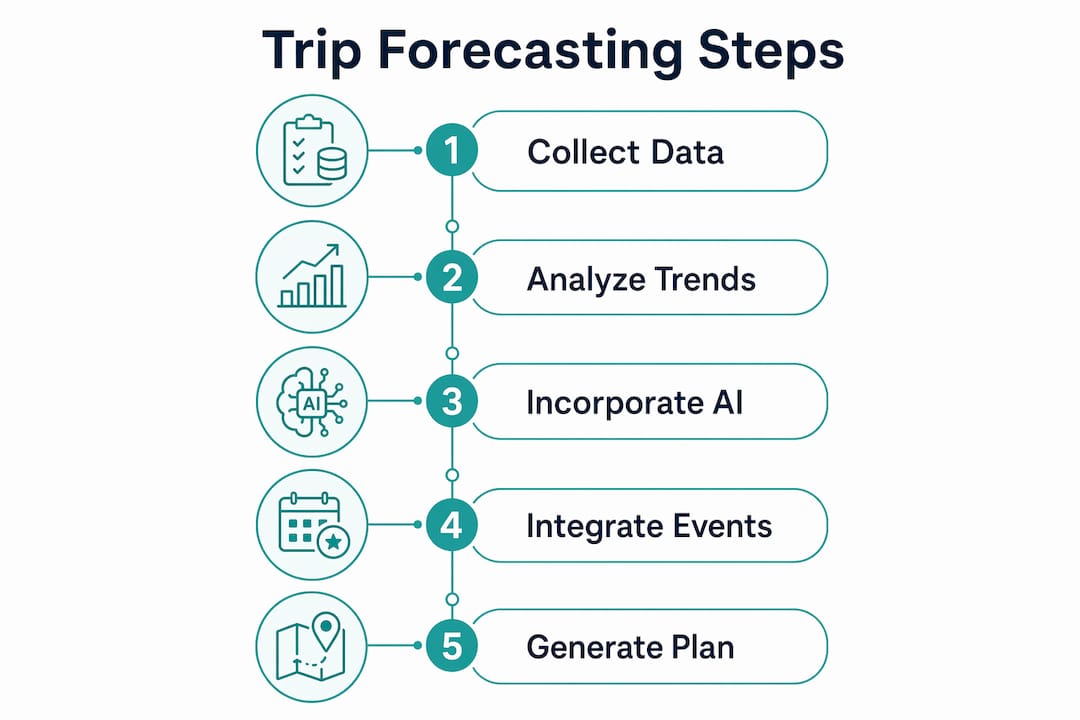
What are the benefits of trip plan forecasting for travelers?
Applying trip forecast analysis to your planning process delivers concrete advantages at every stage of a trip.
-
Better itinerary feasibility. Forecasting flags constraints before they become conflicts. If demand predictions show that a popular national park reaches capacity by 9:00 AM on summer weekends, you can book an early entry permit instead of showing up and being turned away.
-
Smarter resource allocation. Accommodation and transportation are perishable inventory. Empty seats and rooms cannot be sold after the date passes, which is why prices spike when demand is high. Forecasting tells you when to book early and when you can afford to wait for a better rate.
-
Anticipating demand spikes and quiet periods. Knowing that a destination is quieter in the second week of september than the first lets you shift dates and save money without sacrificing experience. This is one of the most underused trip planning techniques available to independent travelers.
-
Reduced planning confusion. AI-assisted trip forecasting reduces manual effort by automatically consolidating information across flights, hotels, and activities, while leaving final preference choices to you. The result is a structured plan that takes hours to produce manually but minutes with the right tools.
-
Group coordination. For group trips, forecasting aligns everyone's constraints, budgets, and timing preferences into a single feasible plan. It removes the back-and-forth that kills group travel momentum.
The efficiency gain is real, but the bigger benefit is confidence. When your itinerary is built on forecast data rather than guesswork, you arrive at each destination knowing what to expect.
What are the limitations of trip plan forecasting?
Forecasting is a tool, not a guarantee. Knowing its limits makes you a better planner, not a more anxious one.
The most important limitation is the accuracy window. AI-driven demand forecasting is most accurate within a two to four week planning horizon. Beyond that range, day-level precision drops and forecasts shift toward broader seasonal trends. This means a forecast built three months out is useful for budgeting and booking flights, but it cannot reliably predict whether a specific museum will be crowded on a specific Tuesday.
Unpredictable factors compound this problem. Wildcard events, such as local festivals, cruise ship arrivals, or sudden weather changes, disrupt quantitative forecasts in ways that models cannot fully anticipate. Combining quantitative models with qualitative local event data improves robustness, but no forecast eliminates surprise entirely.
The "efficiency trap" is a subtler risk. Travelers who over-forecast tend to overschedule. Experts recommend capping forecasted activities to 2–3 major items per day to preserve the flexibility that makes travel enjoyable. A perfectly optimized itinerary with no breathing room is exhausting to execute and leaves no room for the unexpected discovery that becomes the highlight of the trip.
Forecasting also cannot replace personal preference. AI supports itinerary generation but final choices, like which neighborhood restaurant to try or whether to skip a museum for a long walk, should stay with you. The forecast sets the frame. You fill it in.
Pro Tip: Treat forecasts as a filter for your highest-stakes decisions: flights, accommodation in high-demand areas, and timed entry tickets. Leave the rest of your day open for real-time decisions based on how you feel when you get there.
How do you apply forecasting to your trip planning process?
A practical approach to trip itinerary predictions follows a clear sequence. Skipping steps or reversing the order creates planning conflicts that are hard to untangle later.
The most effective sequencing locks high-constraint elements first, then builds discretionary activities around them. Here is how that works in practice:
- Step 1: Lock your travel dates. Dates anchor everything else. Use seasonal demand forecasts to choose dates that balance price, crowd levels, and weather. Shifting a trip by one week can mean the difference between peak pricing and shoulder-season rates.
- Step 2: Book flights first. Flights are the least flexible element of any trip. Securing them early, especially for popular routes, protects you from price surges and sold-out inventory.
- Step 3: Plan accommodation around demand predictions. In high-demand destinations or during festival periods, book accommodation immediately after flights. Use booking strategies that account for demand forecasts to get better rates and availability.
- Step 4: Cap daily activities. Plan 2–3 anchored activities per day and leave the rest open. This preserves flexibility without leaving your days unstructured.
- Step 5: Iterate as the trip approaches. Update your plan as new forecasts and real-time information come in. A forecast from three months out is a starting point, not a final answer.
The table below shows how forecast accuracy and planning focus shift across different time horizons.
| Planning horizon | Forecast accuracy | Best use |
|---|---|---|
| 3+ months out | Low day-level precision | Budgeting, date selection, flight booking |
| 4–8 weeks out | Moderate | Accommodation booking, major activity tickets |
| 2–4 weeks out | Highest accuracy | Transport, restaurant reservations, day-level planning |
| Under 1 week | Real-time data dominant | Adjustments based on weather and local conditions |
AI tools that support data-driven trip planning can automate much of this sequencing, pulling together flight options, hotel availability, and activity forecasts into a single structured plan. The manual version of this process takes significant time. The automated version takes minutes.
Key Takeaways
Trip plan forecasting works best when travelers use it to lock high-constraint decisions early and leave room for flexibility in daily activities.
| Point | Details |
|---|---|
| Forecasting accuracy window | AI-driven forecasts are most reliable within a 2–4 week planning horizon. |
| Sequence your bookings | Lock flights first, then accommodation, then discretionary activities. |
| Cap daily activities | Limit anchored plans to 2–3 items per day to avoid over-scheduling. |
| Layer your data sources | Combine historical booking trends with weather and local event data for realistic forecasts. |
| Forecasting supports, not replaces | Use forecasts to frame decisions; keep personal preferences in your own hands. |
Why I think most travelers use forecasting backwards
Most travelers I have worked with apply forecasting at the wrong stage. They spend hours researching crowd levels and pricing trends for activities, then book flights and hotels on impulse. That is backwards. The high-constraint elements, the ones with the least flexibility and the highest price volatility, are exactly where forecasting delivers the most value.
The efficiency gain from AI trip planning tools is real, but it is only useful if you apply it to the right decisions. Forecasting which coffee shop is less crowded on a Tuesday morning is a waste of analytical energy. Forecasting whether a coastal destination will be sold out during a school holiday window is not.
The other mistake I see constantly is treating a forecast as a schedule. A forecast tells you what conditions are likely. It does not tell you what to do every hour. The travelers who get the most out of forecasting are the ones who use it to make three or four key decisions with confidence, then stay loose on everything else. Spontaneity is not the enemy of good planning. Over-scheduling is. The digital reservation process has made it easier than ever to book on short notice, which means you genuinely do not need to lock every detail months in advance.
— Helen
How Destlist puts trip forecasting to work for you
Destlist combines AI with human travel expertise to build personalized itineraries that reflect real demand conditions, your budget, and your preferences. The platform handles the forecasting-heavy work: matching flights and hotels to your dates, sequencing activities for logical flow, and flagging weather considerations before they become problems.
Every plan from Destlist arrives ready to book within 24 hours, built around the constraints that matter most to you. Whether you are planning a 7-day escape to Bali or a city trip across multiple destinations, the platform applies the same structured forecasting logic that makes itineraries feasible rather than aspirational. Travelers who want a plan that actually works, not just one that looks good on paper, can start with a custom travel itinerary built to their exact specifications.
FAQ
What is trip plan forecasting in simple terms?
Trip plan forecasting is the process of predicting travel demand, pricing, and conditions to build a more feasible and efficient itinerary. It combines historical data, weather inputs, and event calendars to help travelers make smarter booking decisions.
How accurate is AI-based trip forecasting?
AI-driven forecasts are most accurate within a 2–4 week window before travel. Beyond that range, day-level precision drops and forecasts are better suited for broad budgeting and date selection rather than specific activity planning.
How many activities should I plan per day using forecasting?
Experts recommend capping forecasted activities at 2–3 major items per day. This preserves flexibility and avoids the over-scheduling trap that makes itineraries exhausting to execute.
What data sources improve trip forecast accuracy?
Layering historical booking data with weather forecasts, public holiday schedules, and local event calendars produces the most accurate results. Relying on booking history alone misses wildcard events that reshape demand patterns.
Can forecasting replace personal travel preferences?
Forecasting frames the logistics of a trip but does not replace personal choice. AI tools generate structured recommendations, but decisions like which neighborhoods to explore or which meals to prioritize should stay with the traveler.