
TL;DR:
- A travel itinerary is a flexible, structured plan that consolidates bookings and guides your journey without being overly rigid. It should include key components like dates, destinations, transport, accommodations, activities, and buffer times to ensure a smooth experience. Effective planning involves anchoring must-see experiences, grouping activities by location, and scheduling realistic, manageable days to prevent exhaustion and allow for spontaneous enjoyment.
Most people think a travel itinerary is just a rigid schedule that locks you into a minute-by-minute program. That misunderstanding leads to either over-packed days that leave you exhausted or completely winging it and wasting hours figuring out logistics on the ground. A well-built travel itinerary is neither a straitjacket nor a vague wish list. It is a structured, flexible plan that holds your trip together while leaving room to breathe, explore, and adapt. This guide covers the travel itinerary meaning, what it should include, and practical steps to build one that actually works.
Table of Contents
- Key takeaways
- What is a travel itinerary, really
- What a travel itinerary should include
- Mistakes that turn itineraries into stress machines
- How to create a travel itinerary that actually works
- How technology makes itinerary management easier
- My honest take on itinerary planning
- Let Destlist build your itinerary for you
- FAQ
Key takeaways
| Point | Details |
|---|---|
| Itinerary is not a strict schedule | A travel itinerary is a flexible plan, not a rigid minute-by-minute checklist. |
| Six core components matter most | Dates, destinations, transport, accommodation, activities, and buffer time form the backbone of every effective itinerary. |
| Over-planning is a real risk | Load days to only 60 to 70% capacity to keep your trip enjoyable and resilient. |
| Zone-based planning saves time | Grouping activities by location cuts transit time and reduces decision fatigue on the road. |
| Digital tools change the game | Apps and platforms like Destlist turn fragmented bookings into a unified, accessible travel plan. |
What is a travel itinerary, really
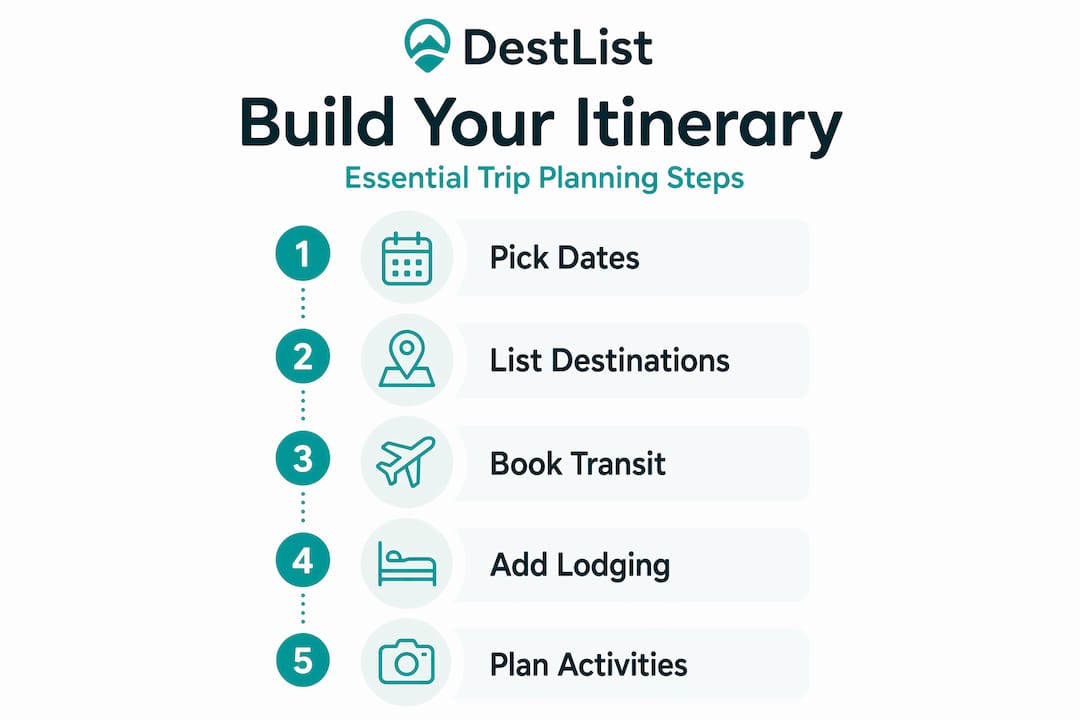
A travel itinerary is a detailed plan or schedule for a journey that covers your route, destinations, transportation, accommodation, and a chronological list of activities. Think of it as the backbone of your trip. It answers the questions: where are you going, when are you going, how are you getting there, and where are you sleeping.
The travel itinerary meaning goes beyond a simple list of places. It functions as a document that aggregates your fragmented bookings into one readable timeline. You might have a flight confirmation in your email, a hotel booking in an app, a restaurant reservation on a third platform, and a tour ticket somewhere else. An itinerary pulls all of that together.
It is also worth understanding what an itinerary is not. An itinerary is not a ticket. Itineraries and tickets serve different functions entirely. A ticket is a financial document that proves you have paid for the right to travel on a specific service. An itinerary is a schedule and plan. You can have a beautifully detailed itinerary without a single ticket purchased, but you cannot board a flight without the ticket.
Itineraries come in many forms:
- A basic printed schedule listing dates, times, and locations for a short weekend trip
- A digital document or spreadsheet with booking references and contact numbers
- A dynamic app-based plan that syncs live flight data, hotel check-in times, and walking routes
- A professionally curated trip plan built by a travel agent or platform like Destlist
"The itinerary is not just a document. It is the central nervous system of your trip, connecting every moving part into one coherent experience."
Itineraries are used across leisure travel, business trips, group tours, and family vacations. The format changes but the core function stays the same: give you clarity before you leave, so you spend less time confused once you arrive.
What a travel itinerary should include
Understanding what should a travel itinerary include is where most travelers go wrong. They either include too little and lose track of critical details, or they include so much it becomes overwhelming to read. Here is what actually belongs in a well-structured itinerary.
The six essential components:
- Dates and timing: Every activity, check-in, flight, and transfer should have a specific date and a realistic time window attached to it.
- Destinations and routes: Be specific. "Paris" is not enough. Which neighborhoods? Which attractions? Map the logical flow from one place to the next.
- Transportation details: Include your flight or train number, departure terminal, booking reference, and any ground transport between locations.
- Accommodation information: Hotel name, address, check-in and check-out times, and a direct contact number. You will need this if your GPS fails.
- Confirmed activities and attractions: List booked tours, restaurant reservations, museum tickets, and anything with a fixed time.
- Buffer time and flexibility slots: This is the one most people skip and the one that matters most.
| Component | Why it matters | What to include |
|---|---|---|
| Dates and timing | Keeps every piece of the trip in sequence | Specific times for flights, check-ins, tours |
| Transportation details | Prevents missed connections | Booking refs, terminal numbers, transfer times |
| Accommodation info | Critical for late arrivals or issues | Address, phone, check-in window |
| Activities | Manages expectations and access | Reservation confirmations, entry times |
| Buffer time | Absorbs delays, reduces stress | Explicit 30 to 60-minute gaps between activities |
Pro Tip: Write your buffer times as actual calendar events. Label them "Transit buffer" or "Rest block." If you do not schedule them, they disappear and your day becomes a sprint.
Mistakes that turn itineraries into stress machines
The biggest planning mistake is treating your itinerary like a task list where success means checking every box. That mindset turns a vacation into a performance review.
Here are the most common planning failures, and why they happen:
- Overloading every day. Travelers see a five-day trip to Rome and try to hit 12 attractions a day. By day two, they are worn out, irritable, and not absorbing any of it.
- Ignoring realistic transit times. Google Maps says the Colosseum is 15 minutes from the Vatican. That estimate does not account for walking to a cab, finding the entrance, or the line to get in.
- Skipping rest periods entirely. Treating every waking hour as productive travel time backfires. Fatigue kills enjoyment faster than a canceled tour.
- Treating the plan as fixed. When a museum closes unexpectedly or it rains all afternoon, travelers with rigid itineraries panic. Travelers with flexible ones pivot.
- No contingency for delays. A single delayed flight at the start of a trip can cascade and disrupt everything that follows if there is no buffer built in.
Buffer days are not gaps. They are essential elements that allow trips to breathe and adapt to disruptions like weather or transport delays.
Pro Tip: Before you finalize any day's plan, ask yourself: "If the first activity runs 45 minutes over, does the rest of the day still work?" If the answer is no, you have built in too little flexibility.
The importance of a travel itinerary is not just in what it schedules. It is equally in what it consciously leaves open.
How to create a travel itinerary that actually works
Building an effective itinerary is less about filling every hour and more about making strategic decisions upfront. Follow these steps.
- Start with your anchors. Identify the two or three things you absolutely must do or see. These are your locked-in, non-negotiable commitments. Book them first and build everything else around them.
- Plan by zones. Grouping activities by location rather than by category reduces transit time and decision fatigue. If you are spending Monday in the historic district, fill Monday with historic district options, not a scattered map of the whole city.
- Load days to 60 to 70% capacity. A functional itinerary uses only 60 to 70% of available time for scheduled activities. The remaining 30 to 40% is intentional slack for rest, transit, and unexpected detours.
- Add a "maybe list" per zone. For each area of the city or region, create a short list of optional activities you would enjoy if time allows. These are not commitments. They are possibilities you have already vetted.
- Write buffers as calendar events. Schedule 30 to 60 minutes before and after every major activity. Label them explicitly. This pre- and post-anchor buffer approach is what separates a resilient itinerary from a brittle one.
- Include one open half-day for every three days of travel. Experts recommend at least one open half-day block for every three days of travel to absorb delays and prevent burnout.
- Choose your format and stick with it. A spreadsheet works. A travel app works better. What does not work is switching between seven different notes apps mid-trip.
| Planning approach | Outcome |
|---|---|
| Zone-based planning | Fewer transit gaps, more time at destinations |
| 60 to 70% day loading | Realistic pacing, less exhaustion |
| Anchor-first scheduling | Must-do items protected, flexibility built around them |
| Optional "maybe list" | Spontaneity within a structured framework |
| Buffers as calendar events | Delays absorbed without cascading disruption |
Pro Tip: When using a travel itinerary template, resist the urge to fill every field. A half-empty template with realistic times beats a fully packed one that falls apart by noon on day one. Check out this itinerary formatting guide for practical layout advice.
For a deeper look at building your plan from scratch, the itinerary planning workflow at Destlist walks through the full process step by step.

How technology makes itinerary management easier
Travel technology has fundamentally changed what an itinerary can do. In technical terms, a modern digital itinerary is a dynamic data container that aggregates bookings from multiple suppliers into a single, readable timeline. That means your flight PNR, hotel confirmation, and tour booking all live in one place, updating in real time.
Here is what good digital itinerary management looks like in practice:
- Centralized booking references: No more digging through email folders. One document or app holds every confirmation code.
- Live flight alerts: Many apps flag gate changes, delays, or cancellations before you would otherwise notice.
- Offline access: Downloaded itineraries work without Wi-Fi, which matters when you land in a foreign country with no data plan yet.
- Group sharing: For multi-person trips, shared digital itineraries mean everyone has the same information without endless group chat messages.
Travel itineraries prepared by agents or built through online platforms reflect the broader shift toward digital travel planning, and the tools available today go far beyond a simple spreadsheet. For Western Cape travelers, a region-specific resource like this multi-day itinerary guide shows how digital planning translates to complex, multi-stop trips.
Pro Tip: Always export a PDF copy of your full itinerary before you leave. Apps crash, accounts lock out, and roaming data fails. A saved PDF on your phone is your backup that requires nothing to open.
My honest take on itinerary planning
I have spoken with hundreds of travelers who came back from trips feeling vaguely disappointed. When I ask what went wrong, the answer is almost never "too little to do." It is almost always some version of "we were exhausted by day three" or "we spent half our time getting from one thing to the next."
Over-scheduling is the silent killer of great travel. I have seen people build Tokyo itineraries with eight attractions a day and then wonder why they have no memory of any single one. The human brain does not store experiences it rushes through. It stores the ones it had time to absorb.
What I have learned is that slack time in an itinerary is often the most valuable part. The afternoon you left open because you were not sure what you wanted to do. That is when you find the coffee shop that becomes the highlight of the trip, or you stay an extra hour at the museum because you actually wanted to. Structure gives you a safe container. Space gives you a reason to be there.
My personal rule is this: if I cannot explain to someone in 30 seconds what I am doing on a given day, the day is too complicated. A good day plan has one or two anchors, a zone, and room to wander. That is it. If you want to learn how to plan flexibly for your next trip, that mindset shift is where everything starts.
— Helen
Let Destlist build your itinerary for you

Building a great itinerary takes time, research, and the kind of destination knowledge most travelers do not have before they go. That is exactly what Destlist was built for. Whether you want a fully custom travel itinerary tailored to your travel style, budget, and schedule, or you want to browse from a library of 50 ready-made 7-day itineraries by city and travel style, Destlist gives you a professionally structured plan without the hours of research. Every plan includes day-by-day activities, mapped routes, hotel and flight matching, and built-in buffer time. Your itinerary arrives ready to use within 24 hours, so you can spend less time planning and more time actually traveling.
FAQ
What is the basic definition of a travel itinerary?
A travel itinerary is a detailed plan that outlines your route, transportation, accommodation, and activities in chronological order. It functions as a unified timeline that brings all your travel bookings together in one place.
What should a travel itinerary include?
A solid travel itinerary should include travel dates, destination details, transportation booking references, accommodation addresses and contacts, confirmed activity times, and buffer periods between major events.
How is an itinerary different from a ticket?
An itinerary is a schedule and plan. A ticket is a financial document proving your right to travel. You can create an itinerary before purchasing any tickets, but you cannot travel without the ticket itself.
How do I create a travel itinerary that is not too rigid?
Start by booking your must-do anchors, then plan by geographic zones, and fill only 60 to 70% of each day with scheduled activities. Write buffer blocks into the plan explicitly so delays do not cascade into the rest of the day.
How far in advance should I build a travel itinerary?
For international trips, start building your itinerary four to eight weeks before departure so you can secure reservations for popular attractions and confirm transportation. For shorter domestic trips, two to three weeks is generally enough time to put a solid plan together.