
TL;DR:
- Customizable travel automation allows businesses to create flexible booking workflows aligned with their specific policies and preferences. It integrates modular modules like profile management, itinerary assembly, and policy enforcement to scale bookings and improve compliance without increasing staff. Implementing it requires careful assessment, pilot testing, and a focus on API-first architecture, version-controlled rules, and structured human oversight.
Customizable travel automation is intelligent, configurable software architecture that lets travel businesses define, execute, and adjust booking workflows — itinerary generation, supplier coordination, and policy enforcement — precisely to their organizational rules, budgets, and traveler preferences. Unlike generic booking tools, it adapts its logic to your constraints rather than forcing your operations into a vendor's preset mold. The immediate payoffs are real: faster proposal turnaround, consistent policy compliance without manual policing, and the ability to scale bookings from dozens to thousands per month without a proportional increase in headcount.
Common use cases include:
- Corporate travel policy enforcement — conditional approval chains triggered by trip cost, destination risk rating, and traveler grade
- Bespoke FIT itineraries — multi-leg, multi-supplier packages assembled in real time with component-level markup control
- Proactive disruption handling — automated rebooking or alert triggers when a flight cancels or a hotel closes
Table of Contents
- What are the core components of a customizable travel automation system?
- Configuration vs. customization: why the difference matters for your program
- Key business benefits and use cases that justify the investment
- How to implement customizable travel automation: a practical roadmap
- Integration and technical considerations you need to plan for
- Measuring success: KPIs and a simple ROI framework
- How Destlist applies customizable automation in practice
- Training and change management for staff adapting to travel automation
- Key Takeaways
- The real gap between automation promises and what actually works
- Destlist brings AI-drafted itineraries and human expertise together
- Useful sources for further research
What are the core components of a customizable travel automation system?
Every production-grade system is built from discrete modules that pass data between each other in a defined sequence. Understanding each one helps you evaluate vendors honestly and spot gaps before they become operational problems.
Intake and brief capture collects traveler preferences, trip parameters, and policy constraints at the start of every workflow. This feeds directly into the traveler profile store, a centralized record of loyalty numbers, seat preferences, dietary needs, and historical booking data.
The itinerary engine is where the actual assembly happens. It pulls live availability from supplier integrations (GDS connections, direct hotel APIs, activity APIs) and applies pricing rules from the pricing and markup engine to produce a draft itinerary. Practitioners commonly use orchestration tools like n8n or Make alongside large language models to synthesize GDS results into structured, machine-readable itinerary drafts for downstream workflows.
The rule and policy engine is the brain of the operation. It enforces approval thresholds, preferred-supplier hierarchies, and compliance rules before anything moves to booking. From there, booking orchestration handles the actual confirmation sequence across multiple suppliers, while human-in-the-loop (HITL) approval gates high-value or complex bookings for a final human check. Post-booking, notifications and disruption monitoring watch for schedule changes, cancellations, and risk events, and reporting closes the loop with margin, compliance, and volume data.
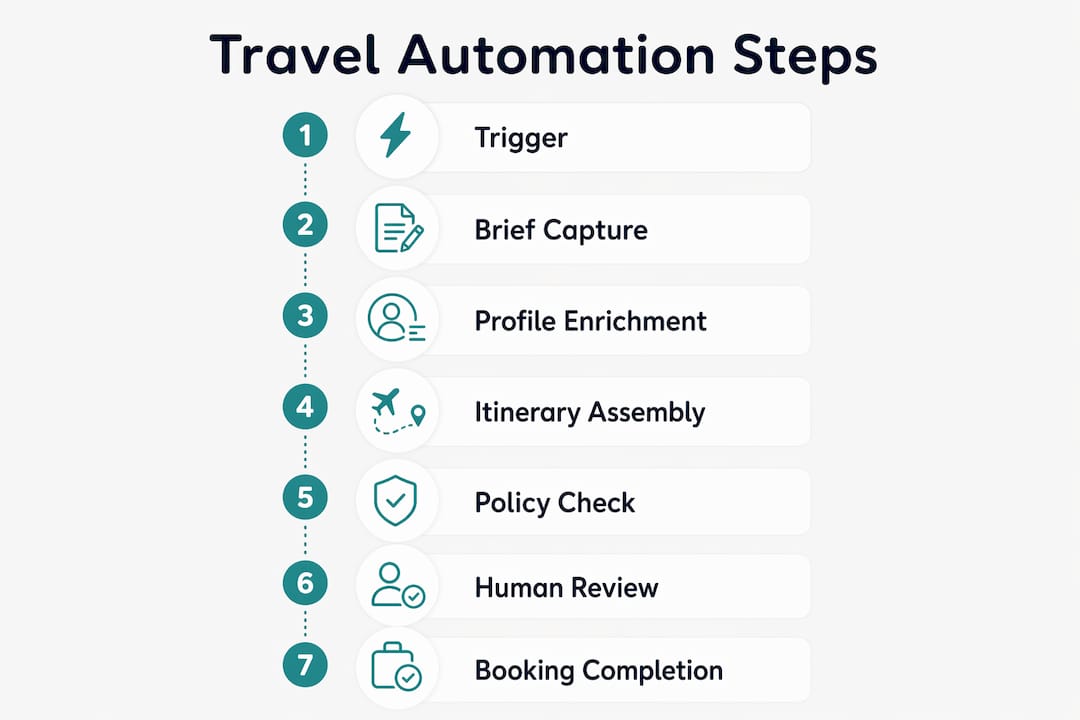
The orchestration flow looks like this: trigger → brief capture → profile enrichment → itinerary assembly → policy check → HITL approval → booking confirmation → monitoring.
Pro Tip: When evaluating vendors, ask whether each module exposes its own API. If the answer is no for even one critical module, you are accepting vendor lock-in for that function. Modular, API-first architecture lets you swap components as technology evolves without rebuilding entire workflows.
Configuration vs. customization: why the difference matters for your program
This distinction trips up more procurement teams than almost anything else in travel technology.
Configuration means adjusting parameters within boundaries the vendor already built: toggling preferred suppliers on or off, setting a per-diem cap, choosing from template itinerary layouts. It is fast to implement and requires no engineering. The problem is that configuration has a ceiling. When your corporate policy requires an approval chain that branches on three simultaneous conditions — trip cost above $3,000, destination flagged as elevated risk, and traveler grade below director — a configuration-only system simply cannot express that logic.
Customization means code-defined business logic: scripted rules, TypeScript-defined agents, or API-extensible workflows that are version-controlled, testable, and auditable. Business rules live in your codebase, not inside a vendor's black box. That matters enormously when a policy changes and you need to trace exactly which rule version applied to a booking made six months ago.
Where configuration typically fails:
- Unique loyalty tier rules that require conditional markup or upgrade logic
- Multi-level corporate approval chains with dynamic routing
- Custom duty-of-care triggers based on real-time risk feeds
- Branded itinerary templates with dynamic content injection
The practical test: if a vendor says "yes, we support that" and the answer involves a support ticket rather than a pull request, you are likely in configuration territory, not customization.
Key business benefits and use cases that justify the investment
The business case for travel automation rests on a handful of measurable outcomes, not abstract efficiency gains.
Scale without linear hiring. Automation enables scaling from a small number to many monthly bookings without proportional staff increases by using templated logic and live API connections. An agent who manually builds several FIT proposals per month can oversee a significantly larger volume when the system handles data assembly and supplier queries.
Personalization at scale. Traveler profiles feed the itinerary engine directly, so every proposal reflects known preferences — seat class, hotel brand loyalty, dietary restrictions — without the agent manually checking a spreadsheet. Itinerary personalization at this level was previously only viable for high-touch luxury clients.
Policy compliance by design. Rules enforced in code do not depend on an agent remembering to check a policy document. Compliance becomes a structural property of the workflow, not a training outcome.
Margin protection. Dynamic packaging engines let operators assemble flights, hotels, transfers, and activities in real time with component-level markup applied automatically, preventing margin erosion from manual pricing errors.
Faster proposals, better conversion. Automation for FIT and bespoke travel reduces turnaround time for proposals and increases conversion when paired with curated content and human review.
| Business benefit | Primary metric impacted |
|---|---|
| Faster proposal assembly | Time-to-proposal (hours) |
| Scale without headcount | Bookings per agent per month |
| Policy enforcement in code | Compliance rate (%) |
| Automated markup rules | Average margin per booking ($) |
| Disruption monitoring | Time-to-resolution (minutes) |
| Traveler profile matching | Traveler satisfaction / NPS |
How to implement customizable travel automation: a practical roadmap
Phase 1: Assessment
Before touching any technology, map your current workflows end to end. Document every manual step, every spreadsheet, every email handoff. Identify your top three automation targets by asking two questions: where does the most time go, and where do errors most often occur? Stakeholders to include at this stage are operations leads, finance (for policy rules), IT (for integration constraints), and at least two frontline agents who know where the real friction lives.
Phase 2: Pilot
Pick one workflow that is low-risk but high-frequency. A good candidate: intake → automated itinerary draft → HITL approval for a standard domestic corporate trip. Define success metrics before you start — specifically, measure your current time-to-proposal manually for two weeks so you have a real baseline.

Pro Tip: Record time-to-proposal for every booking in the two weeks before your pilot launches. Without that baseline, you cannot prove ROI to leadership after go-live. A simple timestamped log in a shared sheet is enough.
Phase 3: Integration and launch
Key integration tasks, in order:
- Connect supplier APIs (GDS, hotel, activity) and validate live availability responses
- Map traveler profile data from your CRM or HR system into the profile store
- Configure SSO and SAML/OAuth for agent and traveler authentication
- Set up webhooks for real-time disruption events
- Integrate expense management for post-trip reconciliation
- Define rollback procedures before go-live — know exactly how to revert to manual if a supplier API fails
Phase 4: Change management and governance
Write operator playbooks that describe exactly what agents do when the system flags a booking for HITL review. Define escalation paths. Run structured training sessions focused on the new decision points, not the full system — agents do not need to understand the API layer, but they do need to know when to override an automated recommendation and how to log that decision.
Vendor evaluation checklist:
- Does the system expose module-level APIs, or is it a monolithic platform?
- Are business rules version-controlled and auditable?
- What is the HITL approval interface, and how long does a typical review take?
- Which GDS connections and direct supplier APIs are pre-built?
- How does the system handle supplier API failures — retry logic, fallback suppliers?
- What PII data is stored, where, and for how long?
- What is the SLA for disruption alerts?
Integration and technical considerations you need to plan for
The technical layer is where implementations most often stall. Planning for it upfront is cheaper than retrofitting.

API-first architecture gives you vendor swapability, version control, observability, and auditability. If a supplier changes their API, you update one connector, not your entire workflow. Successful implementations prioritize flexibility over vendor lock-in by using API-first stacks so components can be swapped as technology evolves.
Required integrations to plan for:
- GDS or direct supplier APIs (flights, hotels, transfers, activities)
- CRS and CRM for traveler profiles and booking history
- Payment processing with PCI-compliant tokenization
- Expense management platforms for post-trip reconciliation
- SSO with SAML 2.0 or OAuth 2.0 for agent and traveler authentication
- Webhooks for real-time supplier events (cancellations, schedule changes, price drops)
Data and PII considerations deserve their own planning session. Traveler profiles contain sensitive personal data. Define retention periods, consent mechanisms, and minimal-data patterns (store only what the workflow actually needs). Every rule application and booking action should write to an audit log with a timestamp and the rule version that fired.
Scalability is often underestimated. Long-running booking workflows that span multiple supplier calls need retry logic for transient API failures, idempotency keys to prevent duplicate bookings, and clear state management so a workflow can resume after a timeout. HITL handoffs need a queue with visibility into pending approvals and SLA timers.
Pro Tip: Store itinerary artifacts as structured JSON with a defined schema from day one. Unstructured text itineraries are fine for human reading but create friction for every downstream tool — expense systems, reporting dashboards, disruption monitors — that needs to parse them.
Measuring success: KPIs and a simple ROI framework
You cannot manage what you do not measure, and the KPIs for travel automation are more specific than most teams initially track.
Primary KPIs to instrument from day one:
- Time-to-proposal — from intake submission to draft delivery (hours)
- Bookings per agent per month — the clearest scale indicator
- Booking error rate — wrong dates, wrong traveler, supplier mismatch (%)
- Average margin per booking — tracks markup rule effectiveness ($)
- Time-to-resolution for disruptions — from alert to confirmed rebooking (minutes)
- Traveler NPS — collected post-trip via a short survey
Collect these through event logging in your orchestration layer. Every workflow state transition (intake received, draft generated, HITL approved, booking confirmed) should emit a timestamped event. That event stream is your analytics foundation.
| KPI | Typical pre-automation baseline | Target after automation |
|---|---|---|
| Time-to-proposal | 4–8 hours | Under 1 hour |
| Booking error rate | 5–8% | Under 1% |
| Disruption resolution time | 2–4 hours | hours |
Automation enables scaling monthly bookings without proportional staff increases — the bookings-per-agent metric is where that claim becomes concrete and defensible to leadership.
How Destlist applies customizable automation in practice
Destlist's delivery model is a working example of the hybrid automation pattern described throughout this article. The workflow runs like this: a traveler submits their preferences and budget through the intake interface. The system matches that brief against a curated destination catalog and traveler profile data, then generates a structured itinerary draft covering flights, hotels, day-by-day activities, mapped routes, and estimated walking times. Human curators then review and refine that draft before final delivery, with the full process targeting a 24-hour SLA.
This is not full end-to-end autonomous booking. The AI-drafted itinerary reaches a human before it reaches the traveler, which is the right call for high-value, complex, or first-time-destination trips where a subtle error (wrong airport, mismatched hotel tier) would damage trust.
Lessons from Destlist's approach that implementers can apply directly:
- Profile matching before assembly — the system knows traveler preferences before the itinerary engine runs, not after
- Curated content as a quality layer — automation drafts from a vetted content library, not raw supplier data alone
- Fixed SLA as a forcing function — committing to 24-hour delivery creates accountability for the automation layer to perform
- Human review as the quality gate — curators catch edge cases the model misses; their corrections feed back into the system over time
Training and change management for staff adapting to travel automation
The technology is usually not the hard part. Getting experienced agents to trust a system that does what they used to do manually — that is where implementations slow down or fail.
Start with the agents who are most frustrated by the current manual process. They are your early adopters and your internal advocates. Involve them in the pilot design, not just the training. When agents help define the HITL approval criteria, they own the outcome rather than resenting the system for taking over their work.
Training should focus on decision points, not system mechanics. An agent does not need to understand how the rule engine evaluates a conditional approval chain. They need to know: here is what the system flags for my review, here is what I check, here is how I approve or override, and here is how I log my reasoning. Keep the playbook to one page per workflow.
Manual, spreadsheet-based management of custom travel packages creates operational risk that agents already feel acutely. Frame automation as eliminating the work they hate (chasing supplier confirmations, reformatting itineraries, manually checking policy) so they can focus on the judgment calls only they can make.
Governance matters as much as training. Establish a clear owner for rule changes — someone who reviews and approves updates to the policy engine before they go live. Without that, rules drift, agents lose confidence in the system's outputs, and the HITL approval rate climbs back toward 100%, defeating the purpose of automation. Pair this with flexible travel planning practices that let agents adapt workflows without breaking the underlying logic.
Key Takeaways
Customizable travel automation delivers measurable scale, compliance, and personalization only when built on API-first, code-extensible architecture with structured HITL governance from day one.
| Point | Details |
|---|---|
| Start with an assessment | Map every manual step and error source before selecting a platform or writing a rule. |
| Prefer API-first architecture | Modular, API-first systems let you swap components without rebuilding workflows as technology evolves. |
| Pilot one workflow first | Run intake → draft → HITL approval on a single trip type; measure time-to-proposal before and after. |
| Measure the right KPIs | Track time-to-proposal, bookings per agent, error rate, and margin from day one to prove ROI. |
| Destlist as a reference model | Destlist pairs AI-generated itinerary drafts with human curator review for 24-hour delivery — a practical HITL pattern any team can adapt. |
The real gap between automation promises and what actually works
Most vendors selling travel automation lead with the end state: fully automated bookings, zero manual effort, instant proposals. The gap between that pitch and a production system is where most implementations get into trouble.
The teams that get this right share one habit: they treat their business rules as code. Not settings, not configuration toggles — actual versioned logic that goes through a review process before it changes. When a policy update breaks a downstream workflow at 2 AM on a Friday, the team that version-controls its rules can identify the change, roll it back, and fix it properly. The team that made the change through a vendor UI has no audit trail and no rollback.
The other thing most articles understate is how much the HITL layer matters for quality, not just compliance. Automation is genuinely good at data synthesis: pulling availability, matching preferences, assembling a structurally sound itinerary. It is not yet reliable for the judgment calls that experienced agents make instinctively — reading between the lines of a brief, knowing that a client who says "budget" actually means "value," catching a routing that is technically correct but practically miserable. The human review step is not a concession to imperfect AI. It is the feature that makes the output trustworthy.
Audit your rules quarterly. Not because the technology demands it, but because your business changes — new suppliers, new corporate policies, new traveler expectations — and rules that were correct six months ago may now produce subtly wrong outputs that no one notices until a client complains.
Destlist brings AI-drafted itineraries and human expertise together
Planning a custom trip or building a corporate travel program from scratch takes time most teams do not have. Destlist cuts that time significantly by pairing AI-driven itinerary drafts with real human curators who review every plan before it reaches the traveler — the same HITL pattern this article recommends for high-value bookings.
The platform handles profile matching, day-by-day itinerary construction, flight and hotel selection within your budget, and final delivery within 24 hours. Every plan is ready to book, not just ready to review. For travel teams evaluating what a well-executed automation workflow actually produces, a Destlist custom itinerary is a concrete reference point. Browse curated travel plans to see the output standard, or start a custom request to experience the intake-to-delivery workflow firsthand.
Useful sources for further research
- Business Travel Personalized with Automation — practical overview of how automation applies to corporate travel programs; good starting point for program managers building a business case
- Automated Travel System glossary entry — concise technical definition useful for vendor RFP language and stakeholder briefings
- FIT Travel Solution — Moonstride — detailed look at tailor-made travel management software for FIT operators; relevant for scale and workflow architecture decisions
- AI Automations for the Travel Industry — Seokru guide — practitioner-level guide covering orchestration tools, LLM integration, and itinerary change management; recommended for developers and technical leads
- Custom Travel Solutions — corporate travel program management reference with policy, duty-of-care, and reporting context; useful for enterprise program evaluation
- What Are Flexible Travel Rewards? — partner resource on loyalty-driven customization and flexible incentive structures relevant to corporate reward program design