
TL;DR:
- Digital travel curation combines AI, real-time data, and human expertise to create personalized itineraries that replace extensive research. Its effectiveness depends on detailed traveler input, transparent recommendations, and human review to address limitations and build trustworthy plans. The future relies on hybrid models that integrate AI efficiency with human nuance for truly customized travel experiences.
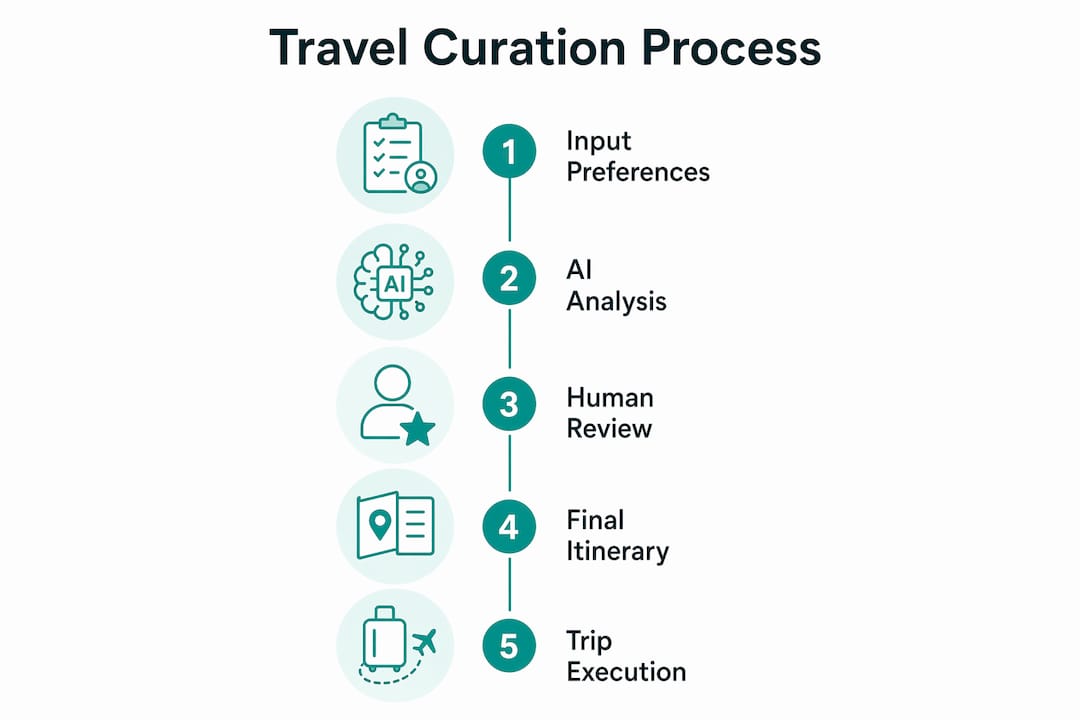
Digital travel curation is the process of using AI, human expertise, and real-time data to build personalized travel itineraries that replace hours of scattered research with a single, structured plan. The industry term for this practice is itinerary curation, and it sits at the intersection of travel technology and concierge-level personalization. Platforms like Google and Delta have already deployed curation tools that pull live flight data, mapping layers, and local recommendations into one coherent experience. For travelers who want trips that actually fit their preferences rather than a generic checklist of tourist stops, understanding how digital travel curation works is the first step toward planning smarter.
What is digital travel curation and how does it work?
Digital travel curation is defined as the systematic collection, filtering, and assembly of travel options into a personalized itinerary using technology, data, and often human review. It differs from a simple Google search in one critical way: it does not just surface options. It organizes them into a logical sequence with timing, routing, and preference alignment built in.

The workflow splits into three distinct phases. First, preference and constraint capture: the traveler provides input on budget, travel dates, interests, dietary needs, pace preferences, and must-see priorities. Second, recommendation generation: an AI engine or human curator matches those inputs against a database of flights, hotels, activities, and reviews. Third, itinerary assembly: the selected components are arranged into a day-by-day plan with mapped routes, estimated travel times, and booking links.
Skipping detailed preference input leads to generic itineraries even when the presentation looks polished. This is the single most common failure point in AI-based travel planning. The algorithm is only as good as the data you feed it.
Airlines have moved into this space as well. Delta Locals launched curated itineraries for multiple destinations in late 2024 and expanded the program through 2026, using local experts to add cultural depth that pure algorithms cannot replicate. This hybrid model represents where the industry is heading.
What technologies power digital travel curation?
The technological backbone of digital travel curation combines AI planning engines, real-time data feeds, and interactive interfaces that allow travelers to refine plans on the fly.
Google's AI Mode uses Canvas to merge Search and Maps data into a single travel planning interface. A traveler can ask follow-up questions, adjust for tradeoffs like hotel location versus activity proximity, and see live flight pricing updated in real time. This is not a static itinerary generator. It is a conversational planning environment that responds to changing inputs.
The core data sources feeding these systems include:
- Real-time flight and hotel pricing from aggregators like Expedia and direct airline APIs
- Mapping and routing data from platforms like Google Maps and OpenStreetMap
- User reviews and ratings from sources like TripAdvisor and local review databases
- Weather forecasts integrated to flag potential disruptions
- Booking confirmation systems that close the loop from recommendation to reservation
The result is a planning flow that reduces manual research by pulling fragmented information into one structured output. For a traveler planning a 10-day trip across multiple cities, this can compress days of research into under an hour.
Pro Tip: When using any AI travel planning tool, treat your first output as a draft, not a final plan. Ask follow-up questions, push back on suggestions that feel generic, and request alternatives for at least two or three key activities. The iterative process is where personalization actually happens.
You can also explore AI-driven itinerary tips to understand how to get the most out of these planning flows before you start.
How do personalization levels in travel curation differ?
Not all curated travel plans are equal. The industry uses four distinct terms to describe increasing levels of personalization, and knowing the difference helps you set the right expectations when choosing a tool or service.
| Level | Definition | What it requires |
|---|---|---|
| Curated itinerary | A pre-built plan for a destination, lightly filtered by category | Minimal traveler input; works for general interest trips |
| Personalized itinerary | A plan adjusted to stated preferences like pace, budget, and interests | Moderate input; traveler completes a detailed preference profile |
| Bespoke travel plan | A fully custom plan built from scratch around specific traveler needs | High input; often involves a human planner or detailed AI interview |
| Hyper-personalized itinerary | A plan that adapts in real time based on behavior, feedback, and live conditions | Continuous input; requires platforms with feedback loops and dynamic scheduling |
Most travelers start with a personalized itinerary and discover they actually want something closer to bespoke once they see how much better the results are. Detailed traveler profiling including preferences, constraints, and cultural interests is the single biggest driver of itinerary quality. A traveler who specifies "no tourist traps, prefer local markets, vegetarian meals, moderate walking pace" will receive a fundamentally different plan than one who simply enters "Paris, 5 days."
Understanding itinerary personalization at this level of granularity is what separates travelers who get genuinely useful plans from those who end up with a repackaged version of every other Paris guide online.
Pro Tip: Before using any curation platform, write out your travel preferences in a single paragraph as if you were briefing a personal assistant. Include what you hate as much as what you love. Negative constraints often do more to sharpen a plan than positive preferences.
What challenges limit AI-based travel curation?
AI-based travel curation has real limitations, and understanding them helps you use these tools more critically rather than accepting every recommendation at face value.
More than 60% of travelers cite accuracy concerns as a barrier to trusting AI travel recommendations. This means the majority of potential users are skeptical, which is a significant adoption problem for the industry. Skepticism is rational here. AI systems trained on historical data can recommend restaurants that have closed, hotels undergoing renovation, or activities that are seasonally unavailable.
The Cornell research also found that AI travel planning ranks behind conventional search and review sites in traveler trust. The implication is clear: AI tools need to earn confidence through transparency, not just convenience.
"Traveler adoption of AI curation depends heavily on perceived recommendation accuracy and trustworthiness, meaning transparency and clear rationale are critical design factors." — Cornell Hospitality Research
Practical ways to evaluate any digital travel curation tool critically:
- Check the data freshness. Does the platform show when recommendations were last updated? Static databases are a red flag.
- Look for source attribution. Tools that cite where a recommendation comes from (a specific review, a local expert, a booking partner) are more trustworthy than black-box outputs.
- Test with a destination you know well. Run a query for a city you have visited before and see whether the output matches your actual experience.
- Identify the human layer. The strongest platforms combine AI efficiency with human curator review for experiential quality that algorithms alone cannot guarantee.
The human layer is not a luxury feature. It is the mechanism that catches the scheduling errors, cultural missteps, and logistical impossibilities that AI systems still produce with surprising regularity.
How to curate travel experiences effectively using digital tools
Getting real value from digital travel curation requires a deliberate approach. Here is a practical sequence that consistently produces better results than simply typing a destination into an AI tool and accepting the first output.
-
Build a detailed traveler profile before you open any tool. Document your travel style, budget range, dietary needs, physical limitations, interests, and any hard constraints like visa requirements or travel dates. The more specific this profile, the better every subsequent step performs.
-
Choose a platform matched to your trip type. A solo backpacker through Southeast Asia needs different tools than a family planning a theme park vacation. Segment-aligned AI design shifts from generic rollout to value-first functionality, meaning the best tool for you depends on your specific travel segment.
-
Use iterative refinement, not single-query planning. Start with a broad request, review the output, then ask targeted follow-up questions. "Replace the museum on day 3 with something outdoors" or "find a hotel closer to the old town" are the kinds of refinements that transform a generic plan into a genuinely useful one. Features like feedback loops and dynamic scheduling are specifically designed for this process.
-
Cross-reference AI suggestions with local sources. Use neighborhood-specific blogs, local tourism boards, and recent traveler forums to validate key recommendations. AI tools are strong on logistics and weak on the kind of hyper-local knowledge that makes a trip memorable.
-
Build flexibility into the final itinerary. Leave at least one unscheduled half-day per three days of travel. Real trips encounter delays, unexpected discoveries, and weather changes. A plan with no slack is a plan that breaks.
Pro Tip: For stress-free curation, read about expert trip curation approaches used by professional planners. The core principle is always the same: gather more input than you think you need, then let the structure do the work.
Key takeaways
Digital travel curation produces genuinely personalized trips only when detailed traveler input, transparent AI recommendations, and human review work together across all three phases of the planning workflow.
| Point | Details |
|---|---|
| Definition is precise | Digital travel curation combines AI, data, and human expertise to build structured, personalized itineraries. |
| Input quality drives output quality | Detailed preference profiles produce far better plans than minimal or vague traveler inputs. |
| Four personalization levels exist | Curated, personalized, bespoke, and hyper-personalized plans each require different levels of input and tool sophistication. |
| Trust barriers are real | More than 60% of travelers cite accuracy concerns, making transparency a non-negotiable feature in any curation tool. |
| Human review closes the gap | AI handles scheduling and data aggregation; human curators catch cultural and experiential errors algorithms miss. |
Why the hybrid model is the only honest answer
I have spent years watching travelers return from trips they planned entirely through AI tools, and the pattern is consistent. The logistics were fine. The flights connected, the hotels were booked, the days were full. But the trips felt assembled rather than designed. There was no sense that anyone, human or machine, actually understood what that particular traveler needed from that particular trip.
The future of digital travel curation is not more powerful AI. It is better integration between what AI does well (processing constraints, finding deals, mapping routes) and what humans do well (understanding context, cultural nuance, and the difference between a technically correct recommendation and a genuinely good one).
What concerns me about the current wave of AI travel tools is the confidence they project. A plan that looks polished and complete can still be wrong in ways that only become obvious when you are standing in front of a closed restaurant at 8 p.m. in a city you do not know. Transparency about data sources and recency is not a nice-to-have feature. It is the baseline requirement for any tool worth trusting.
My advice: treat digital travel curation as a starting point, not a finished product. The best trips I have seen planned through these tools all had one thing in common. The traveler stayed engaged throughout the process, pushed back on suggestions that felt off, and brought their own judgment to the final itinerary. The tool did the heavy lifting. The traveler made it personal.
— Helen
Plan your next trip with Destlist
Destlist combines AI-powered planning with real human travel curators to build itineraries that go beyond what any single tool can produce alone. You submit your preferences, budget, and travel dates, and Destlist delivers a ready-to-book trip within 24 hours, complete with flights, hotels, day-by-day activities, mapped routes, and estimated walking times.
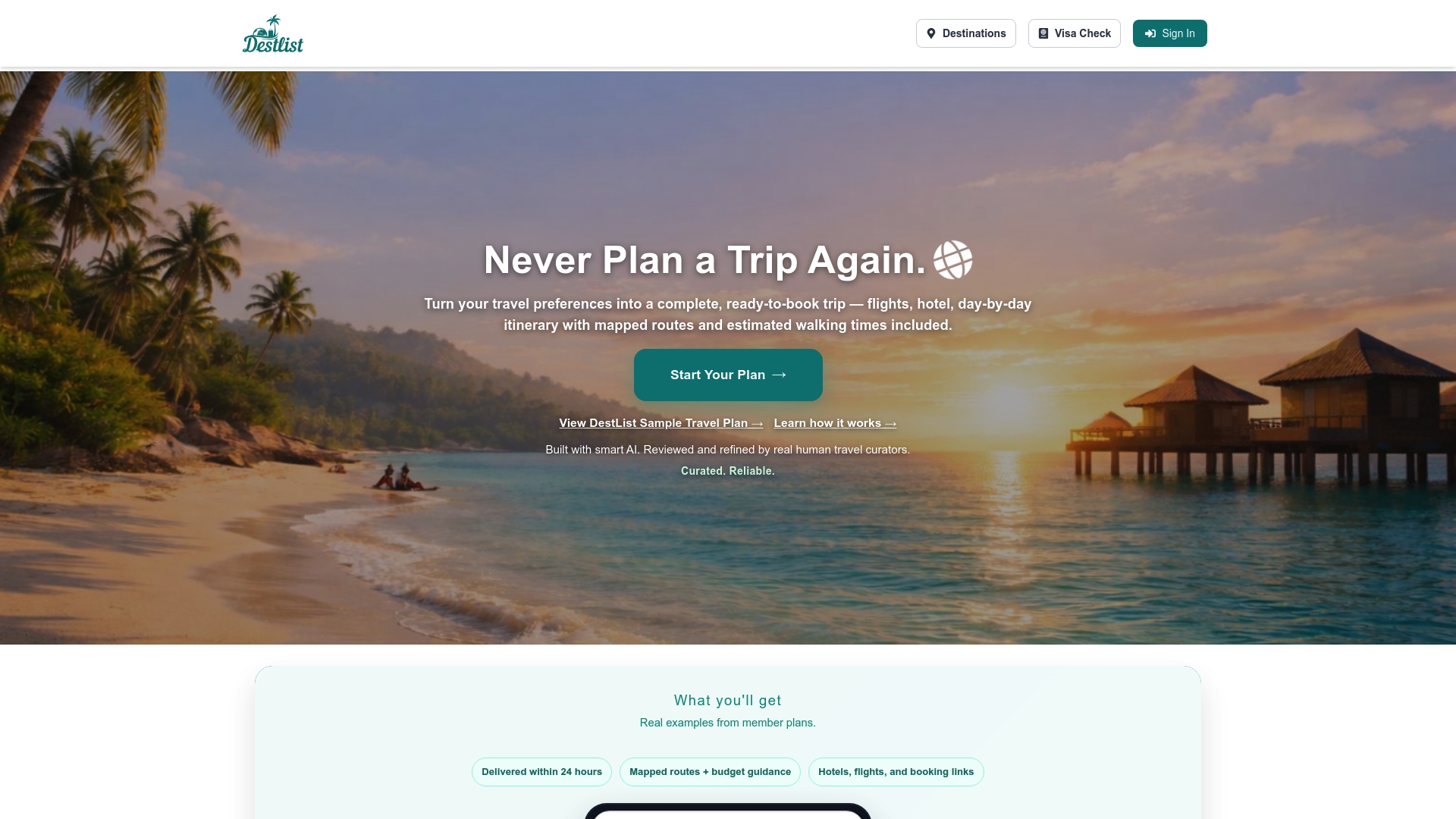
For travelers who want a genuinely personalized plan without spending days researching, Destlist's custom travel itinerary service handles the full workflow from preference capture to final booking. The platform also offers a free destination discovery tool to help you choose where to go before you start planning. Explore curated travel plans built around your specific trip and see what a properly structured itinerary actually looks like.
FAQ
What is digital travel curation in simple terms?
Digital travel curation is the process of using AI and human expertise to organize travel options into a personalized, day-by-day itinerary. It replaces manual research by pulling flights, hotels, activities, and routes into one structured plan.
How does digital travel curation differ from a standard travel search?
A standard search surfaces options. Digital travel curation filters, sequences, and assembles those options into a coherent plan based on your specific preferences, budget, and constraints. The output is a ready-to-use itinerary, not a list of links.
Why do AI travel recommendations sometimes feel generic?
Generic outputs result from skipping the detailed preference input phase. When a traveler provides minimal information, even advanced AI systems default to the most common recommendations for a destination. Detailed profiling is what separates a personalized plan from a recycled tourist guide.
How do I know if a digital travel curation tool is trustworthy?
Look for tools that show data sources, update frequency, and include a human review layer. Cornell research confirms that more than 60% of travelers cite accuracy concerns as their primary barrier, so any credible platform addresses this directly through transparent recommendation rationale.
What is the difference between a curated and a bespoke travel plan?
A curated plan is pre-built and lightly filtered by category or destination type. A bespoke plan is built from scratch around your specific needs, often with direct input from a human planner or a detailed AI interview process. Bespoke plans require significantly more input but produce substantially more personalized results.