
TL;DR:
- Travel itinerary benchmarking measures planning system quality across six dimensions, including accuracy and utility. Human verification remains essential, as automated scores often misjudge pacing and local details. Destlist combines AI clustering with human review to deliver reliable, itemized, and ready-to-book travel plans.
Travel itinerary benchmarking is the standardized process of measuring how well a planning system — AI, agent, or human-assisted — generates feasible, cost-aware, and user-suitable trip plans under real-world constraints. Researchers and product teams use it to score itineraries across six dimensions, and the results tell you whether a plan will actually work or just look good on paper.
The six dimensions every serious benchmark measures:
- Accuracy — factual correctness, cost arithmetic, and absence of invented attractions
- Compliance — honoring hard constraints: dates, party size, visa rules, pre-booked tickets
- Temporality — schedule realism: opening hours, transit durations, rest windows, pacing
- Spatiality — geographic logic: neighborhood clustering, routing, transfer feasibility
- Economy — realistic pricing and honest budget alignment, itemized rather than vague
- Utility — traveler-centered value: engagement, comfort, fatigue management, preference match
Named benchmarks you'll encounter in research and provider claims: TravelEval, Trip+, and TripScore.
Table of Contents
- What do the six benchmarking dimensions actually test?
- How are itinerary benchmarks actually built?
- Which named benchmarks should you know?
- Where do AI itinerary generators most often fail?
- What does benchmarking mean when you're choosing a planner?
- How Destlist applies these principles
- Key Takeaways
- The gap between a benchmark score and a trip worth taking
- Destlist builds the itinerary you'd plan yourself, if you had the time
What do the six benchmarking dimensions actually test?
Each dimension targets a different way a plan can fail you. Understanding them helps you ask sharper questions before you hand over your trip to any planner.
- Accuracy catches hallucinations — a museum that closed two years ago, a ferry that doesn't run on Mondays, an entrance fee listed at half the real price. Any fabricated detail here wastes your time or money.
- Compliance checks whether the plan respects your non-negotiables. If you've already booked a hotel in the old city for nights three and four, a compliant plan builds around that anchor, not against it.
- Temporality is where most AI drafts quietly fall apart. A plan that schedules the fish market at 2 PM (it closes at noon) or stacks four major sites on a day you land at 6 PM fails this dimension entirely.
- Spatiality measures routing intelligence. Visiting a neighborhood's top attraction in the morning, then doubling back across the city for a second attraction in the same neighborhood at dusk is a spatiality failure — and it's exhausting.
- Economy goes beyond a ballpark total. A strong score here means itemized estimates: museum entry, a taxi from the airport, a mid-range dinner for two. Vague totals hide surprises.
- Utility is the hardest to quantify and the most important to you personally. A plan can be technically feasible and still be joyless — too rushed, no downtime, wrong mix of activities for your travel style.
Pro Tip: Ask any planner to show you the temporality and spatiality checks on your draft. If they can't point to specific opening-hour verifications or explain the routing logic between neighborhoods, those dimensions were never checked.
How are itinerary benchmarks actually built?
The mechanics behind a benchmark score matter because they determine what the number actually proves. A score built on real booking data and human annotation means something different from one generated by asking a model to grade itself.
Strong benchmarks draw from several data sources: live pricing feeds, points-of-interest databases with current opening hours, transit schedules, and historical user itineraries. Data-driven trip planning depends on the freshness and accuracy of these inputs — stale data produces confident-sounding plans with wrong details.

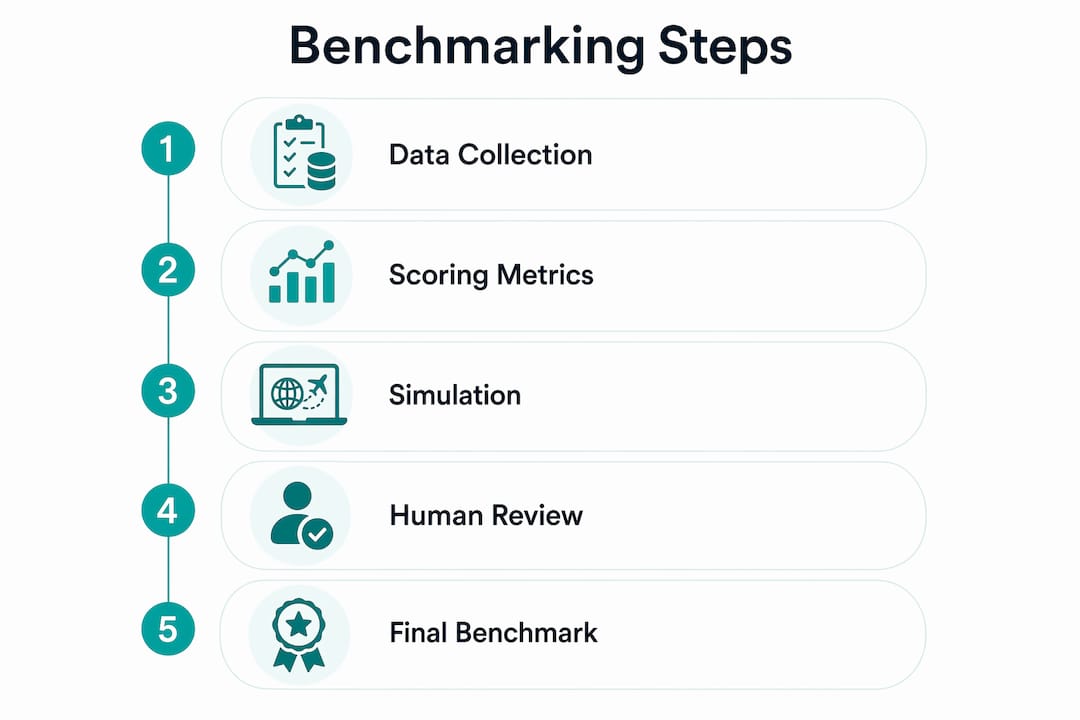
Human annotation is the gold standard for ground truth. Expert reviewers build reference itineraries and write annotation guidelines that define what "feasible" and "well-paced" mean concretely. Benchmarks then measure how closely an AI-generated plan matches those expert judgments.
Scoring rubrics translate the six dimensions into measurable metrics:
- Cost Calculation Deviation — how far the plan's cost estimates stray from real prices
- Violation Rate of Opening Hours — percentage of scheduled visits that conflict with actual hours
- Fictitious Attraction Rate — share of recommended places that don't exist or are misrepresented
- Transfer Feasibility Score — whether connections between sites are achievable in the time allotted
- Preference Alignment Score — how well the plan matches the traveler's stated profile
Sandboxing and simulation add another layer. TravelBench and similar frameworks use cached tool calls and simulated execution to test minute-level feasibility — checking whether a traveler could actually complete each transition, not just whether the schedule looks plausible on paper.
The trust signal to look for: published annotation guidelines, reproducible test scenarios, and a reported human-expert agreement score. TripScore reports roughly 60.75% alignment with human-expert assessments — a useful benchmark for what "moderate agreement" looks like in practice, and a reminder that no automated score fully replaces expert judgment.
Which named benchmarks should you know?
Three names come up repeatedly in research and product claims. Each emphasizes something different.
- TravelEval runs a six-dimensional, sandboxed evaluation with realistic pricing and transport data. Its strength is end-to-end emulation: it doesn't just check whether a plan looks reasonable, it simulates execution to catch spatio-temporal failures that only appear when you try to actually follow the schedule.
- Trip+ focuses on multi-turn, profile-aware planning. It measures how well an agent handles follow-up requests — "actually, skip the museum and add a cooking class" — and tracks fatigue and pacing across a simulated traveler experience. If personalization and replanning matter to you, Trip+ scores are the relevant signal.
- TripScore aggregates multiple constraint types into a single reward score and reports human-expert alignment. Its dataset spans 897 cities, 9,376 hotels, and 10,997 attractions, including 219 real-world free-form user requests. That breadth makes its alignment figure meaningful rather than cherry-picked.
Reading these scores correctly: TravelEval tells you about per-day feasibility and routing logic. Trip+ tells you about long-horizon personalization and stateful replanning. TripScore tells you how close the overall plan quality comes to what a human expert would approve.
Where do AI itinerary generators most often fail?
Current LLM-based agents struggle with globally-optimized multi-dimensional planning, particularly when budget compliance and spatio-temporal reasoning have to work together. The failures are predictable enough that you can watch for them.
Over-optimization for technical feasibility. A plan can pass a basic feasibility check and still be exhausting. Fitting seven sites into a day is achievable; enjoying it is not. AI drafts often maximize coverage at the expense of pacing.
Hallucinated prices and invented attractions. Budget miscalculations and fabricated details are accuracy failures, and they're more common than most providers admit. An itemized cost breakdown is the fastest way to surface them.
Poor spatio-temporal planning. Ignoring opening hours, underestimating transit time, and scheduling impossible connections are the most frequent temporality and spatiality failures. A common version: scheduling a popular site for late afternoon without accounting for last-entry cutoffs.
Planning by nights booked instead of usable days. Arrival and departure days are partial days, not full ones. Over-scheduling them is one of the most consistent practical mistakes in AI-generated plans.
Pro Tip: When you receive a draft itinerary, check the first and last days first. If Day 1 starts with a full activity slate and you land at 3 PM, or Day 5 packs in three sites before a noon flight, the plan wasn't built around your actual usable hours.
Human verification addresses these failures because it brings pacing judgment, local knowledge, and pragmatic trade-offs that no benchmark fully captures. Human-aided trip design catches the difference between a plan that works on a spreadsheet and one that works on the ground.
What does benchmarking mean when you're choosing a planner?
Translate the research into a short checklist. Before committing to any AI-assisted planner, ask or look for:
- Published rubric or evaluation criteria — can they explain what they check and how?
- Example annotated itinerary — a sample day with curator notes on pacing, routing, and cost assumptions
- Human-expert agreement signal — TripScore's moderate alignment (https://ar5iv.labs.arxiv.org/html/2510.09011) with expert annotations shows what "good" looks like; ask whether your provider's output has been validated similarly
- Sandbox or simulation evidence — were opening hours and transit times actually verified, or assumed?
- Itemized cost assumptions — line-item estimates, not a single total
For timeline and booking: lock your fixed anchors (flights and hotels) first, then build flexible activities around them. Request human review at least two weeks before departure for complex trips. Limit each day to roughly 1–2 fixed anchors plus flexible time, with buffer slots for transit and meals.
To validate a delivered itinerary quickly: check opening hours for every morning and evening activity, confirm the routing clusters activities by neighborhood, verify that transit times between sites are realistic, and flag any day with more than two hard-scheduled anchors as a potential over-scheduling risk.
How Destlist applies these principles
Destlist uses AI to draft geographically clustered, paced itineraries and human curators to verify feasibility and enjoyment before delivery. The operational checks map directly to the benchmarking dimensions: cost sanity checks against real pricing data, schedule verification against opening hours, neighborhood clustering for routing efficiency, and backup alternatives for weather or closures.
What you get from a custom travel itinerary through Destlist:
- A day-by-day plan with mapped routes and estimated walking times (spatiality and temporality checks built in)
- Budget-conscious flight and hotel matching with itemized cost assumptions (economy dimension)
- Weather alerts and packing lists added to the delivery (utility and compliance)
- Ready-to-book plans available within 24 hours for travelers who need a fast turnaround
When you request a plan, ask for a sample annotated day, itemized cost assumptions, and curator notes on pacing or accessibility. Those three elements are the practical equivalent of a published benchmark rubric — they show you exactly what was checked and why decisions were made.
Key Takeaways
Travel itinerary benchmarking proves that plan quality is measurable across six concrete dimensions, but human verification remains the bridge between a passing score and a trip you'll actually enjoy.
| Point | Details |
|---|---|
| Six dimensions matter | Accuracy, compliance, temporality, spatiality, economy, and utility each catch a different category of planning failure. |
| Human alignment is the key trust signal | TripScore reports approximately 60.75% agreement with expert annotations — ask any provider how their output was validated. |
| AI fails predictably | Hallucinated prices, poor routing, and over-scheduled arrival days are the most common and avoidable failures. |
| Validate the first and last days first | Arrival and departure days are partial days; over-scheduling them is the most consistent AI planning mistake. |
| Destlist combines both layers | AI drafts with human curator verification, itemized costs, and a 24-hour ready-to-book option. |
The gap between a benchmark score and a trip worth taking
Benchmarks are indispensable. Without them, "AI-verified" is marketing language with no substance behind it. TravelEval, Trip+, and TripScore give researchers and product teams a shared vocabulary for what feasibility actually means, and that vocabulary is slowly making its way into how travelers evaluate providers.
But a 60.75% human-alignment score is also a candid admission: automated evaluation still disagrees with expert judgment roughly four times in ten. That gap isn't a flaw in the benchmark — it's an honest description of where the technology stands. The dimensions a benchmark scores well (opening hours, transfer times, cost arithmetic) are exactly the ones a computer handles reliably. The ones it scores less well (pacing feel, local quirks, the judgment call between a crowded landmark and a quieter alternative two blocks away) are exactly the ones a human curator earns their keep on.
The practical takeaway: use benchmarks to filter out providers who can't explain what they check. Use human verification to close the gap between a plan that passes and a trip that delivers. For complex itineraries, tight budgets, or accessibility needs, that human layer isn't optional — it's where the real work happens.
Destlist builds the itinerary you'd plan yourself, if you had the time
Most travelers don't need a benchmark paper. They need a plan that works when they land. Destlist delivers AI-drafted, human-verified itineraries with itemized costs, mapped routes, pacing notes, and weather alerts — ready to book within 24 hours.

The AI handles the clustering and cost research. The human curators handle the judgment calls: which neighborhood to anchor each day, where the routing saves you an hour, which attraction is worth the line and which isn't. You get curated travel plans that reflect both layers — not a raw AI output dressed up as a finished product.
Browse ready-made destination plans or request a custom itinerary built around your dates, budget, and travel style.
Useful sources
- TripScore: Benchmarking and rewarding real-world travel planning — benchmark paper; human-expert alignment methodology and reward scoring
- TravelEval: A Comprehensive Benchmarking Framework for LLM-Powered Travel Planning Agents — benchmark paper; six-dimensional rubric and sandboxed evaluation
- Trip+: Benchmarking Agents in Personalized Interactive Travel Planning — benchmark paper; multi-turn, profile-aware simulation and fatigue metrics
- Beyond Itinerary Planning: A Real-World Benchmark for Multi-Turn and Tool-Using Travel Tasks — ACL paper; TravelBench sandboxing and minute-level feasibility testing
- How to build a realistic travel itinerary — practical planning guide; nights-vs.-days pacing and tiered anchor structure
- Step by Step Travel Itinerary: Build Smarter Trips — practical planning guide; frame-first planning, buffer time, and anchor sequencing