
Sustainable travel is worth prioritizing because it protects the places you want to visit, supports the people who live there, and tends to produce better experiences than mass tourism. The case isn't abstract: tourism accounts for roughly 10% of the global economy and is the largest single source of revenue financing many protected areas worldwide. When that money flows through local businesses and certified operators, it does real conservation work. When it doesn't, the damage compounds quietly.
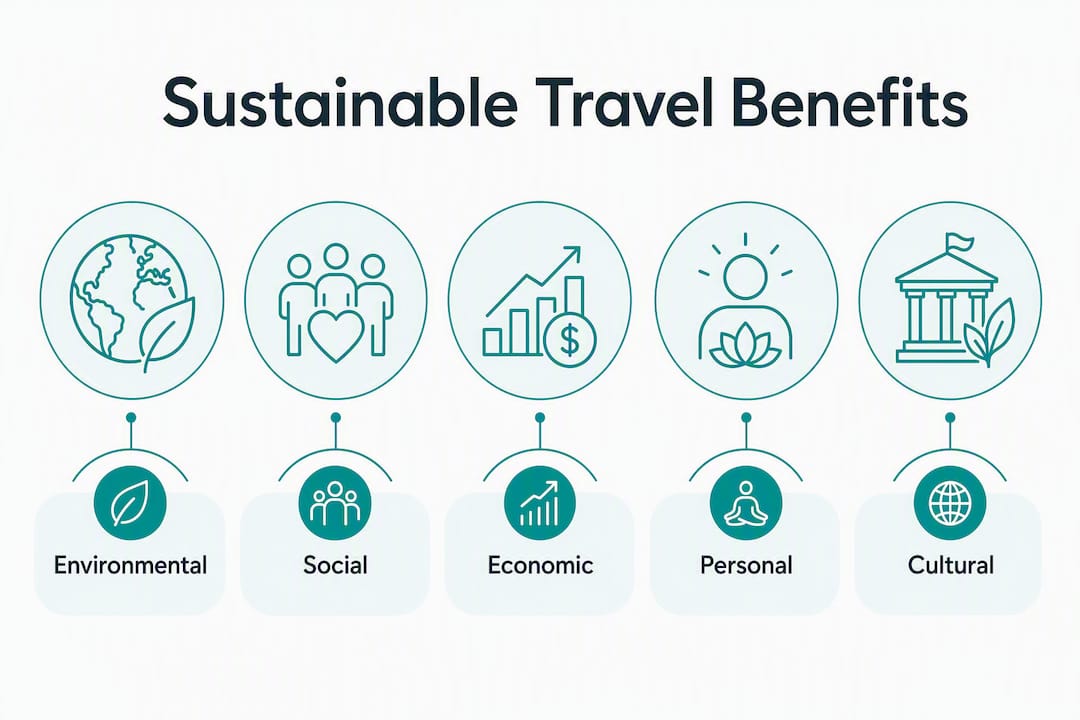
The core reasons to prioritize sustainable trips fall into four categories:
- Environmental: Reduces emissions, protects habitats, cuts waste, and funds conservation in protected areas
- Social: Sustains local cultures, safeguards heritage sites, and improves health and safety for host communities
- Economic: Keeps spending in local hands, reduces economic leakage, and supports small businesses and jobs
- Personal: Delivers more authentic experiences, less crowded destinations, and long-term access to places you love
Table of Contents
- What are the real benefits of sustainable travel?
- How do you actually prioritize sustainability when planning a trip?
- What frameworks help you evaluate sustainable tourism?
- Is sustainable travel actually more expensive or inconvenient?
- What does the evidence say about sustainable travel's impact?
- Your sustainable travel checklist
- Key Takeaways
- Sustainable travel and the planning gap
- Destlist makes sustainable trip planning practical
- Useful sources
What are the real benefits of sustainable travel?
The environmental case is the most visible, but it's not the only one worth understanding.
Environmental benefits
Choosing direct flights over multi-hop itineraries, staying in certified accommodations, and avoiding single-use plastics are all measurable actions. But the bigger picture is protected-area funding. Many national parks and wildlife reserves depend on tourism revenue to operate. When travelers choose operators that channel fees toward conservation, they're directly financing the habitats they came to see. Unmanaged mass tourism does the opposite: it erodes trails, stresses wildlife, and pollutes water sources faster than ecosystems can recover.
Social benefits
Tourism can sustain local cultures or hollow them out, depending on how it's structured. Community-based tourism models, where local guides lead tours and families run guesthouses, keep cultural knowledge alive and give residents economic agency. The UN links sustainable tourism to several Sustainable Development Goals, including decent work (SDG 8.9) and responsible consumption (SDG 12.b), precisely because the social dimension is inseparable from the environmental one. Heritage sites that attract tourists without a management plan tend to degrade within a generation.
Economic benefits
Economic leakage is the quiet problem most travelers never think about. When you book through an international chain, eat at a franchise, and buy souvenirs made overseas, a large share of your spending leaves the destination immediately. Spending at locally owned restaurants and shops keeps tourism dollars circulating in host communities instead of flowing back to corporate headquarters elsewhere. Small shifts in where you eat and shop can materially increase the benefit to the people who actually live there.
Personal benefits
According to Booking.com's Travel & Sustainability Report 2026, 85% of travelers consider sustainable travel important, and a growing share are shifting toward off-season travel and local spending. That shift isn't just ethical. Off-season travel means fewer crowds, lower prices, and more genuine interactions with locals. Slower, more intentional trips tend to produce stronger memories than a five-city sprint. The experience quality goes up when you're not competing with tour buses at every stop.
How do you actually prioritize sustainability when planning a trip?
Sustainable travel planning breaks into three stages: before you leave, while you're there, and after you return.
Planning stage
Pick destinations where your presence adds value rather than pressure. Overtouristed spots like certain Venetian neighborhoods or Maya Bay in Thailand have documented carrying-capacity problems; choosing a less-visited region nearby often produces a better trip anyway. Prioritize nonstop flights when the route allows, since takeoff and landing generate a disproportionate share of aviation emissions. Look for accommodations with GSTC-accredited certification or a transparent sustainability report, not just a green logo. And consider staying longer in one place rather than hopping between cities — fewer inter-city hops cut transport emissions and logistical complexity while deepening your experience of a place.
Pro Tip: When vetting an accommodation or tour operator, look for a publicly available sustainability report with specific targets and third-party verification. A hotel that says "we care about the environment" without naming a certification body or publishing measurable goals is a greenwashing red flag.
During travel
Use public transport, walk, or rent a bike where possible. Eat at locally owned restaurants rather than international chains, and buy from local markets and artisans. Respect wildlife-watching guidelines: feeding animals, even unintentionally, disrupts natural behaviors and can make them dependent on human contact. Carry a reusable water bottle, bag, and utensils — the UN recommends these basics as among the simplest ways to reduce harm. Choose tour operators that have a stated policy on wildlife interaction and community benefit.

After you return
Carbon offsets are a legitimate tool when used alongside genuine reduction, not instead of it. Verified offset programs through Gold Standard or Verra are more reliable than airline-branded options with no independent audit. Beyond offsets, share what you learned: a well-placed recommendation for a small local guesthouse or guide can send meaningful business their way. Support conservation organizations working in places you visited, and check whether the operators you used have published follow-up reports on their commitments.
What frameworks help you evaluate sustainable tourism?
Three established frameworks give travelers and operators a shared language for what "sustainable" actually means.
The three pillars
Every credible definition of sustainable tourism rests on three pillars: environmental protection, social equity, and economic viability. The key word is balance. A resort that protects a coral reef but pays staff poverty wages fails the social pillar. A community-run lodge that employs locals but dumps waste into a river fails the environmental one. All three pillars have to hold simultaneously, which is why single-axis claims ("we plant trees") are rarely sufficient evidence of genuine sustainability.
The 5 P's framework
The 5 P's, adapted from the UN's Sustainable Development Goals framework, cover People, Planet, Prosperity, Peace, and Partnerships. For travelers, the practical application is straightforward: ask whether a destination or operator is actively contributing to local wellbeing (People), protecting natural systems (Planet), generating income that stays local (Prosperity), operating in a stable and safe context (Peace), and collaborating with community stakeholders rather than working around them (Partnerships). It's a useful mental checklist when reading a hotel's sustainability page.
GSTC criteria
The Global Sustainable Tourism Council sets minimum criteria for accommodations and tour operators across four categories: sustainable management, social and economic impacts, cultural heritage, and environmental impacts. GSTC accreditation means an independent body has verified that a business meets those criteria, not just that the business claims to. When you see a GSTC-accredited logo, it signals a baseline level of accountability that a self-declared "eco-friendly" label does not.
Pro Tip: Three quick red flags for greenwashing: (1) vague language with no measurable targets ("we love nature"), (2) a green logo with no named certifying body, and (3) no publicly accessible sustainability report. Legitimate operators can tell you exactly what they measure and who verifies it.
Is sustainable travel actually more expensive or inconvenient?
The honest answer is: sometimes, and less often than people assume.
The most common barriers travelers cite are higher cost, extra research time, limited options in certain regions, and confusing or overlapping certifications. These are real, not imaginary. A certified eco-lodge in Costa Rica may cost more per night than a chain hotel. Finding a GSTC-accredited tour operator in a less-visited destination takes more effort than clicking the first result on a booking site.
But several of the perceived trade-offs dissolve on closer inspection:
- "Sustainable travel is boring" — Local and slower travel consistently produces more authentic experiences. Staying in a family-run guesthouse in Oaxaca and eating at the market is not a compromise; for most travelers, it's the highlight.
- "Offsets cancel out my footprint" — Offsets are a supplement, not a substitute. Flying less and staying longer in fewer places has a larger impact than purchasing credits after the fact.
- "There aren't sustainable options where I want to go" — Certified options are expanding rapidly. Curated platforms that vet providers for you reduce the research burden significantly, especially for travelers who don't have hours to cross-check certifications.
- "It costs too much" — Off-season travel, locally owned guesthouses, and public transport often cost less than the mass-tourism equivalent, not more.
The regenerative framing Dr. Becken describes is worth sitting with. It moves the question from "how little damage can I do?" to "what did I contribute?" That's a more demanding standard, but it's also a more motivating one.
What does the evidence say about sustainable travel's impact?
The data on traveler behavior and tourism's economic role makes a strong case for why sustainable choices matter at scale.
Tourism's role as the largest single revenue source for many protected areas worldwide is not a minor detail. Without that funding, ranger patrols, habitat restoration, and anti-poaching programs lose their financial base. The connection between where a traveler spends money and whether a wildlife corridor survives is direct, even if it's not visible from a hotel lobby.
On the demand side, Booking.com's 2026 report found that 85% of travelers consider sustainable travel important, with measurable shifts toward off-season travel and local spending. That's a significant majority signaling preference, not just aspiration.
The gap between interest and action, however, is real. Survey data cited by Expedia Group Media Solutions found that many travelers who want to make sustainable choices feel overwhelmed when trying to identify genuinely sustainable options. The verification problem is the bottleneck: travelers can't easily tell a legitimate certification from a marketing claim, which is exactly why frameworks like GSTC and curated platforms that pre-vet providers matter.
"Slowing down — staying longer in fewer places — is the single most impactful behavioral shift a traveler can make. It cuts transport emissions, reduces logistical complexity, and almost always improves the quality of the experience."
— National Geographic, sustainable travel guide
The eco-friendly travel planning landscape in 2026 reflects this shift: hospitality businesses are increasingly adopting formal programs and frameworks, and travelers who know what to look for can find genuinely verified options more easily than five years ago.
Your sustainable travel checklist
Use this before you book, while you're packing, and on the ground.
Planning and booking
- Choose a destination where tourism is managed and your visit adds economic value to local communities
- Book nonstop flights where the route allows; avoid unnecessary layovers
- Look for GSTC-accredited accommodations or operators with published, third-party-verified sustainability reports
- Prefer locally owned guesthouses, boutique hotels, and small-group tour operators over international chains
- Plan a longer stay in fewer places rather than a multi-city sprint
- Check local sourcing practices at accommodations — hotels that source food locally reduce supply-chain emissions and support regional farmers
- Use a custom travel itinerary service that pre-vets sustainable options to cut research time
Packing
- Bring a reusable water bottle, tote bag, and utensils
- Pack reef-safe sunscreen for coastal destinations
- Leave single-use plastics at home
On the trip
- Eat at locally owned restaurants and buy from local markets and artisans
- Use public transport, walk, or cycle where practical
- Follow wildlife-watching guidelines; never feed animals
- Respect local customs, dress codes, and photography norms at cultural and religious sites
- Conserve water and energy in accommodations
After you return
- Use verified offset programs (Gold Standard, Verra) only as a supplement to reduction, not a replacement
- Recommend the local guides, guesthouses, and operators you used to other travelers
- Support conservation organizations working in destinations you visited
Pro Tip: Busy travelers can shortcut the certification research by filtering for GSTC-accredited properties on booking platforms, or by using a curated itinerary service that has already done the vetting. The Destlist approach to customized trips is built around exactly this kind of pre-filtered, human-reviewed planning.
Key Takeaways
Sustainable travel protects ecosystems, supports local economies, and consistently produces more authentic experiences than mass tourism, making it the stronger choice for travelers who want access to the world's best places long-term.
| Point | Details |
|---|---|
| Tourism funds conservation | Tourism is the largest single revenue source for many protected areas worldwide — where you spend matters. |
| Local spending reduces leakage | Eating and booking locally keeps money in host communities instead of flowing to international chains. |
| Slower travel cuts emissions | Fewer inter-city hops reduce transport emissions and improve experience quality. |
| 85% of travelers agree | Booking.com's 2026 report found 85% consider sustainable travel important, with real shifts in behavior. |
| Destlist pre-vets options | Destlist's curated itineraries include sustainability-aware filters and human-reviewed vendors, cutting research time for busy travelers. |
Sustainable travel and the planning gap
The argument for sustainable travel is solid. The harder problem is execution: most travelers who care about it still struggle to act on it consistently, and the reason is almost never values. It's time and information.
Certifications overlap and conflict. Greenwashing is widespread enough that a skeptical traveler has good reason to distrust any claim that isn't independently verified. And the research required to vet a single accommodation, let alone an entire itinerary, can take hours that most people simply don't have before a trip.

What that means practically is that the biggest lever for sustainable travel isn't convincing more people to care. It's reducing the friction between caring and doing. A traveler who books a pre-vetted, locally anchored itinerary through a platform that has already checked certifications and filtered for local ownership will make better choices than the same traveler spending three hours on a booking site trying to decode sustainability badges.
The contextual trip suggestions model matters here too. When a recommendation is built around a specific destination's local operators, seasonal rhythms, and community experiences, it naturally steers toward sustainable choices without requiring the traveler to become an expert in certification standards.
The regenerative framing Dr. Becken describes is the right long-term direction. But for most travelers, the immediate step is simpler: book better, spend locally, stay longer. The infrastructure to do that is better than it's ever been.
Destlist makes sustainable trip planning practical
Planning a sustainable trip from scratch takes real time: vetting certifications, finding locally owned accommodations, checking operator policies, and building an itinerary that doesn't require five flights. Destlist removes that research burden with AI-assisted, human-reviewed custom travel itineraries that include sustainability-aware filters, vetted local vendors, and curated experiences built around local operators rather than international chains.

Every Destlist plan is reviewed by a human travel curator before delivery, which means the sustainability claims attached to recommended properties and operators have been checked, not just scraped from a booking algorithm. You get a ready-to-book itinerary within 24 hours, including flights, hotels, day-by-day routes, and local activity suggestions, with options filtered for local ownership and verified credentials where available.
Destlist is a paid service. Plans are available as one-time purchases or subscriptions. To see what a curated, sustainability-aware itinerary looks like for your next destination, browse Destlist's travel plans and start building your trip.
Useful sources
Use these to verify certifications, check local rules, and go deeper on any topic covered above.
- Responsible travel tips | WWF — Covers tourism's economic scale and its role in financing protected areas; practical traveler guidance from one of the most authoritative conservation organizations.
- What is Sustainable Tourism? | GSTC — The primary reference for GSTC criteria and what accreditation covers for accommodations and tour operators.
- Sustainable tourism | UN SDGs — Links tourism to specific Sustainable Development Goals; useful for understanding the global policy context.
- Is it possible to be a 'sustainable tourist'? | UN News — Practical traveler behaviors recommended by the UN, including reusable items, local purchasing, and responsible operator selection.
- How to Take a Sustainable Trip | The New York Times — Covers the Expedia Group Media Solutions survey finding on traveler interest versus difficulty identifying sustainable options; practical planning guidance.
- How to travel better | National Geographic — Practitioner guidance on slowing down, reducing inter-city hops, and using a basecamp model; one of the most widely cited beginner guides.
- All the sustainable travel habits tourists are adopting in 2026 | Euronews — Reports on Booking.com's Travel & Sustainability Report 2026, including the 85% figure and behavioral shift data.
- Dr. Susanne Becken on regenerative tourism | DestinationThink — Academic perspective on the shift from low-impact to regenerative travel; useful for understanding where the field is heading.
This article is general information, not professional travel, legal, or environmental advice. Certification standards and local regulations vary by destination — verify current requirements with the relevant authority or a qualified professional before booking.