
Interest-based travel guides help you spend less time choosing and more time enjoying trips that actually match what you care about. Instead of sorting through a generic top-10 list and guessing which stops apply to you, a guide built around your interests filters the world down to what's relevant. Research published in PLOS ONE confirms that matching the recommendation source to your trip motivation produces better decisions, and MDPI's review of AI-driven personalization shows personalization raises perceived relevance and satisfaction when paired with transparency.
Three reasons travelers reach for interest-based guides:
- Relevance: Every stop, activity, and route connects to your specific interest, so nothing feels like filler.
- Time saved: You skip the research spiral. A focused guide cuts decision complexity before you even open a map.
- Deeper experiences: Trips organized around a theme tend to produce stronger memories and more meaningful local connections.
Key Takeaways
Interest-based travel guides consistently outperform generic lists when the guide is built on verified local knowledge and matched to a traveler's real motivation.
| Point | Details |
|---|---|
| Relevance beats breadth | Guides built around your interests remove noise and cut decision time before you arrive. |
| Match source to trip type | Use AI-curated guides for utilitarian trips; expert or crowdsourced picks for hedonic, experiential travel. |
| Two layers are non-negotiable | Thematic coherence plus verified practical details (times, distances) separates usable guides from vibe boards. |
| Verify before you rely | Cross-check opening times and recent reviews for any interest-specific stop before building your day around it. |
| Destlist combines both layers | AI-assisted itineraries reviewed by human curators deliver interest-matched plans with verified logistics, ready to book. |
Table of Contents
- Why use interest-based travel guides instead of general ones?
- Core benefits of interest-based guides, backed by research
- When do interest-based guides work best for your trip?
- How to plan a trip based on your interests, step by step
- What formats exist, and what do they cost?
- Limitations and red flags to watch for
- How Destlist applies interest-based planning for travelers
- What interest-based planning looks like in practice
- The case for interest-based guides, from someone who plans trips for a living
- Destlist turns your interests into a ready-to-book itinerary
- Sources
Why use interest-based travel guides instead of general ones?
A general travel guide covers a destination broadly: top museums, best restaurants, popular neighborhoods. An interest-based guide, sometimes called a niche or themed travel guide, starts from a different premise. It asks what you care about first, then builds the destination around that answer.
The structure has two layers. The first is thematic coherence: every recommendation shares an interest thread, whether that's architecture, food culture, hiking, or live music. The second is practical relevance: the guide includes opening times, walking distances, and sequencing that makes the theme actually workable on the ground. Without both layers, as Accenture's travel industry analysis puts it, a personalized guide risks becoming a "vibe board" rather than a usable plan.
Common formats include:
- Niche guidebooks focused on a single theme (cycling routes, culinary trails, literary destinations)
- Themed digital guides organized by interest category and updated more frequently than print
- Curated itineraries built to a specific traveler profile, with day-by-day routing and booking details
Core benefits of interest-based guides, backed by research
The single biggest advantage is relevance: a guide that reflects your interests removes the noise that makes trip planning feel like a second job. But the benefits go further than that.
Reduced decision complexity. Generic top-lists are useful for orientation, but they rarely answer "what's right for me." Industry analysis shows that travelers increasingly expect recommendations tailored to their interests, time, and travel style, and that generic lists consistently fall short of that expectation. A focused guide pre-filters choices, so you spend less mental energy on elimination.
Stronger, more memorable experiences. Interest-driven learning research documents that connecting tasks to personal interests boosts persistence and produces richer knowledge structures. The same principle applies to travel: when every stop connects to something you already care about, you engage more deeply and remember more. A food-focused traveler who spends a day at a regional market, a cooking class, and a family-run trattoria will recall that day far more vividly than a day spent ticking off a mixed list of "must-sees."

Better local discovery. Themed guides tend to surface smaller, locally owned businesses that generic promotion overlooks. That's good for travelers seeking authenticity and good for the destinations themselves: personalized recommendations help local businesses get discovered and can increase per-visitor value compared with mass-market promotion.
| Dimension | General guide | Interest-based guide |
|---|---|---|
| Relevance to traveler | Low to moderate | High |
| Decision complexity | High (many unfiltered options) | Lower (pre-filtered by interest) |
| Depth of experience | Broad, surface-level | Focused, immersive |
| Local discovery | Skewed toward popular spots | Includes niche, local businesses |
The MDPI research on personalization and traveler satisfaction adds an important nuance: personalization only converts to satisfaction when trust and perceived value are present. Transparency about how recommendations are made and giving travelers some control over the output are the two design levers that matter most.
When do interest-based guides work best for your trip?
Match the guide style to your trip goal. That's the short answer. The longer one comes from PLOS ONE research showing that AI recommendations outperform crowdsourced and expert picks for utilitarian travel goals (efficiency, business, logistics), while expert or crowdsourced recommendations score higher for hedonic trips where emotional judgment and serendipity matter.
A quick decision guide:
- Short business trip: Prioritize efficiency-focused guides with AI-curated logistics. Interest-based guides still add value if you have a half-day free and a clear preference.
- Long leisure trip: Interest-based guides shine here. You have time to go deep, and thematic routing prevents the scattered "we saw everything, remembered nothing" problem.
- Family trip: A family-focused interest guide built around shared interests (outdoor adventure, food, history) keeps everyone engaged and reduces on-the-ground negotiation.
- Event-driven visit: The event is already your interest thread. A themed guide built around it adds context, nearby experiences, and practical logistics.
Interest-based guides add less value when your destination is genuinely unfamiliar and you need broad orientation first, or when your group has conflicting interests with no shared thread to build around.
How to plan a trip based on your interests, step by step
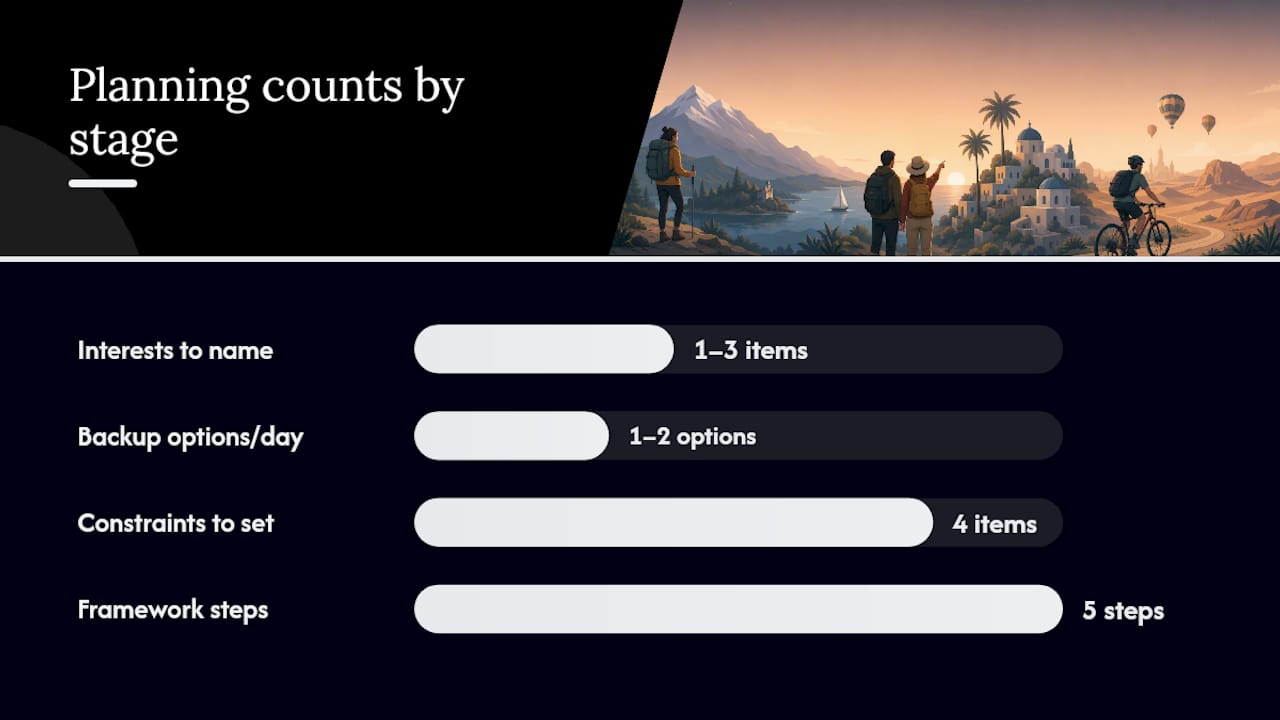
Use a five-step framework: identify your interest thread, set constraints, pick coherent pathways, validate practical details, and build in fallback choices.
- Identify your interest thread. Name one to three interests that would make a trip feel worth it. Be specific: "food" is too broad; "regional pasta traditions in central Italy" gives you something to route around.
- Set your constraints. Days available, budget, pace (intense vs. relaxed), and mobility all shape which pathways are realistic. Customized itineraries save time precisely because they're built inside real constraints, not around an imaginary unlimited schedule.
- Pick coherent pathways. Group stops thematically and geographically. A morning at a ceramics workshop followed by a museum of decorative arts followed by a studio visit makes a coherent day. The same three stops spread across three days lose the thread.
- Validate practical details. Check opening times, seasonal closures, and travel times between stops. This is where many interest-based guides fail: the theme is right but the logistics haven't been verified.
- Build in fallback choices. One or two backup options per day prevents a closed venue from derailing the whole itinerary.
Pro Tip: Verify seasonality before committing to any interest-specific stop. A lavender farm in November, a ski-focused guide in April, or a festival-driven itinerary on the wrong weekend all collapse the same way: the asset isn't there.
Blend your sources by trip type. For utilitarian trips, AI-curated suggestions handle logistics well. For hedonic trips, layer in expert picks and recent traveler reviews where emotional resonance matters. Explaining itinerary personalization covers how these sources work together in practice.
What formats exist, and what do they cost?
Format maps to value and cost in a fairly predictable way. Free content covers the widest ground with the least personalization; paid curated services offer the tightest fit but require investment.
Pay for a curated itinerary when your trip is complex (multiple cities, tight timing), when your time is genuinely limited, or when getting the experience right matters more than saving $40. For a straightforward weekend trip with a clear interest thread, a well-researched themed digital guide often does the job. Locally curated hotel experiences follow the same logic: the curation premium pays off when the alternative is hours of research with uncertain results.
Limitations and red flags to watch for
Specificity only helps if the destination can actually back it up. A guide promising "the best jazz bars in [city]" is only as good as the city's jazz scene and the guide's last update.
Red flags to watch for:
- Overpromising on niche assets. Niche guides deliver stronger resonance only when the destination has the assets to support the guide's promises. A guide built around a persona the destination can't serve will disappoint.
- Stale opening times and prices. A guide last updated two years ago may list venues that have closed, changed hours, or moved.
- No local verification. Guides assembled from secondary sources without on-the-ground checking often miss the details that matter most.
- Poor accessibility detail. An interest-based guide that ignores mobility, dietary restrictions, or family logistics is only personalized on the surface.
- Narrow persona mismatch. A guide built for solo adventure travelers won't serve a couple on a relaxed anniversary trip, even if the destination is the same.
Pro Tip: Before relying on any guide, cross-check the three most important stops against recent Google reviews and the venue's own website. Five minutes of verification prevents the most common disappointments.
How Destlist applies interest-based planning for travelers
Destlist builds AI-assisted itineraries reviewed by human curators, combining the speed of automated personalization with the judgment that hedonic and complex trips require. The platform takes your interests, budget, and travel constraints and produces a custom travel itinerary with mapped day plans, flight and hotel matching, weather alerts, and booking-ready options, typically within 24 hours.
The workflow addresses the two failure modes that undermine most interest-based guides. First, it applies the two-layer structure Accenture's analysis identifies as essential: thematic coherence plus verified practical details. Second, it builds in the transparency and user-control signals that MDPI's research links to higher traveler satisfaction.
What travelers typically get:
- A day-by-day plan organized around their stated interests, not a generic destination template
- Pacing built to their schedule, with fallback options for each day
- Verified logistics: opening times, travel times between stops, and booking links
- Human review that catches the gaps automated tools miss
For travelers who want to see the approach in action, Destlist's done-for-you planning page shows how AI and human curation work together on a real itinerary.
What interest-based planning looks like in practice
Consider a traveler heading to Lisbon with a strong interest in mid-century modernist architecture. A general guide sends them to the usual highlights: Belém Tower, the Alfama, a fado show. An interest-based guide routes them through the Parque das Nações district built for Expo '98, the Calouste Gulbenkian Museum's modernist campus, and a handful of lesser-known residential buildings from the Estado Novo period, with a ceramics studio visit that connects the decorative arts thread. The stops are fewer, the day is more coherent, and the traveler leaves with a specific, defensible opinion about Lisbon's architectural identity rather than a vague sense of having "done" the city.
A family traveling to Japan for the first time with kids who are passionate about anime and gaming faces a different planning problem. A generic guide gives them temples and cherry blossoms. An interest-based itinerary routes them through Akihabara, the Ghibli Museum (booked well in advance), a retro gaming arcade in Osaka, and a themed café in Kyoto, with the cultural context woven in rather than bolted on. The trip works because the interest thread is real and the destination has the assets to support it.
Both scenarios reflect what customization does to travel planning: it shifts the question from "what should we see?" to "what will we actually remember?"
The case for interest-based guides, from someone who plans trips for a living
Most travelers underestimate how much a shared interest thread changes the feel of a trip. Generic guides are built for the median traveler, which means they're built for no one in particular. The architecture lover, the food obsessive, the trail runner, and the music historian all get the same list, and all of them spend the first day filtering it.
What I've seen consistently is that the trips people talk about years later are almost always the ones organized around something specific. Not "we went to Paris" but "we spent four days eating our way through the 11th arrondissement and ended up at a natural wine bar that isn't in any guide." That specificity comes from starting with the interest, not the destination.
The caveat I'd add: interest-based guides only work when the guide itself is honest about what the destination can deliver. A guide that oversells a niche the city can't support is worse than a generic one, because it sets expectations the trip can't meet. That's why the human review layer in a service like Destlist matters: it's the check between what sounds good on paper and what actually works on the ground.
Destlist turns your interests into a ready-to-book itinerary
You tell Destlist what you care about, and it builds a complete trip around that, not around what everyone else is doing. The plan arrives within 24 hours, reviewed by human curators who check the details a purely automated tool would miss.
What you get when you book a curated plan:
- A day-by-day itinerary mapped to your interests, pace, and budget
- Flight and hotel options matched to your preferences, not a generic price sort
- Verified logistics with fallback options built in
- Human review before the plan reaches you
Start your custom itinerary and see what a trip planned around your actual interests looks like.
Sources
- AI recommendation vs. crowdsourced recommendation vs. travel expert recommendation: The moderating role of consumption goal on travel destination decision | PLOS One
- AI-Driven Personalization and Traveler Satisfaction: The Role of Trust and Perceived Value, and Technology Readiness
- Why Generic Recommendations No Longer Work
- The Travel Industry's New Trip (Accenture report)
- Niche Travel Guides and the Persona Advantage