
TL;DR:
- Travel convenience involves choices that reduce stress and save time during trips, often at a cost.
- A detailed budget with separate convenience line items helps travelers evaluate expenses honestly and avoid overspending.
Travel convenience is defined as the set of choices that reduce friction, save time, and lower stress during a trip, often at a direct financial cost. The real skill in trip planning is not choosing between comfort and savings. It is knowing exactly where each dollar of convenience spending pays off and where it does not. This guide to balancing travel convenience and cost walks you through budgeting, timing, planning tools, and upgrade decisions using current traveler behavior data. The result is a trip that feels smooth without quietly draining your account.
How to build a travel budget that balances convenience and cost
A detailed, line-item travel budget is the single most effective tool for managing the tradeoff between convenience and cost. Generic daily averages routinely miss $150–$300 in additional expenses on a standard week-long trip, according to real-time quote research. That gap almost always comes from convenience-related costs that travelers did not plan for.
Build your budget around these six core categories:
- Flights — Use current route-specific quotes, not last year's averages. Prices shift weekly.
- Accommodation — Factor in location relative to your activities. A cheaper hotel far from the center often costs more in transport.
- Local transport — Taxis cost tourists 3–5 times more than public transit or pre-booked fixed-rate transfers. Budget accordingly.
- Food and drink — Separate restaurant meals from street food and grocery days. The difference is significant.
- Activities and entry fees — List each planned activity with its actual price. Estimates here are where budgets collapse.
- Convenience upgrades — Give these their own line. Expedited security, airport transfers, priority boarding, and lounge access each carry a specific cost that belongs in the plan.
Add a 15–20% contingency buffer on top of your total. This covers baggage fees, unexpected transfers, last-minute bookings, and the small charges that accumulate invisibly. Travelers who skip this buffer consistently overspend.
Pro Tip: Keep convenience upgrades as separate line items in your budget. When you see the cost isolated, you can judge its value honestly instead of absorbing it into a vague "miscellaneous" category.
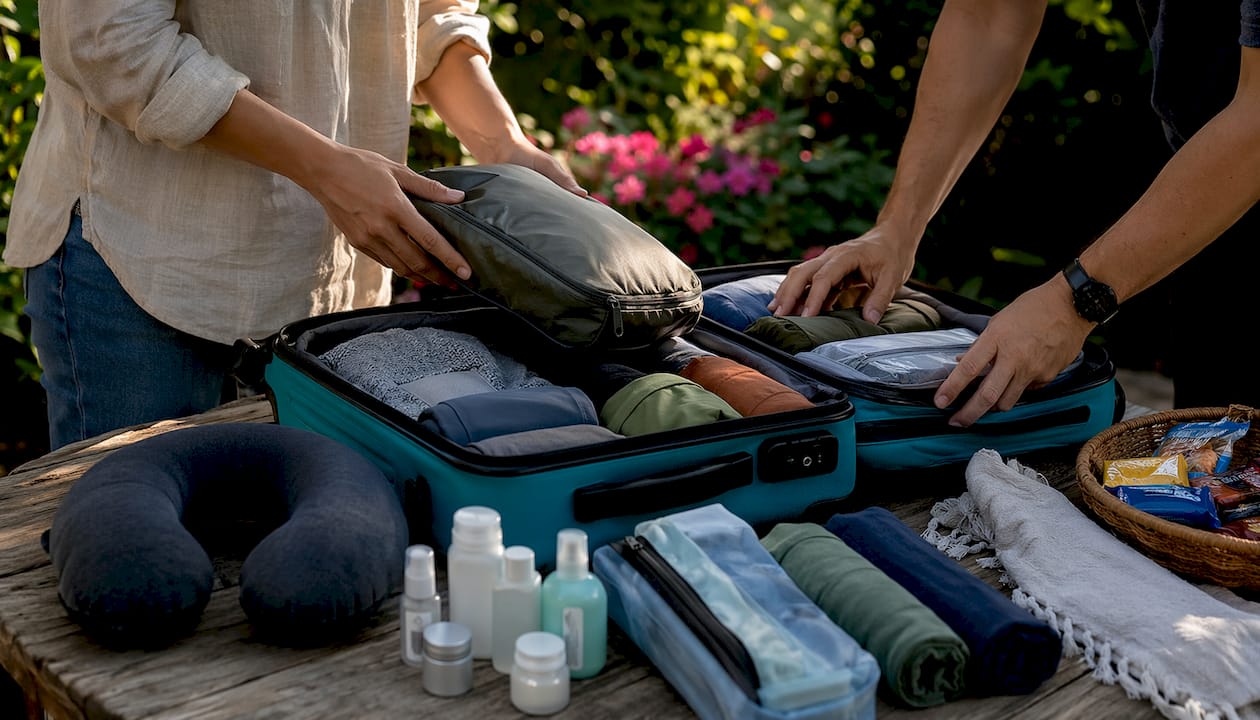
For real-time price tracking, apps that sync flight and hotel prices against your budget give you a live picture of where you stand. Printed copies of confirmations and insurance documents serve as a reliable backup when connectivity fails.
What are the best timing strategies to reduce travel costs?
Choosing the right travel dates is one of the highest-leverage decisions in trip planning. Traveling in low or shoulder seasons can reduce flight and hotel costs by 10%–60% compared to peak periods. That range is not a rounding error. It represents the difference between a budget trip and an expensive one on the exact same itinerary.
Here is how the three seasons compare in practical terms:
| Season | Cost level | Crowd level | Convenience impact |
|---|---|---|---|
| Peak season | Highest | Very high | Long queues, full hotels, limited flexibility |
| Shoulder season | Moderate | Moderate | Good availability, shorter waits, better service |
| Low season | Lowest | Low | Best prices, some closures, weather risk |
Thailand is a clear example. Baseline costs in low season sit at roughly 0.8 times the standard rate, while peak holiday periods push costs to 1.3 times that same baseline. That 60% swing applies to flights and hotels simultaneously.
Shoulder season is often the best balance point. Prices drop meaningfully, but the destination still operates at full capacity. You get shorter queues, better hotel availability, and more attentive service because staff are not overwhelmed.
Booking windows matter too. Flights booked 6–8 weeks in advance for domestic routes and 3–5 months out for international travel typically offer the best combination of price and seat selection. Waiting for last-minute deals works occasionally, but it removes flexibility and adds stress.
Pro Tip: Convenience upgrades like airport lounges and priority boarding are often cheaper to purchase during off-peak travel periods. Airlines and lounges price these dynamically, so the same upgrade costs less when fewer people want it.
How do hybrid planning methods improve convenience and cost control?
Hybrid trip planning combines digital tools for real-time updates and bookings with printed documents for reliability. This method prevents the single biggest failure point in modern travel: total dependence on connectivity.
The practical setup looks like this:
- Digital side: A travel app that syncs your itinerary, flight times, hotel confirmations, and local transport options in one place. Set price alerts for any bookings you have not yet made.
- Printed side: Hard copies of your travel insurance, hotel confirmations, visa documents, and emergency contacts. These work when your phone battery dies, your roaming fails, or airport Wi-Fi is unusable.
- Routing logic: Optimizing your route to minimize backtracking saves both time and transport costs. A well-sequenced itinerary is a convenience tool that costs nothing.
The Destlist platform applies this logic directly. Its AI-built itineraries include mapped routes with estimated walking times, so you are not doubling back across a city because activities were booked in the wrong order.
Understanding digital reservation systems also helps. Knowing how to manage, modify, and confirm bookings digitally reduces the friction that causes delays and missed connections.
Pro Tip: Check in online 24 hours before your flight and use a mobile boarding pass. This saves 20–30 minutes of airport wait time at zero cost. It is one of the cheapest convenience upgrades available.
For a deeper look at this approach, the Destlist blog covers hybrid travel planning in detail, including how to structure your documents and apps before departure.
Which convenience upgrades are actually worth the cost?
Most travelers confuse convenience with luxury. Convenience-focused upgrades reduce stress and increase control more effectively than luxury class travel does. The distinction matters because it changes which upgrades you prioritize.
The data backs this up. 68% of travelers pay for expedited security and 58% use airport lounges to reduce travel stress. These are not indulgences. They are time-management tools with a clear cost-benefit calculation.
Here is how to evaluate each common upgrade:
- Expedited security (TSA PreCheck, Global Entry): Annual fee, used on every trip. The per-trip cost drops quickly for frequent travelers. High value.
- Airport lounges: Worth it on long layovers or early morning departures. Day passes cost $30–$50. Credit card lounge access makes this free.
- Priority boarding: Low cost, high value on full flights where overhead bin space runs out. Eliminates the stress of gate-checking a carry-on.
- Pre-booked airport transfers: Fixed-rate transfers cost more than public transit but less than taxi uncertainty. On a tight schedule, the predictability is worth it.
- Flexible hotel check-in/out: Useful when flights land early or depart late. Often negotiable at no charge if you ask directly.
81% of travelers report they are more likely to upgrade when they can use points or rewards. If you hold a travel credit card, apply points to lounge access and priority boarding before spending cash on them.
Pro Tip: Packing carry-on only removes baggage fees, eliminates the wait at baggage claim, and makes public transport far easier. Experienced travelers treat this as a foundational cost and time-saving habit, not a sacrifice.
Practical steps to execute your balanced travel plan
A plan that stays in a spreadsheet does not help you at the airport. Execution requires a clear sequence of decisions made before you leave.
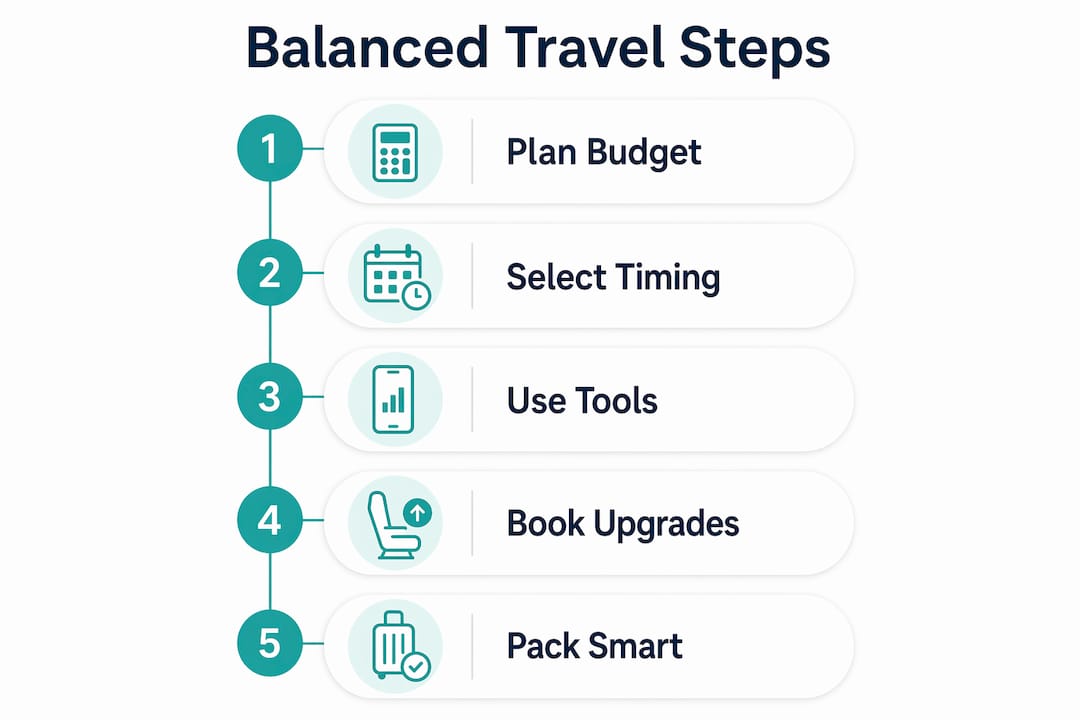
Follow these steps to move from planning to a working trip:
- Finalize your budget with real-time quotes for every category, including a 15–20% buffer.
- Select your travel dates based on shoulder or low season availability for your destination.
- Book in the right order: flights first, then accommodation, then activities. Each booking constrains the next.
- Pack carry-on only where possible. Decide on this before you start packing, not after.
- Set up your hybrid system: itinerary app on your phone, printed confirmations in your bag.
- Check in online 24 hours before departure.
- Track spending daily against your budget. A $20 daily overage becomes $140 by the end of a week.
The most common pitfalls are ignoring small fees (airport meals, resort fees, city taxes), overbooking convenience upgrades on a short trip where they add little value, and failing to account for local transport costs. A travel planning checklist built before departure catches most of these before they become problems.
Here is a quick comparison of three common approaches to the convenience-cost balance:
| Approach | Cost profile | Convenience level | Best for |
|---|---|---|---|
| Minimal spend | Lowest | Low | Budget travelers, flexible schedules |
| Mid-tier mix | Moderate | High | Most leisure travelers |
| Full upgrades | Highest | Highest | Short trips, tight schedules, business travel |
The mid-tier mix delivers the best return for most leisure travelers. You spend on the upgrades that save real time and skip the ones that are purely cosmetic.
Pro Tip: Build a simple pre-trip checklist and a separate travel-day checklist. Separating the two prevents the mental overload of trying to remember everything at once.
Key Takeaways
Balancing travel convenience and cost requires a line-item budget, shoulder-season timing, hybrid planning tools, and selective upgrade decisions based on trip complexity and schedule.
| Point | Details |
|---|---|
| Build a line-item budget | Separate convenience upgrades into their own category to evaluate each one honestly. |
| Use shoulder season timing | Traveling outside peak periods cuts costs by 10%–60% while improving availability and crowd levels. |
| Apply hybrid planning | Combine a digital itinerary app with printed backup documents to stay organized regardless of connectivity. |
| Choose upgrades by value | Prioritize expedited security, carry-on packing, and pre-booked transfers over cosmetic luxury add-ons. |
| Track spending daily | A small daily overage compounds fast. Checking your budget each evening keeps the trip on track. |
What I have learned from years of planning trips this way
The biggest mistake I see travelers make is treating convenience as a single category. It is not. Some convenience spending is genuinely protective. TSA PreCheck on a 6:00 AM departure with a tight connection is not a luxury. It is risk management. But paying for priority boarding on a half-empty regional flight is just money leaving your wallet.
I have found that the travelers who struggle most with this balance are the ones who decide on upgrades at the airport, under pressure, with no prior framework. The gate agent offers priority boarding for $15 and you say yes because you are tired and it sounds reasonable. Multiply that by five decisions per trip and you have spent $75 on things you never planned for.
The hybrid planning approach changed how I travel more than any single app or booking tool. Knowing that my itinerary, confirmations, and insurance are both on my phone and in my bag removes a specific kind of low-level anxiety that used to follow me through every airport. The printed documents have saved me twice. Once in a European airport with no Wi-Fi and once when my phone died before boarding.
Shoulder season travel is the other habit I would not give up. The crowds alone justify it. I have visited the same destinations in peak season and shoulder season, and the experience is genuinely different. Shorter queues, more attentive restaurant service, and hotel staff who have time to give real recommendations instead of pointing at a brochure rack.
My honest advice: pick one trip this year and apply the full framework. Line-item budget, shoulder season dates, hybrid planning setup, and a deliberate upgrade list. Compare it to how you planned your last trip. The difference will be obvious.
— Helen
How Destlist builds trips that balance convenience and cost
Planning a trip that genuinely balances convenience and cost takes more time than most travelers have. Destlist combines AI-built itineraries with human travel curators who review and refine every plan before it reaches you.
Each Destlist plan includes day-by-day activities with mapped routes, estimated walking times, budget-matched flights and hotels, and weather alerts. The routing logic alone eliminates the backtracking that quietly wastes hours on poorly planned trips. You can browse curated travel plans built around real destinations, or request a custom travel itinerary matched to your schedule and budget. Ready-to-book plans are delivered within 24 hours.
FAQ
What does balancing travel convenience and cost actually mean?
It means making deliberate choices about which time-saving or stress-reducing expenses are worth paying for and which ones are not. The goal is a trip that runs smoothly without spending on upgrades that add no real value.
How much contingency should I add to a travel budget?
Add a 15–20% buffer on top of your total estimated costs. This covers overlooked fees like baggage charges, unexpected transfers, and small daily expenses that accumulate across a week-long trip.
Is shoulder season always the best time to travel?
Shoulder season delivers the best balance of cost and convenience for most destinations. Prices drop significantly compared to peak season, crowds are smaller, and the destination still operates at full capacity.
Which convenience upgrades give the best return?
Expedited security programs like TSA PreCheck, carry-on-only packing, and pre-booked fixed-rate airport transfers consistently deliver the highest return. They save measurable time and reduce stress at the moments when travel is most unpredictable.
How do I avoid overspending on convenience during a trip?
Track your spending daily against your pre-set budget. Decide on all convenience upgrades before you leave home, not at the gate or hotel desk, where pressure and fatigue drive poor decisions.