
Yes, last-minute trips can save you money, sharpen your travel experience, and do something genuinely good for your mental health — when you have flexibility on dates and destination. The catch: if your calendar is locked, your group is large, or you need a visa, spontaneous booking tends to cost more and stress you out.
Quick verdict:
- Flexible travelers can land steep discounts on hotels, packages, and sometimes flights when suppliers dump unsold inventory.
- Spontaneous trips reduce over-planning, increase presence, and deliver a mental refresh that over-scheduled vacations rarely match.
- Fixed dates, peak-season travel, and large family groups are where last-minute booking reliably backfires.
Key Takeaways
Last-minute trips deliver real financial, experiential, and wellness benefits for flexible travelers who use the right search tactics and avoid fixed-date, large-group scenarios.
| Point | Details |
|---|---|
| Best candidates for last-minute booking | Solo travelers, couples, and small groups with flexible dates and no visa requirements. |
| Top money-saving tactic | Search package deals 1–6 weeks out and re-check your fare at 23 hours to use the DOT refund window. |
| Wellness case for spontaneity | Research links spontaneous trips to lower planning stress and higher presence; multiple short breaks often outperform one long annual trip. |
| Trips to avoid booking last-minute | Peak holidays, large family groups, major festivals, and any destination requiring advance visas or permits. |
| Destlist for last-minute planning | Delivers a ready-to-book itinerary within 24 hours, with budget matching, weather alerts, and flexible tweaks built in. |
Table of Contents
- The real benefits of last-minute trips, broken down by type
- When last-minute trips are a bad idea (or just cost more)
- How to find last-minute deals that are actually worth booking
- Which trip types work best for last-minute booking
- Your 48-hour checklist before you leave
- What the research says about spontaneity and wellbeing
- Why I stopped over-planning and started traveling better
- Destlist gets you a ready-to-book plan in under 24 hours
- Sources
The real benefits of last-minute trips, broken down by type
Financial benefits
Hotels are the clearest win. When a property has unsold rooms three to seven days out, the revenue manager drops rates fast. Package deals work similarly: wholesalers and OTAs bundle leftover flight and hotel inventory at prices that undercut booking each piece separately. Expedia's last-minute deals page documents that the sharpest package discounts typically appear in the one-to-six-week window before departure, and sometimes within a week if you stay destination-flexible.
Membership flash sales add another layer. Programs like I Prefer (Preferred Hotels) have run limited-window promotions offering around one-third off for members, though these often carry non-refundable terms and property-level blackout dates. Read the fine print before you commit.
NerdWallet's last-minute travel guide makes a point worth bookmarking: under U.S. Department of Transportation rules, airlines must offer a full refund within 24 hours of booking on flights to or from the U.S. That means you can grab a fare, then re-check prices the next morning and rebook if something cheaper appears.
Logistical benefits
Short-notice trips sidestep the commitment spiral. You pick a weekend, check what's available, and go. No months-long to-do list, no itinerary that took longer to build than the trip itself. For solo travelers and couples, aligning a two-day window is far easier than coordinating a group calendar six months out.
Nearby airports and flexible departure cities matter here. Searching two or three regional airports instead of one often reveals a fare that's $80–$100 cheaper for the same destination.
Experiential benefits
Shoulder-season and off-peak windows, which are exactly where last-minute deals cluster, tend to mean fewer crowds at the sites you actually want to see. A beach town in late September or a city break on a Tuesday in October hits differently than the same place in July. You get the destination without the line.

Serendipity is real, too. When you're not locked into a 14-item itinerary, you follow a recommendation from the hotel front desk or stumble into a neighborhood market that wasn't in any guide. That looseness is part of what makes spontaneous trips memorable.
Wellness benefits
Spontaneity reduces decision fatigue by eliminating over-scheduling. The psychological payoff is increased presence: when a trip is loosely planned rather than fully scripted, travelers tend to engage more with what's actually in front of them. HuffPost's expert roundup on spontaneous travel cites expert commentary that unplanned trips can lower planning stress and produce a genuine mental-health refresh.

Spontaneous travel by the numbers:
| Stat | Source |
|---|---|
| over half of respondents had booked a trip to a destination they knew little about | Forbes / Skyscanner research |
| many millennial and Gen Z travelers are open to spontaneous getaways | Daily Press / 2024 Amex Global Travel Trends Report |
| Sharpest package discounts appear 1–6 weeks before departure | Expedia last-minute deals |
| DOT 24-hour refund window applies to U.S. flights | NerdWallet |
When last-minute trips are a bad idea (or just cost more)
Spontaneous booking has a failure mode, and it's predictable. Here's when to skip it:
Four quick checks before you book last-minute:
- Are your dates fixed? If you must travel on specific days (a holiday weekend, a school break), you're competing with everyone else who had the same idea. Prices go up, not down.
- Is your group larger than four? Finding four adjacent seats on a flight or two connecting rooms at a decent hotel on short notice is genuinely hard. Groups of six or more should plan ahead.
- Do you need a visa or travel permit? Many countries require applications weeks or months in advance. Last-minute international trips work best where entry is visa-free or on-arrival.
- Are there must-do reservations? Popular restaurants, guided tours, national park entry permits, and sold-out concerts don't hold inventory for spontaneous travelers. If the activity is the point of the trip, book it first.
Operational risks to know: Rental car inventory dries up faster than hotel rooms. If you need a car, book it the moment you decide to go. Seat selection on last-minute flights is often limited to middle seats or basic economy with no changes. And hotel "last room available" pricing is a real phenomenon: the final room in a category frequently costs more than the same room booked two weeks earlier.
Mitigation: Book refundable rates when the price difference is small. Consider package deals over separately booked items, since bundled pricing often stays lower even when individual components spike. For uncertain trips, a refundable hotel hold costs nothing and buys you time to hunt for something better.
How to find last-minute deals that are actually worth booking
A repeatable workflow beats random searching. Here's the sequence that works:
- Start with flexible-date calendars. Google Flights' price grid and similar tools show the cheapest days in a 30-day window at a glance. Pick the cheapest cluster, not a specific date.
- Search broad destinations, not specific cities. Tools that let you search "everywhere" or by region reveal options you'd never have considered. Commit to a feeling (warm, walkable, coastal) rather than a city, and let price guide the final call.
- Check package aggregators. Bundled flight-plus-hotel deals on platforms like Expedia frequently undercut the sum of their parts, especially in the one-to-six-week window before travel.
- Compare hotel-direct vs. OTA pricing. Hotels sometimes offer lower rates or better cancellation terms on their own sites, particularly for last-minute gaps. Call the front desk if the online rate looks high.
- Set fare alerts. Most major travel apps let you track a route and notify you when prices drop. Set one and check it the morning after a price spike, when airlines sometimes release seats.
- Secure a refundable backup. Book a refundable hotel room first so you have somewhere to stay, then keep hunting for a better option. Cancel the backup if you find one.
Points and miles: Award availability behaves unpredictably at short notice. Some airlines release unsold seats as award space within 72 hours of departure. Always compare the cash price to the redemption value before assuming miles aren't worth using. For premium cabin last-minute awards, the math often favors cash; for economy on shorter routes, miles can win.
Pro Tip: Re-check your flight fare 23 hours after booking. Under the U.S. DOT 24-hour rule, you can cancel for a full refund if you find a lower price. Set a phone reminder the moment you book.
For a deeper look at building a flexible search workflow, Destlist's guide to flexible travel planning walks through the full process for busy travelers.
Which trip types work best for last-minute booking
Not every trip is equally forgiving of short notice. These formats consistently deliver the best combination of savings and low friction:
Weekend city breaks (domestic). A two-night stay in a nearby city is the easiest last-minute win. Hotel inventory is usually available, flights are short, and you don't need much planning to fill 48 hours in a place you've never been.
Road trips. No flight to book, no seat selection anxiety. Pack the car Friday afternoon and go. State parks and outdoor destinations like Custer State Park in South Dakota are particularly forgiving: core experiences rarely require advance reservations, and the scenery does the work.
Nearby beach or mountain escapes. Driving distance destinations sidestep the flight problem entirely. A three-hour drive to a coastal town or a mountain cabin often yields better value than a flight to a crowded resort, especially mid-week.
Shoulder-season international trips (simple entry). Mexico, the Caribbean, and parts of Central America are accessible without advance visas for U.S. travelers and often have available inventory outside peak season. Pairing a last-minute flight with a weekend stay booked for value can stretch the budget further than expected.
Solo or couple trips. Two people are infinitely easier to move than eight. Solo travelers have the most flexibility of all: any seat, any room, any destination.
Trips to avoid last-minute: Major music festivals, holiday weekends (Memorial Day, Labor Day, Thanksgiving), large family reunions, and any multi-leg international itinerary requiring permits or pre-booked guided access. These reward early planners and punish late ones.
Your 48-hour checklist before you leave
Pull this up when you decide to go:
Documents and logistics:
- Passport or ID valid for the trip (check expiration now, not at the airport)
- Prescriptions: enough supply for the trip plus two extra days
- Pet care arranged or confirmed
- Mail hold or neighbor notified
- Rental car booked if needed (do this first, before anything else)
- Airport transfer or parking reserved
Booking:
- Refundable hotel room secured as a backup
- Flight booked; fare alert set for re-check at 23 hours
- One or two activity reservations if the trip has a must-do
Packing:
- Carry-on only for trips under five days: four days of clothes built around one color palette, chargers, toiletries under 3.4 oz, and travel documents in one accessible pocket
- Download offline maps for your destination before you leave the house
For handling unexpected changes once you're already en route, Destlist's guide to last-minute trip changes covers hotel and logistics tactics that hold up under pressure.
What the research says about spontaneity and wellbeing
The case for spontaneous travel isn't just anecdotal. HuffPost's expert roundup cites a Radboud University finding that traveler wellbeing tends to peak around day eight of a trip. That's a useful data point: it suggests that multiple shorter breaks may deliver more cumulative wellbeing than saving everything for one long annual vacation.
The demand-side data backs this up. Forbes, citing Skyscanner research, found that about 53% of respondents had booked a trip to a destination they knew little about, a figure that reflects a genuine post-pandemic shift toward openness and spontaneity. Among younger travelers, the 2024 American Express Global Travel Trends Report found roughly 78% of millennials and Gen Z respondents were open to spontaneous getaways.
Practical implications for how you plan:
- Favor two or three short breaks per year over one long trip if wellbeing is the goal.
- Keep at least one trip per year unscripted: no pre-booked tours, no hour-by-hour itinerary.
- The dopamine hit of novelty is real but brief; the deeper benefit comes from being present, which spontaneous trips tend to force.
Why I stopped over-planning and started traveling better
The turning point for me wasn't a dramatic trip. It was a Thursday afternoon when I booked a flight to New Orleans for the following Saturday because the fare was $89 and I had no plans. No research, no restaurant list, no walking tour reserved. I showed up with a hotel address and a vague intention to eat well.
That trip taught me more about how I actually travel than any carefully planned vacation I'd taken before. I found a neighborhood I'd never have Googled. I spent three hours at a bar talking to a local musician. I ate at a place with no reviews because it smelled right.
My rules since then:
- Always check cancellation terms before booking. Refundable rates are worth a small premium when you're deciding on short notice.
- Carry basic travel insurance on any trip over $500. The cost is low; the peace of mind is not.
- Use a flexible-search workflow first. Dates and destination come after price, not before.
- Keep the itinerary loose. One anchor activity per day maximum; let the rest happen.
The spontaneous travel planning guide on the Destlist blog reflects the same philosophy: structure enough to leave confidently, loose enough to actually enjoy it.
Destlist gets you a ready-to-book plan in under 24 hours
Last-minute trips fail most often not because deals don't exist, but because pulling together flights, hotels, activities, and logistics in a few hours is genuinely exhausting. Destlist solves exactly that: you share your dates, budget, and travel style, and the platform's AI combined with human travel curators delivers a complete, ready-to-book itinerary, typically within 24 hours.
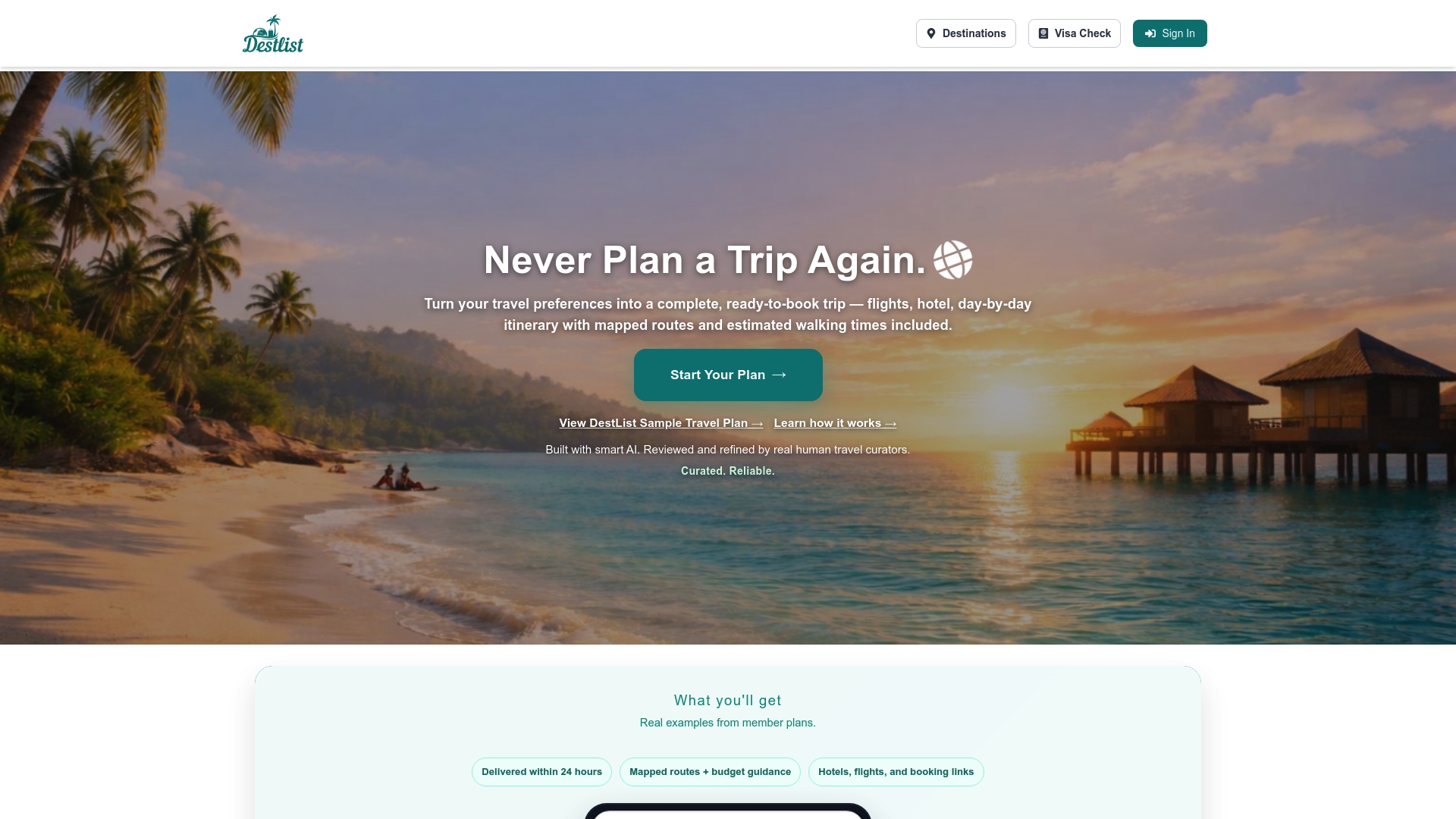
For spontaneous travelers, that means weather alerts built in, refundable-rate options flagged, packing lists generated, and activity reservations identified before you even start searching. No tab-switching marathon, no second-guessing whether you missed a better deal.
- Fast turnaround: ready-to-book plans delivered within 24 hours of your request
- Budget-matched: flights and hotels filtered to your actual spend ceiling
- Flexible by design: on-demand tweaks if your plans shift after booking
- Extras included: packing lists, mapped daily routes, and partner perks
If you want a single trip without a subscription, a one-off plan is available. For travelers who go spontaneous more than twice a year, the subscription pays for itself quickly. Get your custom travel itinerary and leave the logistics to Destlist.
Sources
For the freshest flash deals, check airline and hotel loyalty program pages directly — many publish member-only last-minute rates that never appear on third-party aggregators.