
TL;DR:
- Budget travel segmentation divides travelers into groups based on spending habits, behaviors, and motivations to tailor offers effectively. Marketers should continuously update segments with behavioral data and regional cost differences to improve accuracy and profitability. Prioritizing high-value customers and testing micro-segments enhances marketing efficiency and delivery of relevant travel experiences.
Budget travel segmentation is the practice of dividing travelers into distinct groups based on their spending limits, behaviors, and motivations to create targeted offers that match what each group actually wants. The industry standard term for this practice is travel market segmentation, and defining budget travel segmentation is the specific application of that framework to cost-conscious traveler demographics. A decision tree model achieved 92.5% accuracy in classifying travelers into Budget-Conscious (30%), Moderate (50%), and Luxury-Oriented (20%) categories. That level of precision proves segmentation is not guesswork. For travel marketers, it is the foundation of every profitable campaign and product decision.
What are the main dimensions used to define budget travel segments?
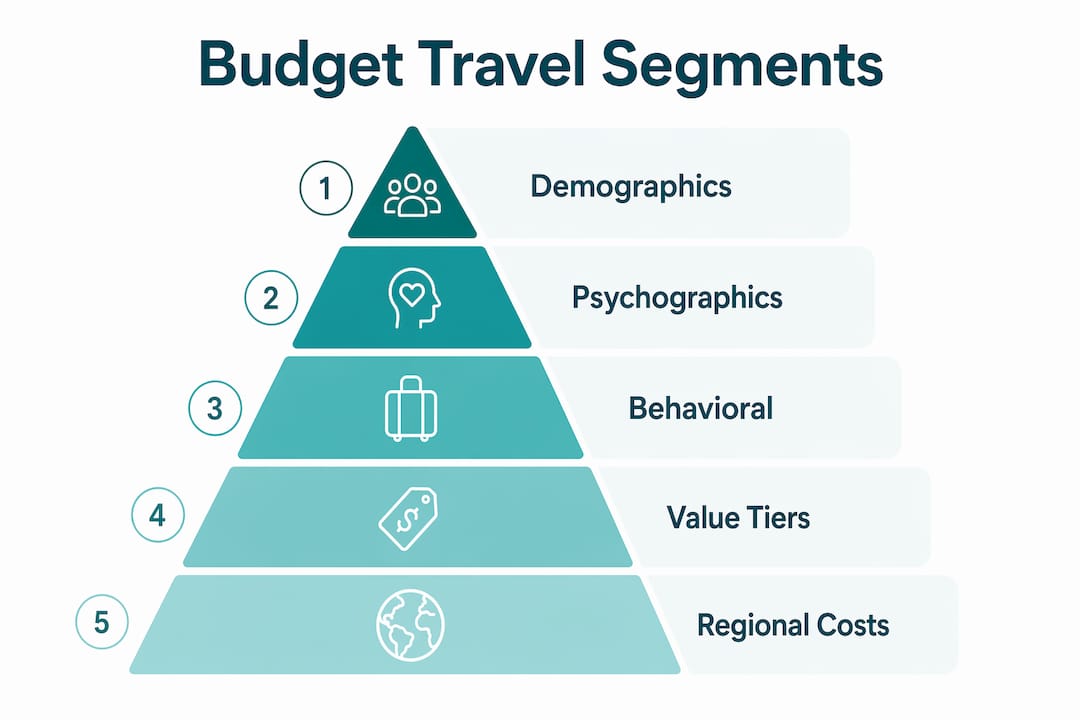
Defining budget travel segments requires more than sorting travelers by income. The most effective frameworks layer four distinct dimensions: demographics, psychographics, behavioral data, and value tiers.

Demographics establish the baseline. Age, household income, and home location all shape what a traveler considers "affordable." A 24-year-old solo traveler from Austin and a 45-year-old parent from New York City may share the same weekly travel budget but have entirely different expectations for what that budget should deliver.
Psychographics reveal motivation. Two travelers with identical incomes may split on whether to spend on a nicer hotel or on more activities. One prioritizes comfort; the other prioritizes experience. Psychographic profiling captures those values and feeds directly into messaging strategy.
Behavioral data is where segmentation gets specific. Booking timelines fall into three clear groups: early planners who book 4–6 months out, mid-range planners at 2–3 months, and last-minute bookers within 30 days. Each group responds to different offers and channels.
Value tiers measure customer lifetime value, not just trip spend. A traveler who books three short trips per year at $800 each is worth more than one who books one $1,500 trip. Segmenting by lifetime value shifts marketing priorities in ways that raw trip-cost data never could.
Regional cost differences add another layer. Daily travel costs range from $12–15 in South Asia to over $50 in Western Europe, with Switzerland and Norway exceeding $200 per day. A "budget traveler" in Bangkok and a "budget traveler" in Zurich are not the same segment. Marketers who ignore regional cost baselines build offers that miss the mark.
| Dimension | What it reveals | Practical use |
|---|---|---|
| Demographics | Age, income, location | Baseline budget range and destination fit |
| Psychographics | Motivations, values | Messaging tone and offer framing |
| Behavioral data | Booking window, frequency | Channel timing and deal structure |
| Value tiers | Lifetime spend | Marketing budget allocation priority |
| Regional cost index | Local price baseline | Realistic budget thresholds by market |
How do cost variables shape budget travel analysis?
Generic daily cost figures mislead both travelers and marketers. Treating travel expenses as distinct categories — flights, accommodation, ground transport, food, and activities — produces far more accurate segmentation than a single daily average.
Here is why that matters in practice:
- Flights often represent the largest single cost and vary wildly by booking window, route, and flexibility. A traveler who books flights early and accepts layovers may free up $300 to spend on accommodation.
- Accommodation is the most emotionally charged category. Budget travelers frequently accept a basic room but will pay a premium for a great location or free breakfast.
- Ground transport costs differ by destination type. A city with strong public transit costs far less than a rural destination requiring car rental.
- Food is the most flexible category. The same traveler may eat street food for six days and splurge on one restaurant meal.
- Activities reveal true traveler priorities. A budget traveler who pays for a cooking class or a guided hike is signaling willingness to pay for experience, not just price sensitivity.
Seasonality compounds every one of these variables. Traveling in low season can cut combined flight and accommodation costs by 40%–60%. Shoulder seasons offer a 10%–20% price drop with good weather and fewer crowds. Marketers who build segmentation models without accounting for travel timing will consistently misread what a segment is actually willing to spend.
Pro Tip: Add a 15%–20% contingency buffer to any itemized budget model. Generic daily cost figures routinely underestimate true expenses, and that gap distorts segment profiling.
For a practical breakdown of how to categorize these costs, Destlist's guide on tracking travel spending walks through the exact categories that matter most for budget planning.
What are effective micro-segmentation strategies for budget travelers?
Micro-segmentation moves beyond broad budget tiers to create traveler profiles precise enough to drive real conversion. Hotels in high-cost cities that target subgroups like weekend escapists or bleisure travelers with specific offers outperform those that compete on price alone. The reason is simple: different pain points drive purchase decisions more reliably than discounts do.
The most productive micro-segments for budget travel include:
- Weekend escapists: Short stays, high convenience needs, willing to pay for walkability and easy check-in. Price is secondary to friction reduction.
- Bleisure travelers: Extending a work trip by one or two days. Their employer covers base costs, so they allocate personal budget to upgrades and experiences.
- Solo adventurers: High flexibility, long booking windows, strong preference for authentic local experiences over branded amenities.
- Budget family travelers: Longest planning windows, highest sensitivity to total trip cost, and strong response to bundled offers that reduce per-person spend.
Behavioral markers sharpen each profile further. Device type signals intent: mobile bookers skew toward last-minute decisions, while desktop sessions correlate with longer research phases and higher average booking values. Length of stay filters out day-trippers from multi-night guests, which changes the entire economics of an offer.
Pro Tip: Pilot each micro-segment with a single offer before scaling. Testing one variable at a time, such as laundry service versus free breakfast, reveals which convenience feature actually drives bookings for that specific group.
Micro-segmentation works best when treated as an ongoing process, not a one-time exercise. Traveler behavior shifts with economic conditions, platform changes, and destination trends. Segments that performed well in 2024 may need recalibration by mid-2026.
For marketers building affordable travel segments around trip purpose, Destlist's resource on budget travel itineraries offers a practical framework for structuring offers by traveler type.
How should marketers allocate resources based on segmentation insights?
Segmentation data is only useful when it drives resource decisions. The most common mistake travel marketers make is allocating budget proportionally to customer volume rather than customer value.
High-value customers representing 20% of a customer base can drive 70% of profit. That ratio justifies a disproportionately larger marketing investment in retaining and expanding that segment, even if it is smaller in headcount.
Practical allocation principles include:
- Prioritize retention over acquisition for high-value segments. The cost to retain a loyal budget traveler is a fraction of the cost to acquire a new one.
- Tailor channel strategy by segment. Direct channels favor packages and loyalty perks for repeat travelers; OTA shoppers respond better to clear price-plus-value offers.
- Customize messaging to segment-specific pain points. A weekend escapist responds to "check in by 2 PM, no hassle" messaging. A bleisure traveler responds to "extend your stay, we handle the rest."
- Track acquisition cost and profitability by segment, not just by campaign. A campaign that drives high volume from low-value segments is a cost center, not a growth driver.
Segmentation also informs product development. If behavioral data shows that a budget segment consistently books activities but skips hotel dining, that is a signal to partner with local experience providers rather than invest in food and beverage upgrades. The data tells you where to build and where to stop spending.
What are common challenges in implementing budget travel segmentation?
The biggest failure mode in budget travel segmentation is over-reliance on demographics. Age and income alone do not predict travel behavior with enough accuracy to build offers around. Behavioral and psychographic data must anchor the model.
- Avoid treating "budget" as a single segment. The gap between a $30-per-day backpacker and a $120-per-day value traveler is enormous in terms of expectations, channels, and messaging.
- Integrate segmentation with CRM and analytics tools. Segments that live only in a spreadsheet do not influence real decisions. The data must connect to booking systems, email platforms, and ad targeting.
- Pilot before scaling. Launching a new segment offer to your entire database before testing it on a subset wastes budget and muddies the data.
- Refresh segments regularly. Seasonal cost shifts and changing traveler demographics mean that a segment defined in january may behave differently by august.
- Balance complexity with operational capacity. Twelve micro-segments are theoretically more precise than three, but only if your team can actually execute twelve distinct offers. Start with four to six and build from there.
The most durable segmentation frameworks combine behavioral data with value-tier analysis and leave room for continuous refinement. Static segmentation models decay quickly in a market as dynamic as travel.
Key Takeaways
Effective budget travel segmentation combines behavioral data, value tiers, and itemized cost analysis to produce traveler profiles precise enough to drive real marketing and product decisions.
| Point | Details |
|---|---|
| Layer your dimensions | Combine demographics, psychographics, behavior, and value tiers for accurate segment profiles. |
| Itemize costs by category | Flights, accommodation, food, transport, and activities each reveal different segment sensitivities. |
| Micro-segment by trip purpose | Weekend escapists, bleisure travelers, and solo adventurers need distinct offers, not just different price points. |
| Allocate budget by value, not volume | The top 20% of customers can drive 70% of profit; weight your spend accordingly. |
| Refresh segments continuously | Seasonal shifts and behavioral changes mean static segmentation models lose accuracy fast. |
What I've learned from watching segmentation done wrong
The travel industry talks about segmentation constantly and practices it poorly. I have watched marketing teams build elaborate demographic models, launch campaigns to "budget travelers aged 25–40," and then wonder why conversion rates stayed flat. The problem is always the same: they defined the segment by who the traveler is, not by what the traveler does.
The most useful shift I have seen is when teams start treating booking behavior as the primary signal. A traveler who books 90 days out, searches on desktop, and reads three destination guides before converting is a completely different customer than one who books on a phone at 11 PM for next weekend. Both might have identical incomes. Only one of them responds to an early-bird discount.
Budget-conscious travelers also do not behave the way the label implies. They often pay premiums for specific conveniences after locking in a low base cost. A traveler who spent weeks finding a $180 round-trip flight will happily pay $40 for a hotel upgrade if it saves them a 45-minute commute. Segmentation models that treat "budget" as uniformly price-sensitive miss that entirely.
The other thing I would push back on is the obsession with discounts as the primary lever. Transparent value communication outperforms discounting in almost every budget segment I have seen tested. Telling a traveler exactly what they get and why it is worth the price converts better than telling them how much they are saving.
— Helen
How Destlist supports budget travel planning at every segment
Destlist builds personalized travel itineraries that account for exactly the kind of cost and behavioral variables that segmentation research highlights.
Whether you are planning for a solo adventurer on a tight daily budget or a bleisure traveler extending a work trip, Destlist matches flights, hotels, and day-by-day activities to the traveler's actual preferences and spending range. The platform delivers curated travel plans within 24 hours, with budget-conscious flight and hotel matching built into every itinerary. For professionals who need a full-service solution, Destlist's done-for-you planning covers every cost category from transport to activities, so no segment detail gets missed.
FAQ
What is budget travel segmentation?
Budget travel segmentation is the practice of dividing travelers into groups based on spending limits, behaviors, and motivations to create targeted marketing offers and products. It applies standard travel market segmentation methodology specifically to cost-conscious traveler demographics.
How many budget traveler segments should a marketer use?
Start with four to six segments based on trip purpose and behavioral data, then expand as operational capacity allows. A decision tree model classifying travelers into three broad tiers achieved 92.5% accuracy, which is a strong baseline before adding micro-segments.
Why does regional cost data matter for budget segmentation?
Daily travel costs range from $12–15 in South Asia to over $200 in Switzerland and Norway. A "budget" threshold means something entirely different depending on the destination, so regional cost baselines must anchor any segment definition.
What behavioral data points matter most for budget traveler profiles?
Booking window, device type, and length of stay are the three most predictive behavioral markers. Early planners who book 4–6 months out respond differently to offers than last-minute bookers who decide within 30 days.
How often should travel marketers refresh their segmentation models?
Segments should be reviewed at least quarterly. Seasonal cost shifts, platform changes, and evolving traveler demographics mean that a segment defined in january may behave measurably differently by the following quarter.