
TL;DR:
- Micro-itineraries focus on deep, themed experiences within 1 to 4 nights, prioritizing quality over quantity. They are increasingly popular in 2026 due to busy schedules, remote work, and demand for meaningful, time-efficient travel. Successful planning involves clear focus, intentional pacing, buffer time, and human curation alongside AI tools.
Most people believe that a truly memorable trip requires at least a week away, a packed bucket list, and endless hours of planning. That assumption is fading fast. Experiential immersion now outranks sightseeing volume for 68% of global travelers in 2026, and the rise of micro-itineraries is proof. Whether you have a long weekend or just 48 hours to spare, a well-designed micro-itinerary can deliver the kind of meaning and refreshment that two-week vacations often fail to provide. This article breaks down what micro-itineraries are, why they work, how to build one, and what mistakes to sidestep.
Table of Contents
- What are micro-itineraries?
- Why micro-itineraries are taking over travel in 2026
- How to design a micro-itinerary: Steps and frameworks
- Common pitfalls and how to avoid them
- Micro-itineraries: What most guides miss
- Take the next step with curated micro-itineraries
- Frequently asked questions
Key Takeaways
| Point | Details |
|---|---|
| Quality over quantity | Focusing on a few immersive experiences delivers more enjoyment than over-booking your time. |
| Personalization is key | Choose themes and activities aligned with your interests for maximum impact. |
| Plan with constraints | Effective micro-itineraries use time and distance limits to avoid overload and ensure feasibility. |
| Leverage expert insights | Human curation and local knowledge still outmatch most AI for truly memorable short escapes. |
| Don’t skip downtime | Scheduling buffer periods is essential to make short escapes rejuvenating rather than exhausting. |
What are micro-itineraries?
A micro-itinerary is a short, tightly focused travel plan built around a single theme or experience rather than a checklist of landmarks. Think of it as quality over quantity applied to travel. Instead of rushing through eight cities in ten days, you spend two nights deeply exploring the food scene of a coastal town or fully unwinding at a mountain wellness retreat.
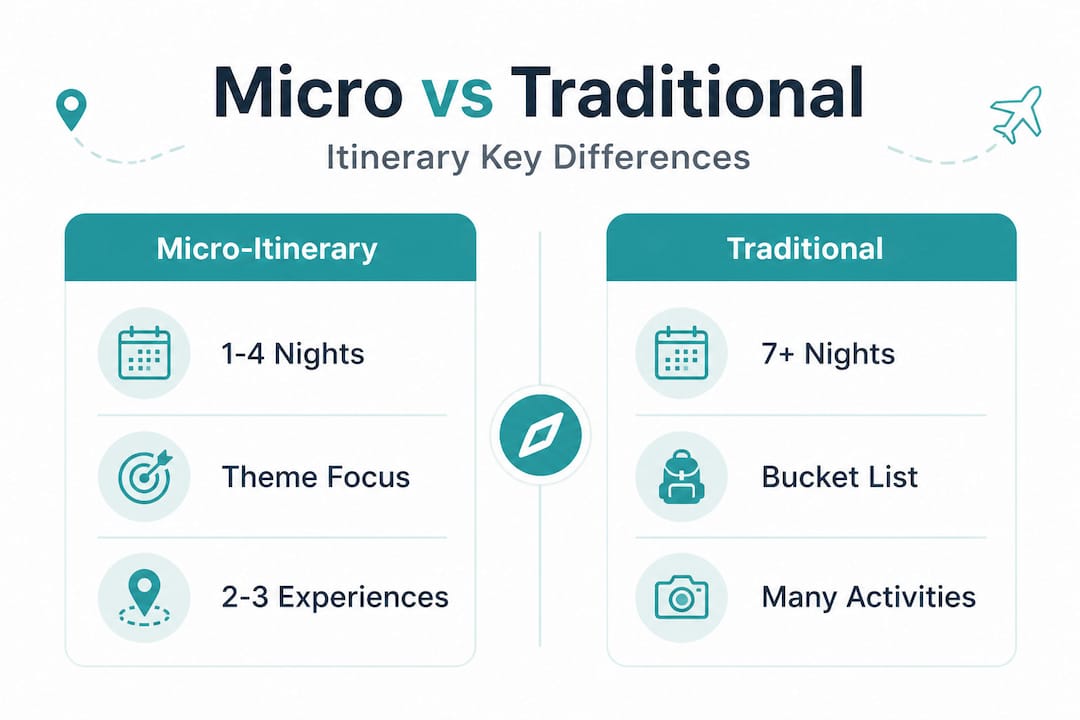
The term is closely linked to "microcations," which various platforms define differently: Expedia counts any trip involving a 24-hour flight, Airbnb defines it as a 1 to 2 day international escape, and the general travel industry lands on four nights or fewer with clear intention behind the visit. The exact length matters less than the mindset: every hour is chosen deliberately.
What separates a micro-itinerary from a traditional trip plan is focus. Traditional itineraries often operate like a catalog of must-see stops. A micro-itinerary narrows the lens. A gastronomy-themed weekend in New Orleans might include one cooking class, two chef-driven restaurants, a market walk, and a distillery tour. That's it. No museum sprint, no rushed cemetery tour, no generic city bus.
To streamline your itinerary process effectively, start by recognizing these core attributes of any micro-itinerary:
- Duration: Typically 1 to 4 nights
- Focus: Built around one central theme (wellness, food, art, nature, culture)
- Personalization: Tailored to your pace, preferences, and energy level
- Flexibility: Includes buffer time and optional add-ons rather than back-to-back obligations
- Intentionality: Every activity earns its place in the schedule
Here's how micro-itineraries stack up against traditional travel plans:
| Feature | Micro-itinerary | Traditional itinerary |
|---|---|---|
| Duration | 1 to 4 nights | 7 to 14+ nights |
| Focus | Single theme or experience | Multiple destinations and landmarks |
| Activity volume | 2 to 4 core experiences per day | 5 to 8+ stops per day |
| Planning time | Hours | Days to weeks |
| Pace | Relaxed and intentional | Often rushed |
| Goal | Meaningful reset or deep dive | Broad exposure and coverage |
| Flexibility | Built-in buffer time | Usually fixed and rigid |
This format resonates because it respects both your time and your energy. You return from a micro-trip feeling recharged rather than in need of another vacation.

Why micro-itineraries are taking over travel in 2026
With the definition clear, it's vital to see why micro-itineraries are rapidly becoming the travel format of choice for busy professionals and leisure travelers alike.
The shift is not purely about shorter attention spans or budget constraints. It reflects a deeper change in how people measure the value of travel. Checklist tourism is giving way to experience-led curation, where travelers would rather sit for three hours at one extraordinary dinner than rush past ten Instagram spots in a single afternoon. The experiences you remember most are almost never the ones you rushed through.
Remote work has also changed the math. When you can work from anywhere, you no longer need to save all your travel for a single annual trip. Instead, you can take four or five intentional short escapes throughout the year. Each one can be themed, seasonal, and curated to exactly what you need at that moment, whether that's adventure, rest, creativity, or connection.
The hospitality industry is catching up quickly. Hotels, tour operators, and local guides are now offering guest experience enhancements specifically designed for short-stay visitors, including curated two-day packages, immersive evening programs, and partnerships with local artisans and chefs. The supply is growing because the demand is undeniable.
Time-efficient travel planning has become just as important as the trip itself. A 2026 traveler does not want to spend 15 hours researching a 48-hour trip. They want a ready-to-use, personalized plan that fits their preferences from the moment they land. That's exactly why the micro-itinerary format has taken hold.
"The best trips aren't the longest ones. They're the ones where every moment was chosen with purpose."
There is also a psychological case for shorter, more frequent travel. Research consistently links anticipation and variety to higher well-being. Four short escapes throughout the year give you four moments of anticipation, four departures from routine, and four distinct sets of memories. A single two-week vacation gives you one.
Pro Tip: When planning a short escape, treat the first two hours after arrival as orientation time rather than activity time. Walk around, eat something local, and let the place settle in before you start your schedule. This small buffer dramatically improves how connected you feel to the destination.
How to design a micro-itinerary: Steps and frameworks
After understanding the appeal and demand, let's break down proven steps to build your own micro-itinerary from scratch.
Step 1: Choose your theme
Every strong micro-itinerary starts with a single organizing idea. Wellness, street food, architecture, hiking, wine, history, nightlife, pottery, photography. Pick one and build everything around it. This is not the trip where you try to "see everything." It's the trip where you go deep on one thing you genuinely love.
Step 2: Set your radius and time frame
Radius-time planning is a framework that prevents overreach in short trips by limiting how far you travel between experiences. A good rule: on a two-day trip, stay within a 15 to 20 minute travel radius between activities. This eliminates dead time spent in transit and keeps your energy focused. Pair this with a realistic time frame. If you're working with 36 hours, that's roughly two mornings, two afternoons, and one evening. Plan for three core experiences total, not six.
Step 3: Identify your non-negotiables
Write down the two or three experiences that would make this trip feel complete. These are your mandatory visits in any optimization model. Everything else is optional. On a food-focused weekend in Chicago, your non-negotiables might be a deep-dish lunch at a beloved neighborhood spot, a private tasting at a natural wine bar, and a Sunday morning visit to the Green City Market. Every other idea is a "nice-to-have" that only enters the schedule if it fits organically.
Step 4: Build in buffer time
This is the step most people skip and later regret. Add 30 to 45 minutes of buffer between every core activity. This time absorbs delays, spontaneous detours, and the kind of unplanned moments that often become the best stories. A buffer is not wasted time. It is the space where travel breathes.
Step 5: Add flex activities
Keep a short list of one or two backup options in case something falls through or you find yourself with extra time. These are low-commitment, easy to access, and thematically consistent with your main focus. You can look at personalized trip plan examples for inspiration on what a well-constructed flex layer looks like in practice.
Here's a real-world scenario: You're planning a two-day wellness escape to Asheville, North Carolina. Your theme is rest and nature. Non-negotiables: a morning forest hike on the Blue Ridge Parkway, a 90-minute massage at a local spa, and a farm-to-table dinner on Saturday night. Flex activities: a visit to a local pottery studio and a Sunday morning yoga class. Buffer time is built in after each block. You land rested, not exhausted.
| Planning type | Radius-time approach | Checklist approach |
|---|---|---|
| Activity spacing | 15 to 20 min travel max | No travel limit |
| Daily activity count | 2 to 3 core | 6 to 10 stops |
| Energy at end of day | Refreshed | Often drained |
| Spontaneity | Encouraged via buffer | Crowded out by schedule |
| Overall satisfaction | High | Variable |
Pro Tip: Limit core experiences to two or three per day. The goal of a micro-itinerary is depth, and depth requires time. Smart AI-assisted planning tools can help you sequence activities logically, but always apply the two-to-three rule manually before finalizing.
Common pitfalls and how to avoid them
To make your micro-itinerary truly successful, let's flag the common errors that can quietly undercut your experience.
Over-ambitious scheduling is the single biggest offender. Travelers often feel that a short trip justifies squeezing in more activities, not fewer. This is backwards thinking. A crowded two-day schedule leaves you more depleted than a full week of normal work. Resist the urge to add "just one more thing."
Inflexible time blocks are the second major trap. Building a schedule with zero margin means one delayed restaurant reservation or one slow museum queue unravels your entire day. Always leave room for the unexpected.
Poor activity curation is subtler but equally damaging. Not every highly-rated activity on a travel app fits your theme, your pace, or your interests. A wellness-focused weekend should not include a three-hour party boat tour just because it has 4.8 stars. Every activity must earn its spot based on your personal priorities, not aggregate ratings.
Here are the most common micro-itinerary slip-ups to watch for:
- Booking more than three core activities per day
- Ignoring travel time between locations
- Choosing activities based on popularity rather than personal fit
- Skipping meal planning (hunger derails more trips than bad weather)
- Failing to check opening hours and reservation requirements in advance
- Relying entirely on AI-generated plans without human review
On that last point: fewer than 10% of AI-generated itineraries from leading large language models achieve human-level performance in feasibility and personalization benchmarks. Even GPT-4o only produces rational, practical plans about 21.5% of the time in rigorous testing. AI is a useful starting point, but it is not a finished product. A comfort-driven itinerary built with human expertise catches the gaps that algorithms miss, like the restaurant that is technically open but requires a six-week advance booking, or the trail that is beautiful in photos but muddy and inaccessible in the spring.
Pro Tip: Schedule at least one "do nothing" block per day on a micro-trip. Sit in a park. Wander without a destination. The best travel memories are often born in unscheduled moments, not programmed ones.
Micro-itineraries: What most guides miss
Most articles about micro-itineraries give you a framework and stop there. Here's the part that rarely gets said out loud.
The real power of a micro-itinerary is not the format. It is the relationship between constraints and creativity. When you have less time, you are forced to ask harder questions: What do I actually want from this trip? What matters to me right now? That kind of intentional self-inquiry is what separates a great short trip from a forgettable one.
There is a growing assumption in the travel industry that more technology equals better planning. The TripTailor benchmark findings showing that fewer than 10% of AI-generated itineraries reach human-level quality should give every traveler pause. Tools like AI platforms are genuinely useful for surfacing ideas, estimating costs, and organizing logistics. But they do not know that you are recovering from burnout and need silence, not stimulation. They do not know that your ideal travel day ends by 9 PM. They do not know the neighborhood that would speak to your specific aesthetic sensibility.
Human curation, whether from a knowledgeable planner, a local expert, or your own honest self-assessment, fills those gaps. If you are exploring Destinations.ai alternatives, look for platforms that combine AI efficiency with genuine human oversight. That combination is where micro-itinerary planning actually works.
The other thing most guides miss: micro-itineraries are not just for solo travelers or couples. Families with young children, groups of friends with different interests, and business travelers with a free evening can all benefit from a focused, deliberately short travel plan. The format adapts. The principle stays the same. Choose less. Experience more.
Take the next step with curated micro-itineraries
You now know what micro-itineraries are, why they work, and how to build one that actually refreshes rather than exhausts you. The gap between knowing the framework and having a ready-to-book plan in your hands is where most people stall.
That's where DestList comes in. Our team blends AI efficiency with hands-on human expertise to create custom travel itineraries that match your theme, pace, preferences, and budget. You get day-by-day activities with mapped routes, estimated walking times, weather alerts, and flight and hotel matches, all delivered within 24 hours. No research rabbit holes. No second-guessing. Just a done-for-you plan that is ready to go. Browse curated travel plans to see what a fully built micro-itinerary looks like before you commit, and find your next intentional escape without the planning headache.
Frequently asked questions
What is the ideal length for a micro-itinerary?
Most micro-itineraries span 1 to 4 nights, with the emphasis on meaningful depth rather than covering lots of ground. The exact length matters less than having a clear theme and intentional structure.
How do I pick the right activities for a micro-itinerary?
Focus on immersive, theme-aligned experiences and limit your schedule to two or three must-dos per day. Since 68% of 2026 travelers prioritize depth over volume, fewer choices made deliberately will always outperform a packed list.
Can I use AI tools to create a micro-itinerary?
AI tools are great for idea generation and logistics, but they work best with human review layered on top. Benchmark research shows fewer than 10% of AI plans reach human-level quality in practicality and personalization, so treat AI output as a draft, not a final product.
Are micro-itineraries suitable for business trips?
Absolutely. Their short, flexible, and personalizable structure makes them ideal for extracting value from limited free time on a work trip. A well-designed evening or day-off plan can turn a routine business visit into a genuinely restorative experience.
What's the main risk of short-trip planning?
Over-packing the schedule is the most common mistake. Too many activities in too little time creates fatigue and defeats the core purpose of a micro-itinerary, which is to leave you feeling more refreshed than when you arrived.
Recommended
- How to tailor trip itineraries for efficient travel
- Top examples of personalized trip plans for effortless travel
- How to customize trips efficiently: methods for busy travelers
- Save time and enjoy more with customized travel itineraries
- Unlock personalized travel: discover unique, immersive journeys