
TL;DR:
- Comfort-driven travel planning prioritizes personal energy and pace over destination highlights, reducing stress and enhancing enjoyment. It employs frameworks like rhythm, flow, and hub-and-spoke models to create seamless, flexible itineraries tailored to individual preferences. This approach aligns with 2026's "Era of YOU," emphasizing personalized, seamless, and comfort-focused experiences for busy professionals.
Most busy professionals plan their vacations the same way they manage a packed work calendar: cram in as much as possible and hope for the best. The result? A trip that leaves you needing another vacation to recover. Comfort-driven planning flips this approach by starting with your energy levels, personal pace, and non-negotiables before a single flight gets booked. This guide breaks down exactly what comfort-driven itineraries are, which frameworks make them work, and how you can use them to travel more and stress less.
Table of Contents
- What is a comfort-driven trip itinerary?
- Core elements: Rhythm, flow, and the hub-and-spoke model
- How personalization boosts comfort and saves time
- 2026 travel trends: The 'Era of YOU' and quiet luxury
- A travel curator's perspective: What most itineraries get wrong about comfort
- Build your comfort-driven itinerary with DestList
- Frequently asked questions
Key Takeaways
| Point | Details |
|---|---|
| Comfort is planned | True comfort comes from methodical itinerary design, not random downtime. |
| Frameworks save time | Using the hub-and-spoke model and guided sequencing can cut hours from planning. |
| Personalization pays off | Choosing your personal pace, rest, and must-haves maximizes trip enjoyment and lowers stress. |
| Trends favor comfort | 2026 travel favors comfort, quiet luxury, and hyper-personalization for busy professionals. |
| Pro help streamlines trips | Expert-built, comfort-driven itineraries let professionals relax and recharge. |
What is a comfort-driven trip itinerary?
A comfort-driven itinerary is not just a relaxed version of a normal trip plan. It is a fundamentally different approach to travel design. Rather than building a schedule around landmarks and must-see lists, defining comfort-driven travel starts with a single question: what kind of experience will leave you feeling restored, not depleted?
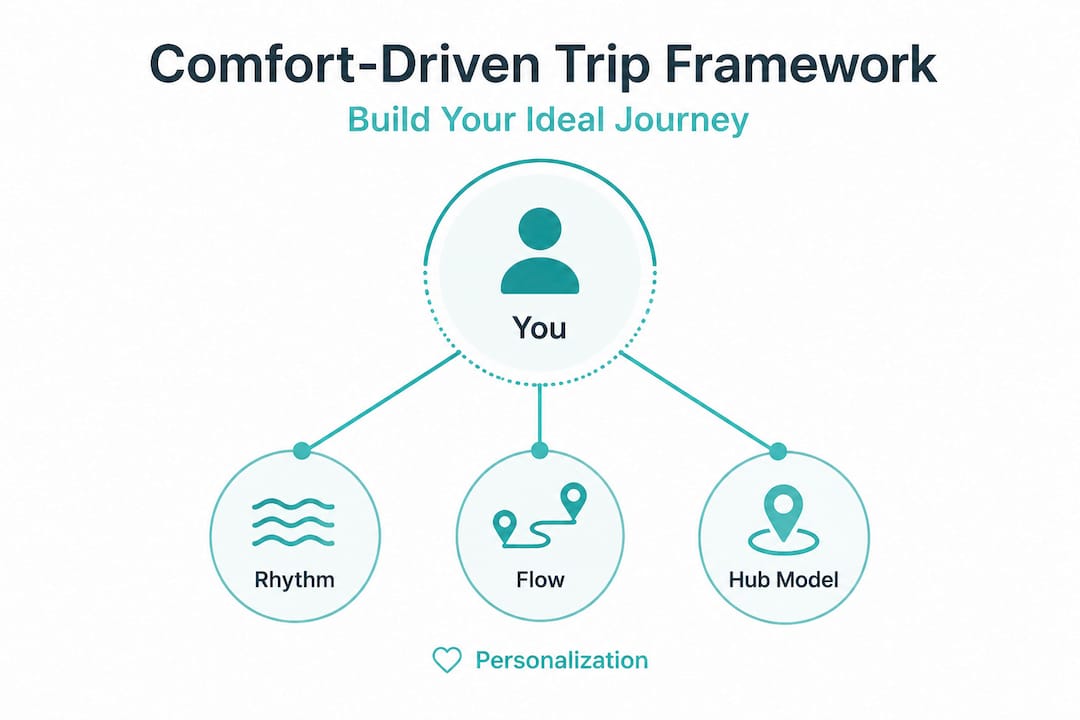
Generic itineraries are built around destinations. Comfort-driven itineraries are built around you. According to travel advisor guidance from Travel and Leisure, the core mechanics include starting with client consultations to define preferences like pace, comfort needs, and deal-breakers, then sequencing activities with rhythm, using hub-and-spoke models to minimize hotel changes, and incorporating private transfers and guides for flexibility.
That distinction matters enormously. When you plan a trip around your rhythm instead of a city's highlights, you stop white-knuckling your way through exhausting days and start actually enjoying the places you visit.
Generic plan vs. comfort-driven plan at a glance:
| Feature | Generic itinerary | Comfort-driven itinerary |
|---|---|---|
| Starting point | Destination attractions | Traveler's pace and preferences |
| Activity volume | Maximize things to do | Balance activity with recovery |
| Accommodation | Lowest price or central location | Matched to needs and comfort level |
| Transport | Cheapest or fastest option | Private or low-stress options |
| Buffer time | Rarely included | Built into every day |
| Flexibility | Fixed schedule | Adapts to energy and mood |
"The best trip isn't the one with the most stamps in the passport. It's the one you actually remember fondly because you were present enough to enjoy it."
Here is what comfort-driven planning actually delivers in practice:
- Reduced decision fatigue during the trip because logistics are handled in advance
- Shorter recovery time after you return home
- More meaningful moments because you have the mental bandwidth to notice them
- Fewer logistical headaches like missed trains, rushed dinners, or last-minute hotel switches
Saving time on travel planning is one of the clearest side benefits. When every element of a trip is designed to work together smoothly, you spend far less time troubleshooting on the ground.
Core elements: Rhythm, flow, and the hub-and-spoke model
Now that we understand what sets comfort-driven itineraries apart, let's look at the specific frameworks that deliver the most comfort in practice. These are not vague concepts. They are repeatable structures that experienced travel planners use on every high-quality itinerary.
Rhythm is the deliberate alternation between high-energy days and low-energy recovery days. Think of it like interval training for your trip. You hike a volcano on Tuesday, but Wednesday is a slow market morning and a long lunch with nothing urgent on the agenda. That contrast keeps your energy sustainable across an entire week or two.
Optimizing trip planning for comfort consistently points back to this principle. According to 2026 travel trend research, smart methodologies emphasize starting trips slowly to combat jet lag, building contrast between high and low energy days, leaving buffer time and genuine downtime, and aligning travel with weather and seasons for maximum comfort. Shoulder seasons, for example, often mean smaller crowds, mild temperatures, and lower prices — all comfort multipliers.
Flow means that transitions between activities feel seamless. No 45-minute scrambles to find a cab. No three-hour gaps between checkout and the next hotel check-in where you're dragging luggage around. A well-designed flow builds in buffer time not as wasted minutes, but as breathing room that protects the rest of the day.
Here is a practical framework for building rhythm and flow into any itinerary:
- Start slow. Schedule no major activities on Day 1 beyond arrival, a short orientation walk, and a relaxed dinner.
- Anchor your energy peaks. Identify your 2 or 3 absolute priority experiences and schedule them for Days 2, 4, and 6 — not back to back.
- Insert pause days. Every 3 full days of activity should be followed by a half-day or full recovery day.
- Build 90-minute buffers. Between any two commitments, especially those involving transport, always schedule at least 90 minutes of unstructured time.
- Limit hard commitments. Cap fixed, time-locked activities at two per day maximum.
The hub-and-spoke model is perhaps the single most underused strategy in travel planning. The idea is simple: you choose one central location as your "hub" and take day trips outward from it rather than continuously moving from city to city. You unpack once, sleep in the same bed, and wake up without the mental overhead of figuring out your new hotel, neighborhood, or city layout.

Pro Tip: When choosing a hub city, prioritize one with strong rail or road connections to nearby towns rather than the most famous destination in the region. You'll often find better value accommodation, quieter streets, and easier logistics than staying in the headline city itself.
Sample hub-and-spoke structure for a 7-day trip in southern Italy:
| Day | Activity | Energy level |
|---|---|---|
| Day 1 | Arrive in Naples, settle in | Low |
| Day 2 | Pompeii day trip by train | High |
| Day 3 | Naples food walking tour, evening free | Medium |
| Day 4 | Amalfi Coast drive | High |
| Day 5 | Rest day: coffee, bookshops, no agenda | Low |
| Day 6 | Capri island day trip | Medium |
| Day 7 | Depart from Naples | Low |
Stress-free trip planning steps consistently show that the hub-and-spoke model reduces packing stress significantly while allowing travelers to cover more ground without burning out.
How personalization boosts comfort and saves time
While structure matters, modern itineraries take comfort further through deep personalization. Structure gives you the skeleton. Personalization gives the trip its personality, and it is where busy professionals gain the most practical benefit.
Consider what full personalization actually covers:
- Hotel matching based on your actual preferences, not just star ratings. That means proximity to key sights for walkability, noise levels, bed quality, and whether you need a workspace.
- Private transfers instead of shared shuttles when you have a tight connection or an early morning flight. The time and stress savings are significant.
- Pause days built specifically around your known patterns. If you always crash on Day 4 of a trip, that day gets light programming before you even depart.
- Meal customization that accounts for dietary preferences, preferred dining times, and whether you want reservations handled or prefer to find spots independently.
- Deal-breaker management where specific things you refuse to do, like guided bus tours, budget hostels, or back-to-back early starts, are simply never included.
The time savings from this level of planning are not trivial. According to Hilton's 2026 travel trends, luxury travelers who book well in advance save between 15 and 20 hours of research time compared to self-planning. That is nearly three full workdays returned to your calendar.
65% of travelers now seek hybrid adventure-comfort trips according to Skift Research 2023, blending active experiences with genuine rest and recovery built into the schedule.
This hybrid approach is particularly relevant for professionals who are used to being "on." The best trips for this group are not purely relaxing spa retreats or purely adventure-filled expedition itineraries. They are carefully calibrated mixes where an active morning gives way to a slow afternoon. Enjoying more with customization is genuinely possible when someone has thought carefully about your specific energy patterns and built the trip around them.
Pro Tip: Before booking anything, write down your three biggest travel complaints from past trips. These are your personal deal-breakers. Any good personalized itinerary should address all three before you ever see a flight option.
Efficient customization methods do not require hours of back-and-forth. The most effective approach is a short intake process that captures pace, comfort priorities, budget parameters, and non-negotiables, and then lets an experienced planner or AI-powered platform do the heavy lifting. Transforming travel planning is less about using more tools and more about using the right inputs upfront to eliminate guesswork downstream.
2026 travel trends: The 'Era of YOU' and quiet luxury
Now that we have seen how personalization enhances any trip, let's put these trends in context for this year specifically. What is driving demand for comfort-driven itineraries right now, and why are busy professionals at the center of it?
The biggest shift in 2026 travel is what Booking.com describes as the "Era of YOU", a travel culture that prioritizes personal comfort, individual preferences, and seamless tech-enabled convenience over mass tourism experiences. This is not a niche preference. It is the dominant direction of the entire industry.
Here is what this trend looks like in practice for professionals:
- Quiet luxury is replacing flashy status travel. Think well-made fabrics, thoughtfully designed boutique hotels, excellent food without Michelin-star theatrics, and transportation that works flawlessly. The goal is quality you feel, not quality you display.
- Technology integration is enabling faster, smarter planning. AI platforms can now match flights, hotels, and daily activity sequences against your stated preferences in minutes rather than days.
- Wellness woven into trips rather than added as an afterthought. This means actual downtime in the schedule, access to fitness or spa facilities if that is your preference, and itineraries that do not require you to sacrifice sleep to see everything.
- Flexible booking structures that allow changes without heavy penalties, because busy professionals know their calendars can shift.
Personalized trip examples across various destinations show a clear pattern: the travelers reporting the highest satisfaction scores are not those who did the most things. They are the ones whose trips matched their personal definition of comfort, whether that meant slow mornings at a lakeside hotel, private vineyard tours with no crowds, or simply not having to figure out airport transfers at midnight.
"Comfort in 2026 isn't about opulence. It's about alignment — trips that match who you are and how you actually travel."
The professionals leading this movement are not necessarily high-budget travelers. They are time-poor travelers who understand that a poorly planned trip is expensive in ways that go beyond money.
A travel curator's perspective: What most itineraries get wrong about comfort
Here is something most travel content will not tell you: the biggest threat to a comfortable trip is not a bad hotel or a delayed flight. It is an itinerary that was built to impress rather than to sustain.
When professionals plan their own trips, they tend to over-research and over-schedule because those are the same skills that make them successful at work. Thorough research, detailed planning, maximum output. But travel is not a project deliverable. Treating it like one is why so many well-planned vacations still feel exhausting.
Real comfort comes from the discipline of saying no. Saying no to the fourth museum because three were already enough. Saying no to the 6am tour when your body needs sleep. Saying no to the "while you're there, you have to see" additions that look harmless on paper but drain the day.
The time-saving planning workflow that experienced travel curators use is built on a philosophy of intentional restraint. Less volume, higher quality, more breathing room. Not every hour needs an activity. Not every city needs three days. Some of the best travel moments happen in the gaps between scheduled events, when you stumble into a neighborhood market or sit at a cafe for two hours because it felt right.
The professionals who take the best trips are the ones who relinquish the productivity mindset at departure and trust that a well-structured, comfort-first itinerary will deliver more than any packed schedule ever could.
Build your comfort-driven itinerary with DestList
Ready to experience a truly comfortable and customized trip? Here is how DestList can help you put these strategies into practice.
DestList builds custom travel itineraries that combine AI-powered matching with real human expertise, delivering ready-to-book trip plans within 24 hours. Every itinerary includes day-by-day activity flows with mapped routes, estimated walking times, budget-matched flights and hotels, and all the logistics handled so you can focus on actually being on vacation. Whether you already know where you want to go or need help choosing, DestList's free trip decision tool matches your mood and budget to the right destination. Browse curated adventure destinations or bring your own destination and let the platform do the planning work for you. Comfort-first travel is not a luxury. It is a decision.
Frequently asked questions
How are comfort-driven itineraries customized for each traveler?
They begin by identifying your ideal pace, rest preferences, energy limitations, and travel deal-breakers, then sequence activities and logistics using hub-and-spoke models, private transfers, and rhythm-based scheduling to support those specific needs.
What are the main benefits of comfort-driven itineraries for busy professionals?
They reduce travel stress, maximize vacation enjoyment, and save 15 to 20 hours of research and planning time compared to self-planned trips.
Is "comfort-driven" planning only for luxury travel?
Not at all. These strategies work at any budget level by focusing on energy management, flexible logistics, and personal comfort rather than price point. Flow and rhythm principles like shoulder-season travel and buffer time cost nothing but planning intentionality.
What is the "hub-and-spoke" model in travel itineraries?
It is a planning strategy where you base yourself in one central location and take day trips outward, so you unpack once and avoid packing stress from constant hotel changes throughout the trip.
Are tech tools being used to create comfort-driven itineraries?
Yes. AI-powered platforms are increasingly central to personalized planning, and the rise of "Era of YOU" travel in 2026 reflects how tech-enhanced convenience is becoming the standard expectation for busy professionals who want smarter, comfort-first trips.
Recommended
- Trip planning guide: save 10+ hours on your next vacation
- How to customize trips efficiently: methods for busy travelers
- Itinerary planning workflow: save 10+ hours per trip
- Streamline your travel planning: expert guide, 8 steps
- Successful work trips: What makes your stay truly work - Guestly Homes
- Unlock personalized travel: discover unique, immersive journeys