
TL;DR:
- Maximizing vacation time involves mapping remaining PTO onto high-ROI bridge days around U.S. federal holidays and submitting early requests with coverage plans. Strategic use of bridge days can turn a small number of PTO days into nearly two months of time off, especially in 2026 with its holiday placements. Proper planning focuses on behavioral habits, such as setting concrete dates and preparation, to ensure you actually take the time off and enjoy a restful break.
The fastest way to organize your vacation days is to map your remaining PTO onto the highest-ROI bridge-day windows around U.S. federal holidays, block those dates on your calendar today, and submit one manager-ready request this week. Everything else is refinement.
Here is where to start right now:
- Audit your PTO balance and confirm your company's observed holidays and any blackout periods.
- Identify 2–3 high-ROI windows around federal holidays where one or two PTO days create a stretch of four or more consecutive days off.
- Block those dates tentatively on your calendar before someone else claims them.
- Draft a one-paragraph coverage note so your manager sees a plan, not just a request.
The U.S. Office of Personnel Management publishes the official federal holiday calendar, and the 2026 layout is unusually generous for bridge-day stacking. According to U.S. Travel Association data, 768 million vacation days went unused in a single recent year. That is not a planning problem. It is a prioritization problem, and the steps below fix it.
Pro Tip: Block at least one high-ROI window on your calendar within 48 hours of reading this. The odds that you actually take the time off drop sharply once you close the tab and return to your inbox.
Table of Contents
- How do you organize vacation days step by step?
- How do bridge days turn federal holidays into longer breaks?
- How do you prepare your team before taking time off?
- What tactics help you stretch PTO across the whole year?
- How do travel costs affect when you should use your PTO?
- Sample 1-year PTO calendars for 10, 15, and 20 days
- What mistakes do people make when planning vacation days?
- Key Takeaways
- Why most people underestimate what good PTO planning actually does
- Ready to turn your blocked dates into a real trip?
- Useful sources and references
How do you organize vacation days step by step?
Follow this four-step sequence once a year, ideally in January or at the start of your company's fiscal year. It takes about 90 minutes total.
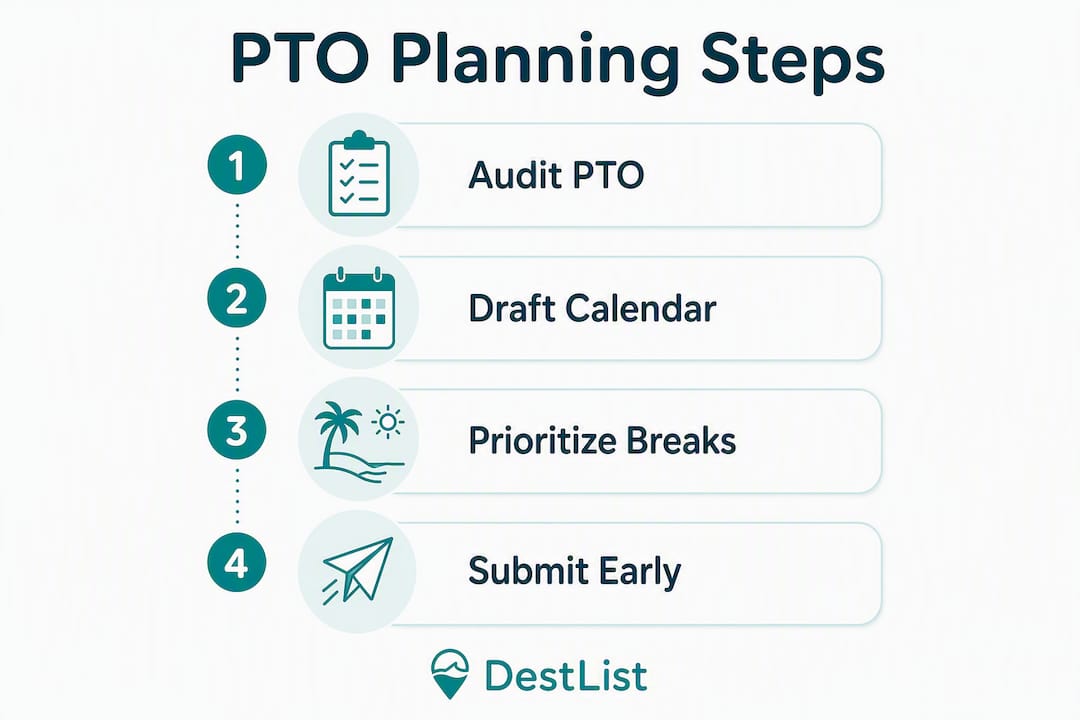
Step 1: Audit your PTO
Pull up your HR portal and confirm three numbers: your current balance, how many days you earn per pay period, and your carryover cap. Then check your company's official observed holiday list. Not every employer observes every federal holiday, and assuming they do is one of the most common reasons requests get denied.
Audit checklist:
- Current PTO balance (hours or days)
- Accrual rate through year-end
- Carryover limit and expiration date
- Company-observed holidays (not just federal)
- Blackout periods (fiscal close, busy seasons)
Step 2: Draft a year-view calendar
Open a blank 12-month calendar (Google Calendar, a printed template, or a spreadsheet) and mark every company-observed holiday. Then circle the Fridays and Mondays adjacent to those holidays. Those adjacent days are your bridge-day targets. Aim for 2–3 longer stretches of 7–10 consecutive days and 3–6 long weekends across the year.

Step 3: Prioritize by what matters most to you
Not every window is worth the same. A week in Europe costs more than a long weekend two states over. Bucket your breaks into three categories: one big trip (7–10 days), two or three medium breaks (4–5 days), and a few long weekends for rest or local travel. Assign your highest-ROI windows to the big trip first, then fill in the rest.
Step 4: Submit early with a coverage plan
Holiday-adjacent requests are competitive. Submit yours well ahead of the window, ideally 4–8 weeks out for popular periods, and even earlier for peak seasons like Thanksgiving or Christmas. Attach a short coverage note every time.
Manager-ready request checklist:
- Exact dates requested (start and return)
- Who covers your key responsibilities
- Status of any in-flight projects
- Emergency contact protocol
- Confirmation that you will be reachable for true emergencies (or not, and who handles it)
Pro Tip: Frame your request around continuity, not absence. "Here is how the team stays on track while I'm out" lands better than "I'd like to take these days off." Managers approve plans, not vacations.
How do bridge days turn federal holidays into longer breaks?
A bridge day is any PTO day you place between a federal holiday and a weekend to create a longer unbroken stretch of time off. The ROI logic is simple: one PTO day adjacent to a Monday holiday gives you four consecutive days off. Two PTO days around a mid-week holiday can yield nine.
Blink's PTO mapping analysis shows that 15 PTO days placed strategically around holidays can create up to approximately 49 days off across a year. Condé Nast Traveler demonstrates a similar approach, showing how a strategic split of 15 PTO days can yield up to 45 days off depending on holiday placements. The math only works if you pick the right windows first.
2026 federal holiday bridge-day opportunities
The OPM 2026 federal holiday calendar places several holidays on high-ROI weekdays. FestiveRadar's 2026 PTO guide and the DEV Community PTO Playbook both flag Memorial Day, Independence Day (observed), and Thanksgiving as the top three windows.
| Holiday | 2026 Date | Day | Bridge-day move | PTO used | Consecutive days off |
|---|---|---|---|---|---|
| Memorial Day | May 25 | Monday | Take Tue May | 1 | 4 (Sat–Tue) |
| Independence Day (obs.) | July 3 | Friday | Take Mon–Thu Jun–Jul | 4 | 9 (early June to early July) |
| Thanksgiving | Nov | Thursday | Take Fri Nov | 1 | 5 (Thu–Mon) |
| Thanksgiving (extended) | Nov | Thursday | Take Mon–Wed Nov + Fri Nov | 4 | 9 (mid-November) |
| Christmas/New Year | Dec 25 + Jan 1 | Friday + Friday | Take Mon–Thu Dec | 4 | 16 (Dec to Jan) |
Key bridge-day principles:
- Always pick the window that yields the most consecutive days per PTO day spent, then move to the next best window with your remaining balance.
- Mid-week holidays (Wednesday) are the hardest to leverage; Monday and Friday holidays are the easiest.
- The Christmas/New Year stretch is the single highest-ROI window in 2026 because two federal holidays fall on Fridays, meaning four PTO days bridge the entire gap.
When you use a PTO optimizer tool, the inputs that matter most are: total PTO balance, which federal holidays your employer actually observes, and your minimum acceptable trip length. The DEV Community's Holiday Optimizer uses a greedy selection method, picking the highest-ROI window first and repeating until the balance runs out.
How do you prepare your team before taking time off?
Preparation is what separates a vacation you actually enjoy from one where you spend three days catching up on Slack. Research from the Seattle Times and workplace experts consistently shows that vacation guilt comes from poor handoffs, not from being away. A named coverage plan removes the guilt and, as a side effect, makes your manager far more likely to approve the request.

Timing your request
Submit holiday-adjacent requests well in advance. For popular windows like Thanksgiving or the Christmas stretch, earlier is always better. For a standard long weekend, a few weeks is usually enough. The key is to go first. Once a teammate claims the same window, your request becomes a negotiation.
Building your coverage plan
A coverage plan does not need to be a formal document. It needs to answer four questions:
- Who owns each of your active responsibilities while you are out?
- What is the current status of anything time-sensitive?
- Who does a client or colleague contact if something urgent comes up?
- What counts as a true emergency, and how do they reach you?
Write those answers in a short email or attach them to your calendar invite. That is the whole plan.
Copy-ready time-off request template
Subject: Time-Off Request — [Your Name] — [Dates]
Hi [Manager's Name],
I'd like to request [X] days off from [start date] through [return date]. Here is the coverage plan:
- [Project/Responsibility A]: [Colleague Name] will handle; I'll brief them by [date].
- [Project/Responsibility B]: Status is [X]; no action needed until [date].
- Urgent contact: [Colleague Name] at [email/phone] for anything time-sensitive.
Happy to discuss if you'd like to adjust the timing. Let me know.
[Your Name]
Keep it short. Managers read the coverage section first. If it is solid, the dates are usually approved without a conversation.
What tactics help you stretch PTO across the whole year?
No single approach works for everyone. Here is a menu of tactics to mix and match based on your travel style, budget, and company culture.
Tactic options:
- Full-week anchor trip: — Protect at least one 7–10 day block for a bucket-list destination. Research from the DEV PTO Playbook suggests restoration benefits peak around 8–10 consecutive days, so this is worth prioritizing even if it uses a larger chunk of your balance.
Tactic comparison
| Tactic | Ease of approval | Cost sensitivity | Rest value | Planning time |
|---|---|---|---|---|
| Bridge days | High | Low to moderate | Moderate | Low |
| Long-weekend stacking | Very high | Low | Moderate | Very low |
| Split-week mini-breaks | Moderate | Moderate | High | Moderate |
| Remote-day buffers | Moderate (policy-dependent) | Very low | Low to moderate | Very low |
| Full-week anchor trip | Moderate | High | Very high | High |
| End-of-year sweep | High | Low | Moderate | Low |
For family travel, the full-week anchor trip and split-week approach tend to work best because they give kids (and parents) enough time to actually decompress. Solo or couple travel is more flexible and benefits most from bridge days and long-weekend stacking, where spontaneity is easier to manage. For short-trip planning, bridge days are the most efficient tool in the kit.
How do travel costs affect when you should use your PTO?
Calendar ROI and cost ROI are not always the same thing. A window that gives you nine days off for four PTO days is only a good deal if you can afford to travel during it. Holiday windows are almost always more expensive.
Timing decisions to factor in:
- Shoulder season savings: Traveling in late April, early September, or early November typically costs 20–30% less than peak summer or holiday windows, even when the PTO math is slightly less favorable.
- Holiday price premiums: Flights and hotels around Thanksgiving, Christmas, and July 4th carry significant premiums. Book these windows 3–6 months out if you plan to travel during them.
- Booking lead times: For peak holiday windows, earlier booking consistently produces lower prices. For shoulder-season trips, 6–8 weeks out is usually sufficient.
- Off-peak flexibility: If you have PTO days that do not align with a high-ROI holiday window, use them in shoulder season. You may get fewer consecutive days off, but the trip costs less and the destinations are less crowded.
The Spokesman-Review's 2026 PTO guide recommends balancing calendar ROI with cost signals and booking lead times. A practical rule: if shifting your trip by one or two weeks saves you 25–30% on flights and hotels, accept the slightly lower PTO-ROI. The money you save is worth more than the extra day off.
Statistic to keep in mind: The U.S. Travel Association reported 768 million unused vacation days in a single year. Most of those days were not lost because people were too busy. They were lost because no one blocked the dates early enough.
For seasonal trip planning, aligning your PTO with shoulder-season windows is one of the most underused moves available to busy professionals.
Sample 1-year PTO calendars for 10, 15, and 20 days
These three calendars show exactly where to place PTO days in 2026 to create the most consecutive time off. All examples assume your employer observes standard federal holidays. If your company does not observe a particular holiday, remove it from the math and shift the PTO days to the next-best window.
10-day PTO plan
| Break | Dates | PTO days used | Consecutive days off |
|---|---|---|---|
| Memorial Day long weekend | Sat May – Tue May | 1 | 4 |
| July 4th extended weekend | Fri Jul 3 – Sun Jul 5 | — | 3 |
| Thanksgiving | Thu Nov – Mon Nov 30 | 1 | 5 |
| Christmas/New Year | Thu Dec 24 – Sun Jan 3 | 4 | — |
| Flex days (2 long weekends) | Various | 4 | 2 × 3-day weekends |
| Total | 10 | — |
15-day PTO plan
| Break | Dates | PTO days used | Consecutive days off |
|---|---|---|---|
| Spring break (bridge) | Mon Mar 30 – Fri Apr 3 | 5 | 9 (late March to early April) |
| Independence Day stretch | Mon Jun – Thu Jul | 4 | 9 (early June to early July) |
| Thanksgiving extended | Mon Nov – Fri Nov | 4 | 9 (mid-November) |
| Flex long weekends (×2) | Various | 2 | 2 × 3-day weekends |
| Total | 15 | Up to 49 |
20-day PTO plan
| Break | Dates | PTO days used | Consecutive days off |
|---|---|---|---|
| Spring trip | Mon Mar 30 – Fri Apr 3 | 5 | 9 (late March to early April) |
| Independence Day stretch | Mon Jun – Thu Jul | 4 | 9 (early June to early July) |
| Fall shoulder trip | Mon Sep 14 – Fri Sep 18 | 5 | 9 (Sat Sep 12 – Sun Sep 20) |
| Christmas/New Year | Mon Dec – Thu Dec | 4 | 16 (Dec to Jan) |
| Flex day | TBD | 2 | 2 × 3-day weekends |
| Total | 20 | — |
Adapting these templates: If your employer does not observe a specific federal holiday, remove that holiday from the bridge-day math. Replace it with the next-best window from the OPM calendar, or use those PTO days for a shoulder-season trip where cost savings offset the lower calendar ROI. For multi-trip planning across 2026, the 15-day and 20-day plans above give you a strong starting framework for creating up to 49 consecutive days off.
What mistakes do people make when planning vacation days?
Most PTO planning failures come down to four recurring errors. Each one has a fast fix.
Common mistakes and quick fixes:
-
Assuming your company observes every federal holiday. Many employers skip Columbus Day, Veterans Day, or others. Pull your HR portal's official observed list before you plan anything. One wrong assumption wastes a PTO day.
-
Not coordinating with teammates. If two people on a small team request the same holiday window, one gets denied. Check with your closest collaborators before you submit. A quick Slack message takes 30 seconds.
-
Saving all PTO for one big trip. A single two-week vacation sounds appealing, but research consistently shows that rest and recovery plateau after about 8–10 days. Two 9-day breaks deliver more total restoration than one 14-day trip.
-
Ignoring travel cost spikes around holiday windows. The bridge-day windows with the best calendar ROI are also the most expensive to travel during. If you book late, the cost premium can make the trip financially painful. Book holiday-window travel at least 3–4 months out.
-
Last-minute requests. Submitting a request two weeks before a popular holiday window is often too late. Someone else already has it. Submit early, submit with a coverage plan, and you will rarely be denied.
-
Letting days expire. If your company has a use-it-or-lose-it policy, set a calendar reminder in October to check your remaining balance. A November sweep of your unused days prevents the December scramble and the forfeiture that follows.
Tracking unused days is straightforward: set a recurring quarterly reminder to check your balance and compare it against your planned breaks. If you are running ahead of plan, add a long weekend. If you are behind, move a planned break earlier.
Key Takeaways
Organizing your PTO around bridge days and federal holidays is the single highest-leverage move for turning a standard vacation balance into significantly more consecutive time off.
| Point | Details |
|---|---|
| Start with an audit | Check your PTO balance, carryover rules, and your company's actual observed holiday list before planning anything. |
| Bridge days multiply time off | One PTO day adjacent to a federal holiday can create four or more consecutive days off; the Christmas/New Year 2026 window yields 16 days for just four PTO days. |
| Submit early with a coverage plan | Holiday-adjacent requests need a named coverage plan attached; this reduces manager objections and vacation guilt simultaneously. |
| Match cost to calendar ROI | Shifting a trip by one to two weeks into shoulder season can cut travel costs 25–30%, which often outweighs the slightly lower PTO-ROI. |
| Destlist turns blocked dates into trips | Once your dates are set, Destlist's custom itinerary service converts them into a ready-to-book plan within 24 hours. |
Why most people underestimate what good PTO planning actually does
Most advice on organizing vacation days treats it as a logistics problem. Block the dates, submit the form, pack a bag. But the real issue is behavioral, not logistical.
The reason 768 million vacation days went unused is not that workers are too busy. It is that unblocked time off does not feel real. A vague intention to "take a trip this summer" competes with every urgent thing in your inbox and loses every time. A blocked date with a flight booked does not.
What the bridge-day approach gets right is that it forces a decision. You pick a specific window, you do the math, you see that four PTO days become nine consecutive days off, and suddenly the trip feels worth the effort of planning. That concreteness is what moves people from "I should use my PTO" to actually using it.
The coverage plan matters for a different reason than most people think. Workplace research shows that vacation guilt is not really about the work. It is about the handoff. When you leave a named person in charge of each responsibility, you stop being the single point of failure. The guilt dissolves because the risk dissolves. That is why the coverage note is not optional. It is the thing that makes the vacation actually restful.
One habit worth building: set aside 90 minutes at the start of each year, or each quarter, to map your PTO against the holiday calendar. Treat it like a budget review. You would not let your financial accounts go unreviewed for 12 months. Your time off deserves the same attention.
Ready to turn your blocked dates into a real trip?
Once your PTO dates are set, the next problem is the trip itself. Most people spend more time planning a vacation than they spend on it, which defeats the point.
Destlist is built for exactly this moment. You have the dates. You know roughly where you want to go. Destlist's custom itinerary service takes your preferences, budget, and travel style and delivers a complete, ready-to-book trip plan within 24 hours. Flights, hotels, day-by-day routes, walking times, and weather alerts are all included. The done-for-you planning option goes further, handling the full logistics so you show up and travel.
You can absolutely follow the DIY calendar plan in this article and book everything yourself. But if you would rather spend those hours on something else, Destlist removes the friction between "dates blocked" and "trip confirmed." One note: always confirm your employer's observed holidays before booking non-refundable travel. Company calendars and federal calendars do not always match.
Useful sources and references
The claims and sample calendars in this guide draw from the following authoritative sources:
- U.S. Office of Personnel Management — Federal Holidays: Primary source for all 2026 federal holiday dates and weekday placements used in the bridge-day table and sample calendars.
- U.S. Travel Association — Unused Vacation Days: Source for the 768 million unused vacation days statistic cited in the opening and Key Takeaways.
- Blink — How to Maximize Paid Time Off: PTO mapping analysis and the 15-day/49-days-off worked example supporting the bridge-day strategy.
- Condé Nast Traveler — How to Turn 15 PTO Days into 45 Days of Vacation: Consumer-oriented illustration of the bridge-day math and sample schedule approach.
- DEV Community — The 2026 PTO Playbook: Source for the greedy bridge-day selection method and the restoration-benefit insight around 8–10 consecutive days.
- Spokesman-Review — How to Get the Most Days Off in 2026: Guidance on balancing calendar ROI with travel cost signals and booking lead times.
- Seattle Times — Vacation and Workplace Coverage Guidance: Reporting on vacation guilt, coverage plans, and the behavioral factors that affect whether workers actually take their PTO.