
Structure every travel day around fixed anchors, a 3-activity cap, geographic grouping, and a short backup list. That single sentence is the whole method. Everything else in this guide is just the detail behind it.
Here's the core checklist you can copy right now:
- Lock anchors first: flights, lodging, major transfers, and any pre-booked experiences
- Cap each day at three priority activities: one anchor, one secondary, one optional
- Group by location, not interest: cluster activities within the same zone to cut transit
- Build in buffers: add 20–30 minutes between activities for transit and the unexpected
- Keep a backup list: two or three low-effort alternatives per zone for when plans shift
That's the blueprint. The rest of this guide unpacks each rule, gives you day templates you can copy, and shows when it makes sense to hand the whole job to a planner.
Key Takeaways
Structured travel days consistently outperform improvised ones because anchors, geographic grouping, and a backup list eliminate the three biggest sources of on-the-ground friction: wasted transit, decision fatigue, and plan collapse when something goes wrong.
| Point | Details |
|---|---|
| Lock anchors first | Book flights, lodging, and ticketed experiences before planning any flexible activities. |
| Cap each day at three activities | One anchor, one secondary, one optional; drop the optional when the day runs long. |
| Group by geography | Cluster activities within a 20–30 minute transit radius to cut backtracking and save energy. |
| Build a backup list per zone | Two or three low-effort alternatives per zone prevent wasted time when plans shift. |
| Destlist automates the structure | Destlist's AI-assisted, human-reviewed plans apply these rules to produce ready-to-book itineraries within 24 hours. |
Table of Contents
- 1. Start with fixed anchors and a three-phase planning timeline
- 2. Group activities by geography and choose lodging that cuts transit
- 3. Design your daily rhythm with the 3-activity rule and split-day model
- 4. Build a three-layered itinerary with a compact backup list
- 5. Practical tools and confirmations to keep travel days on track
- 6. What to book when and how to handle cost checkpoints
- 7. Copyable day templates and two sample itineraries
- 8. When AI-assisted planning applies the same rules at scale
- The one habit that actually changed how I travel
- Destlist builds the plan so you don't have to
- Sources
1. Start with fixed anchors and a three-phase planning timeline
The first move in planning effortless travel is separating what's non-negotiable from what's flexible. Fixed anchors are the items that define your trip's skeleton: flights, accommodation, long-distance transfers, and any ticketed or time-sensitive experiences. Everything else gets layered in around them.
MAKJournal recommends counting your trip in days, not nights, and marking arrival and departure days as half-days from the start. A flight landing at 3 PM is not a full sightseeing day. Treating it as one is how itineraries fall apart by day two.
A simple three-phase timeline keeps booking decisions from piling up:
Phase 1: Early commitments (3–6 months out) Book flights, accommodation for every night, and any high-demand experiences (popular tours, timed-entry museums, restaurant reservations at sought-after spots). Lock these before anything else.
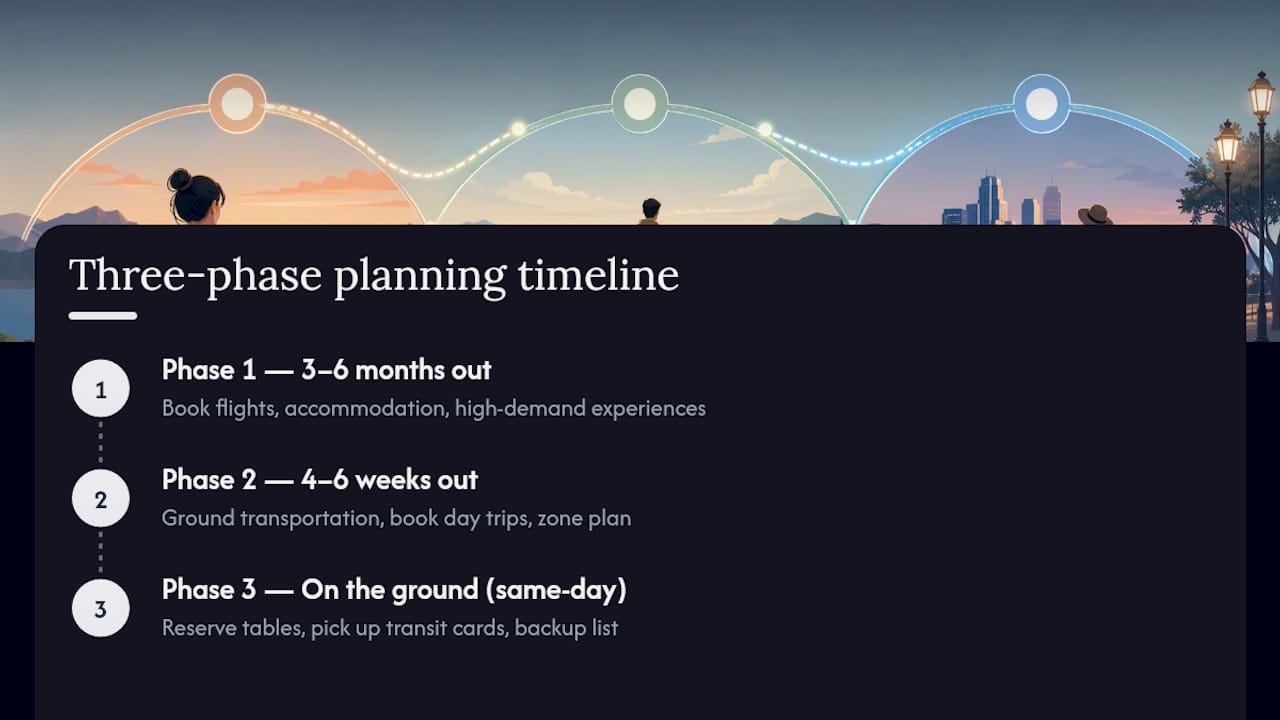
Phase 2: Mid-planning (4–6 weeks out) Confirm ground transportation between cities, book day trips or guided experiences, and finalize your day-by-day zone plan. This is when you assign activities to specific days.
Phase 3: On-the-ground decisions Reserve same-day restaurant tables, pick up transit cards, and make any spontaneous additions from your backup list. Keep this phase light. If Phase 1 and 2 are solid, Phase 3 is just fine-tuning.
Planning buffer guideline: Add extra time beyond your initial estimate for any transit to allow for delays and unexpected conditions. Maps show travel time under ideal conditions. Real travel rarely is.
2. Group activities by geography and choose lodging that cuts transit
The single biggest time-waster in travel is backtracking. Visiting a museum on the east side of a city in the morning, then a market on the west side at noon, then a viewpoint back east in the afternoon turns a pleasant day into a commute.

The fix is simple: plan by zone, not by category. Instead of grouping "all art museums" into one day, group "everything within 20 minutes of the old town" into one day. This geographic approach reduces decision fatigue on the ground and keeps energy where it belongs.
How to zone a day in practice:
- Open a map (Google Maps, Apple Maps, or any offline app like Maps.me) and drop pins for every activity you're considering.
- Draw rough circles with a 20–30 minute transit radius around natural clusters.
- Each circle becomes one day's zone.
- Choose lodging that sits inside or adjacent to your highest-priority zone.
Pro Tip: When evaluating hotels, search from the activity cluster outward, not from the city center inward. A hotel that's a 10-minute walk from your main zone beats a "central" hotel that's 35 minutes from everything you actually want to do.
Quick do/don't list for lodging selection:
- Do: check transit time from the hotel to your anchor activity for each day
- Do: confirm the hotel is walkable to at least one meal option
- Don't: book the cheapest option without mapping its distance to your day's zone
- Don't: assume "city center" means convenient for your specific itinerary
Pro Tip: Use scheduling sightseeing efficiently as a workflow: map first, book second. Never reverse that order.
3. Design your daily rhythm with the 3-activity rule and split-day model
The 3-activity rule is the most practical constraint in trip planning. Each day gets one anchor activity (the thing you'd be disappointed to miss), one secondary activity (good to do, not critical), and one optional activity (drop it without guilt if the day runs long). That's it.

MAKJournal's guidance on the split-day model pairs well with this: one meaningful activity in the morning, a genuine midday break, and one activity in the late afternoon. The break is not optional padding. It's the mechanism that keeps the second half of the day enjoyable rather than a slog.
Alternating intensity matters across days, not just within them. A day at a fast-paced city market followed by a museum followed by a rooftop bar is high-intensity. The next day should be lower: a slow breakfast, one neighborhood walk, an afternoon at a café. Plan at least one genuinely slow day for every five to six days of travel.
Jet lag and meal timing adjustments:
- On arrival days, anchor your first meal to the local time, not your home timezone. Eating at local meal times accelerates adjustment faster than any supplement.
- Avoid scheduling your anchor activity for the first morning after a long-haul flight. Use that morning as a buffer. Your second day is when you're actually ready.
- Keep dinner reservations flexible for the first two nights. Jet lag affects appetite unpredictably.
Energy load tip: Before finalizing each day, rate it on a simple 1–3 scale: 1 = slow/restorative, 2 = moderate, 3 = high-intensity. A well-structured week rarely has more than two consecutive 3-rated days.
4. Build a three-layered itinerary with a compact backup list
A realistic itinerary is built to survive disruption. The structure that holds up in practice has three layers:
Layer 1: Confirmed anchors These are booked, ticketed, or time-locked. They don't move. Examples: a timed museum entry, a cooking class, a ferry departure.
Layer 2: Preferred activities These are your planned secondary and optional items. They're researched and ready, but not booked. If the day runs long or weather turns, you drop from this layer first.
Layer 3: Backup list Two or three low-effort, weather-flexible alternatives per zone. Think: a covered market, a neighborhood café, a bookshop, a short scenic walk. These require no advance booking and no energy to execute.
Building your backup list:
- Pick one indoor option per zone (museum, gallery, food hall)
- Pick one spontaneous option (a neighborhood you haven't mapped yet, a local market)
- Pick one low-energy option (a café with good reviews, a park bench with a view)
When a day goes sideways, use this three-step reset:
- Assess: What's actually broken? A delayed opening, bad weather, or a missed connection each requires a different response.
- Drop the lowest-priority item: Your optional activity goes first. Your anchor stays unless it's physically impossible.
- Re-anchor: Pick one item from your backup list that fits the time and energy you have left. Commit to it and move.
The goal isn't to rescue the original plan. It's to end the day with something worth remembering.
5. Practical tools and confirmations to keep travel days on track
The best itinerary in the world fails if you can't access it when you need it. TravelBuzzy recommends choosing your format based on trip complexity: Google Docs for most travelers (reliable, shareable, offline-capable with pre-loading), TripIt when you have many bookings to consolidate, and Notion for complex multi-destination trips where you need linked databases and checklists.
Whatever format you choose, save an offline copy before you leave. Screenshots of confirmation emails, downloaded maps, and a PDF of your itinerary cover you when you're in a basement restaurant with no signal.
Confirmations checklist (run this 48 hours before each travel day):
- Confirmation numbers for every booking that day
- Pickup location and instructions for any transfers
- Opening hours double-checked (they change seasonally)
- Visa, ID, or entry requirements for any border crossings
- Emergency contact for each accommodation
Packing basics: The 3-3-3 packing rule is a useful starting heuristic for carry-on trips: three tops, three bottoms, three pairs of shoes. It forces decisions before you leave rather than at the airport. For longer trips, the principle still applies: build around a core of versatile pieces and add destination-specific items only when genuinely needed.
Pro Tip: Screenshot your confirmation emails and save them to a dedicated phone album labeled by date. When you're standing at a hotel desk at midnight after a delayed flight, you don't want to be searching your inbox. See also digital reservation practices for what to keep and how to organize it.

6. What to book when and how to handle cost checkpoints
Booking order matters as much as booking timing. The sequence that keeps days flowing is: flights first, accommodation second, major ticketed activities third, everything else flexible.
TravelBuzzy's itinerary format guide reinforces this order because each layer depends on the one before it. You can't choose a hotel zone until you know your arrival airport. You can't book a day tour until you know which nights you're in each city.
Timing windows for common bookings:
- Flights: 2–6 months out for international, 1–3 months for domestic
- Accommodation: immediately after flights, especially for peak season or small properties
- High-demand experiences: as soon as dates are confirmed
- Ground transport between cities: 4–6 weeks out
- Day tours and local activities: 2–4 weeks out
- Restaurants: 1–2 weeks out, or same-day for casual spots
Cost checkpoints to watch:
- Lock non-refundable rates only after your flights are confirmed and unchangeable
- Keep accommodation refundable until 2–3 weeks before travel when possible
- Budget a small contingency (roughly 10–15% of your daily spend estimate) for transit delays, last-minute upgrades, or a backup activity that costs money
- Itinerary styles that save money often come down to one thing: booking the expensive anchors early and keeping the flexible layer cheap
Pro Tip: Set a calendar reminder 72 hours before each non-refundable cancellation deadline. Missing that window on a hotel you end up not needing is an avoidable cost.
7. Copyable day templates and two sample itineraries
These three templates follow the six-element format recommended by TravelBuzzy: date, zone, anchors, flexible options, meal plan, and transit logistics. Copy them into a Google Doc, and fill in your specifics.
Template A: City exploration day
- Morning (9–12): Anchor activity (timed entry or guided experience)
- Midday (12–2): Lunch in zone, rest or short walk
- Afternoon (2–5): Secondary activity (neighborhood, market, gallery)
- Evening (5–7): Optional activity or backup list item
- Dinner (7+): Pre-researched restaurant in zone
- Transit: Walk or one transit leg; no cross-city moves
Template B: Transfer or arrival day
- Morning: Pack, check out, confirm transfer details
- Transit block: Full transfer with buffer time built in
- Arrival: Check in, orient to neighborhood, no anchor activity
- Evening: One low-key meal near accommodation
- Backup: Neighborhood walk or nearby café
- Note: Mark this as a half-day in your energy load rating
Template C: Slow or restorative day
- Morning: Late start, local breakfast, no schedule
- Midday: One optional activity (market, park, short walk)
- Afternoon: Unstructured time, reading, café
- Evening: Early dinner, early night
- Backup: Any item from your zone backup list
- Energy load: 1 (restorative)
Sample itinerary 1: City day in a dense urban destination
Sample itinerary 2: Intensive transfer day
Transfer days are possible but unforgiving. Compact multi-destination travel works when transport is pre-booked, transfer times are realistic, and ID or entry requirements are confirmed in advance. Underestimating taxi costs or missing a passport requirement can collapse the whole day.
8. When AI-assisted planning applies the same rules at scale
The rules in this guide aren't just DIY heuristics. They're the same constraints that well-designed AI planning systems enforce algorithmically.
Google researchers describe a two-stage hybrid approach: a large language model proposes an initial itinerary, then an optimizer grounds it against real opening hours, transit times, and feasibility constraints. The LLM is strong at qualitative choices (the best time to visit a viewpoint, a kid-friendly restaurant) but weaker at hard logistical constraints. The optimizer fixes that gap. The result is a plan that's both appealing and actually executable.
The trip-optimizer open-source project takes this further with an autoresearch pattern: the system proposes plan mutations, scores them across weighted dimensions (experience quality, logistics, food, time management, budget, accommodation, transit), keeps only improvements, and discards the rest. It also maintains a persistent debrief memory so future plans improve based on what worked and what didn't. That's the same iterative logic a good human planner uses after a few trips.
For readers weighing DIY against a done-for-you option, data-driven itinerary building tends to outperform manual planning on one specific dimension: feasibility. Human planners underestimate transit time and overestimate how much fits in a day. Algorithms don't.
Pro Tip: If you hire a planner or use an AI-assisted service, ask three specific questions: Does the lodging placement reflect the day's geographic zone? Is each day capped at three priority activities? Does the plan include a backup list per zone? A planner who can answer all three is applying the same rules this guide teaches.
The one habit that actually changed how I travel
Most travel stress doesn't come from bad destinations or bad weather. It comes from plans that were never designed to absorb reality.
The single habit that made the biggest difference: locking anchors before anything else, then building a backup list for every zone before leaving home. Not a vague mental note. An actual written list, two or three items per zone, sitting in the same document as the itinerary. When something goes wrong on the ground, which it will, the decision is already made. You're not scrambling. You're just picking from a list you already trust.
The planning mantra worth keeping: anchors hold the day; backups save it.
Itinerary structure isn't about control. It's about creating enough certainty that the spontaneous moments feel like gifts rather than gaps. The travelers who seem effortlessly relaxed on the road are almost always the ones who did the most deliberate planning before they left.
Destlist builds the plan so you don't have to
Planning a trip this way takes real time. Mapping zones, researching backups, checking opening hours, confirming transit logistics across multiple cities: done properly, it's several hours of focused work per destination.

Destlist handles all of it. The platform combines AI-assisted itinerary building with human curator review to produce ready-to-book trip plans within 24 hours. Every plan includes map-based routing, day-by-day activity sequencing with realistic transit times, lodging matched to your zone and budget, weather alerts, and a packing list. The geographic grouping, the 3-activity cap, the buffer times: those rules are built into every plan Destlist produces, not left to chance.
It's the right option when you're short on planning time, managing a complex multi-destination trip, or traveling with a group where coordinating preferences manually becomes its own project. For travelers who want the structure this guide describes without spending a weekend building it, get a custom travel itinerary from Destlist and have a ready-to-use plan in your inbox by tomorrow.
Sources
- Optimizing LLM-based trip planning
- How to Build a Realistic Travel Itinerary Without Overloading Your Schedule - MAKJournal
- Travel Itinerary Format: Full 2026 Guide — TravelBuzzy
- michaelpersonal/trip-optimizer