
How trip analytics shapes revenue, personalization, and operations
Trip analytics is the practice of collecting, analyzing, and applying travel-related data to drive smarter business decisions across the entire travel sector. For airlines, hotels, online travel agencies, and tour operators, it has moved well past reporting into genuine competitive infrastructure. Leading brands like Marriott, American Airlines, Hilton, and Agoda now use trip analytics to set prices in real time, predict what individual travelers want before they ask, and catch operational problems before they become customer complaints.
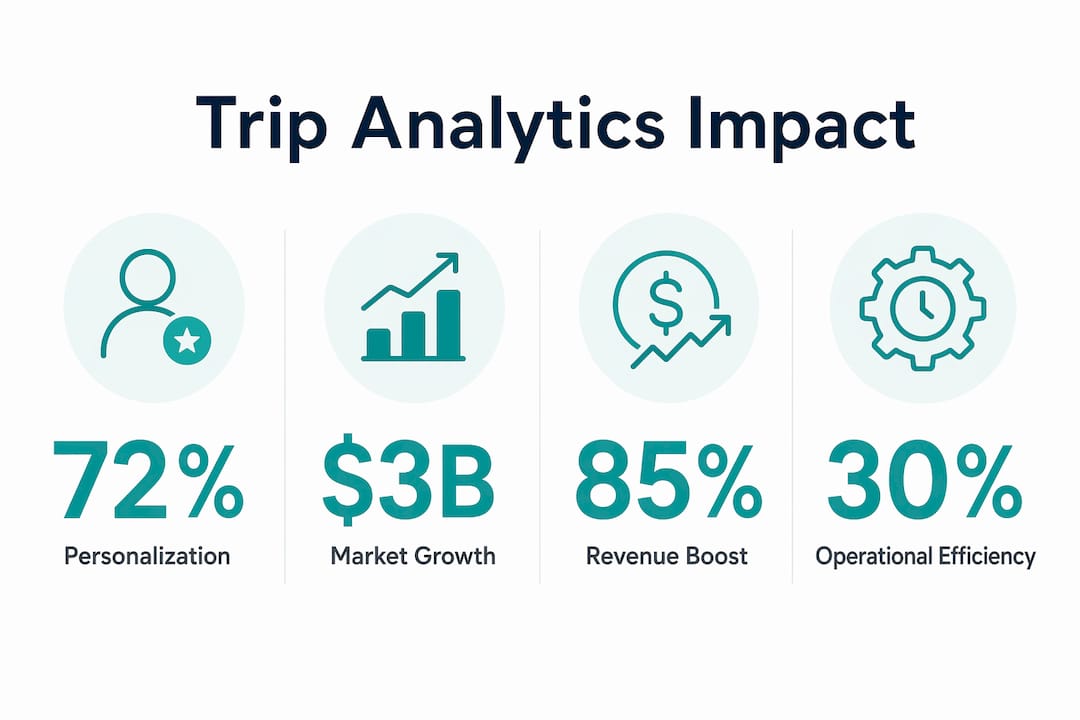
The commercial stakes are clear. A 2024 Deloitte study found that 80% of consumers prefer brands offering personalized experiences, and those consumers spend 50% more with such brands. Dynamic pricing strategies built on trip data can increase revenue by 15–25% without changing base services. These are not marginal gains.
Here is what trip analytics actually delivers across the travel sector:
- Revenue growth through dynamic pricing calibrated to demand, booking windows, and competitor rates
- Personalization at scale by matching offers to individual traveler preferences, past behavior, and group composition
- Operational efficiency by predicting delays, optimizing staffing, and reducing aircraft or room inventory waste
- Loyalty program performance by identifying which benefits drive repeat bookings versus which ones members ignore
- Risk management through fraud detection and disruption forecasting
What types of data and analytics do travel companies actually use?
Travel companies draw from a wide mix of internal and external data sources, and the combination matters as much as any single feed.
Internal data sources include booking records, loyalty program activity, transaction histories, customer service logs, and in-app behavioral signals. External data covers competitor pricing, social media sentiment, weather forecasts, economic indicators, and third-party datasets from providers like OAG, which maintains historical flight data spanning 20 years.
The analytics methods applied to this data fall into four categories:
- Descriptive analytics explains what already happened: which destinations performed best, which booking windows drove the most revenue, where conversion dropped.
- Diagnostic analytics goes a level deeper, uncovering why something happened. Diagnostic tools can reveal the causes behind abandoned searches rather than simply flagging that abandonment occurred.
- Predictive analytics uses historical patterns to forecast future demand, traveler preferences, and operational risk. Travel companies using predictive analytics see a 30% improvement in customer retention and a 20% increase in profitability.
- Prescriptive analytics recommends specific actions: adjust this price, surface this offer, reroute this aircraft.
Beyond these four types, travel companies increasingly rely on trip preference analytics, a more granular approach that maps individual traveler preferences across group size, past destinations, spending patterns, and timing. Agoda, for example, applies behavioral and transactional data to surface destination recommendations that reflect what a specific traveler has already demonstrated they value, not what the average user books.
Pro Tip: Don't treat social media data as a soft signal. Sentiment analysis using natural language processing on review platforms can identify specific rooms, routes, or service touchpoints generating complaints before those complaints compound into rating damage.
Key use cases where travel analytics delivers measurable results
Dynamic pricing and revenue management
Revenue management teams at airlines and hotels use machine learning models to adjust prices continuously based on demand signals, booking windows, competitor rates, and even weather forecasts. The 15–25% revenue lift from data-driven dynamic pricing comes from matching rates to segment price sensitivity rather than applying blanket adjustments. Hotels that implement these strategies can experience noticeable revenue increases, according to industry benchmarks from travel analytics practitioners.

Personalized recommendations and trip planning
Over 70% of customers expect companies to consider their unique needs. Recommender systems built on machine learning analyze age, travel history, group composition, and stated preferences to deliver real-time offers that feel tailored rather than templated. Marriott uses this approach to personalize the guest experience across its properties, surfacing room upgrades, dining offers, and local activity recommendations based on what a guest has chosen on previous stays. Agoda applies similar logic to its search and recommendation engine, using behavioral and booking data to prioritize results that match a traveler's demonstrated preferences.

Ancillary revenue optimization
American Airlines has built analytics programs specifically around ancillary revenue, identifying which passengers are most likely to purchase seat upgrades, baggage add-ons, or lounge access based on booking class, route, and past purchase behavior. The airline also developed a delay prediction system that analyzes weather patterns, aircraft positioning, crew scheduling, and historical delay data, achieving 80% forecast accuracy. That accuracy allowed schedule adjustments and resource reallocation that pushed customer satisfaction scores to 77% within a single year.
Customer segmentation and loyalty program optimization
Loyalty programs generate enormous volumes of behavioral data, and most programs underuse it. Analytics applied to loyalty data can distinguish between members who are genuinely engaged and those who are passively accumulating points with no intent to redeem. Hilton uses segmentation models to identify high-value guests and tailor communications, upgrade offers, and benefit structures to each segment rather than broadcasting the same promotion to its entire member base.
Near-miss and abandoned booking analysis
Analyzing "almost booked" data such as abandoned searches and price sensitivity reveals friction points that traditional booking metrics miss entirely. A traveler who searches a route three times but never completes the booking is telling you something specific about price, availability, or checkout friction. Recovering those near-misses through targeted follow-up offers or UX fixes can move conversion rates without touching acquisition costs.
Fraud detection and risk management
Predictive models flag unusual booking patterns that signal potential fraud, such as multiple reservations from a single IP across different payment methods. Airlines use the same predictive infrastructure to identify flights at risk of delay due to crew scheduling conflicts or aircraft routing constraints, enabling proactive passenger communication rather than reactive damage control.
Operational efficiency and staffing
Hotels analyze check-in patterns, length-of-stay data, and room preferences to calibrate staffing levels and inventory allocation. Properties that apply sentiment analysis to guest reviews and respond quickly see a 12% increase in positive reviews. Car rental companies and transportation providers use GPS and demand data to anticipate fleet needs around events, reducing both shortfalls and idle inventory.
How travel companies build an analytics strategy that actually works
Most travel organizations that struggle with analytics are not short on data. They are short on focus. The most effective approach starts with foundational KPIs: revenue trends, booking funnel conversion rates, and customer acquisition costs. Chasing complex attribution modeling before those basics are solid produces dashboards that look impressive and inform nothing.
The staged maturity model works like this:
- Stage 1: Establish clean data pipelines and measure core booking and revenue KPIs consistently
- Stage 2: Add diagnostic analytics to understand why conversion or retention metrics shift
- Stage 3: Build predictive models on top of a validated historical data foundation
- Stage 4: Integrate prescriptive recommendations into CRM, pricing, and marketing systems
Integration is where most programs stall. Analytics that lives in a separate reporting tool, disconnected from the CRM and the marketing platform, produces insights that nobody acts on. The goal is a unified data environment where a behavioral signal from a loyalty app can trigger a pricing adjustment or a personalized email without a manual handoff.
Travel companies also face three structural challenges that no analytics platform solves automatically:
- Data silos between reservation systems, loyalty platforms, and ancillary booking tools prevent a complete view of the traveler
- Privacy and compliance requirements under frameworks like GDPR and CCPA in California constrain how behavioral data can be stored, shared, and used for targeting
- Skill gaps between data science teams and the operational staff who need to act on analytics outputs
The hotel check-in workflow is a practical example of where analytics integration breaks down in hospitality. Front desk staff often have no visibility into the guest preference data that the analytics system has already surfaced, so the personalization potential never reaches the guest.
Pro Tip: Start your analytics program by picking one business problem with a clear financial metric attached to it, such as reducing booking abandonment on mobile checkout. Solve that problem completely before expanding scope. Narrow wins build the organizational trust that funds broader analytics investment.
What emerging trends are reshaping trip analytics in 2026?
AI and machine learning are moving from experimental to operational
The Trip Basket Analysis Platform market reached $1.12 billion in 2024 and is forecast to hit $3.46 billion by 2033, growing at a CAGR of 13.8%. That growth reflects a shift from descriptive reporting tools to AI-powered platforms that aggregate flight, hotel, car rental, and activity data into a single view of the traveler's decision-making process. Real-time recommendations, dynamic bundling, and automated pricing adjustments are now table stakes for enterprise travel platforms.
Post-trip analytics is the most underused retention lever
Post-trip behavioral signals captured in the 7–30 day window after a traveler returns home predict future bookings more accurately than pre-trip engagement data. A traveler who opens a travel app to browse similar destinations within two weeks of returning has a fundamentally different retention profile than one who only opens a promotional email. Yet most travel apps allocate less than 20% of their analytics resources to this phase, according to Phocuswright research.
The reason is structural. Capturing post-trip behavior requires unified user profiles that connect pre-booking, in-trip, and post-trip data across a single customer record. Most CRM systems were not built for that kind of longitudinal tracking across trip cycles. Platforms that solve this integration problem gain a measurable retention advantage.
Pro Tip: Build a cohort of travelers who browsed new destinations within 30 days of their last trip and compare their 12-month booking frequency against your general base. That single cohort analysis will tell you more about your retention opportunity than any satisfaction survey.
Sustainability and wellbeing analytics are becoming business requirements
Travel analytics now supports corporate sustainability goals by automating carbon footprint reporting and tracking employee wellbeing through connectivity and travel pattern data. For corporate travel managers, this is no longer optional. Large enterprises face ESG reporting requirements that demand granular travel emissions data, and analytics platforms that can generate that data automatically are replacing manual reporting processes. Destlist's approach to eco-friendly travel planning reflects how this sustainability lens is extending into consumer-facing trip planning as well.
Unified traveler profiles are the next competitive frontier
The most sophisticated travel analytics programs in 2026 are not building better individual models. They are building better data architectures. A unified traveler profile that connects search behavior, booking history, in-trip app usage, post-trip engagement, and loyalty activity gives every downstream model a richer input. Airlines, hotel groups, and online travel agencies that achieve this integration can personalize across the full trip lifecycle rather than at isolated touchpoints.
Key Takeaways
Trip analytics drives measurable revenue, retention, and operational gains when travel companies connect data across the full customer lifecycle rather than optimizing isolated touchpoints.
| Point | Details |
|---|---|
| Personalization drives spending | A 2024 Deloitte study found consumers who receive personalized experiences spend 50% more with those brands. |
| Dynamic pricing lifts revenue | Data-driven pricing strategies increase revenue by 15–25% without changing base services. |
| Post-trip window is critical | The 7–30 day period after travel predicts future bookings more accurately than pre-trip engagement data. |
| Analytics maturity requires stages | Start with foundational KPIs like conversion and acquisition costs before building predictive models. |
| Market growth signals urgency | The Trip Basket Analysis Platform market is forecast to reach $3.46 billion by 2033 at a 13.8% CAGR. |
Plan your next trip with data-backed precision
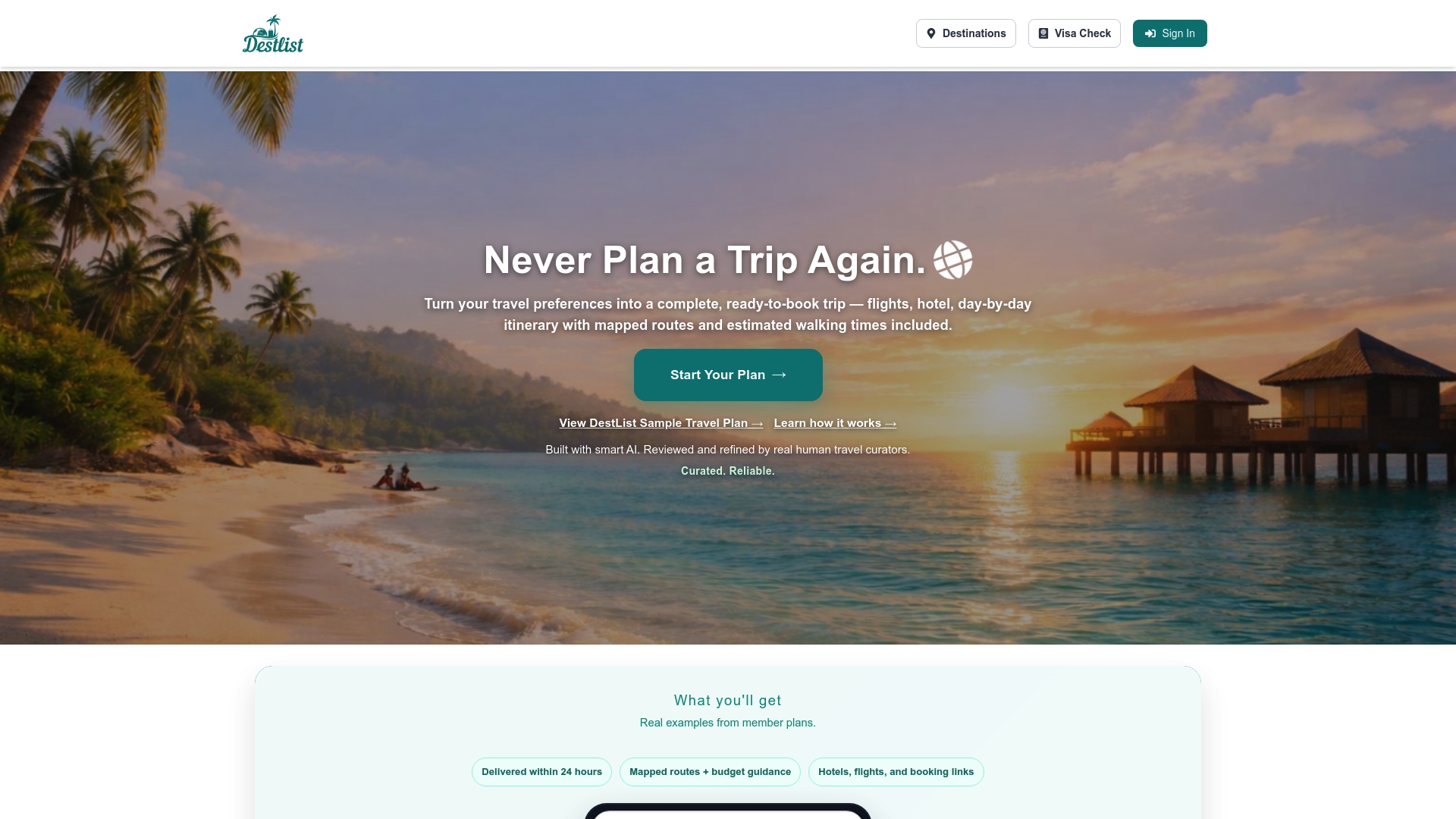
The same principles that drive analytics at Marriott and American Airlines apply at the individual trip level: knowing your preferences, matching them to the right options, and removing friction from the planning process. Destlist applies AI and human expertise to do exactly that, turning your travel preferences into a ready-to-book itinerary delivered within 24 hours. From flight and hotel matching to day-by-day activity planning with mapped routes, every detail is calibrated to how you actually travel. Explore curated travel plans built around your budget, pace, and destination goals.