
TL;DR:
- A structured travel experience mapping list transforms scattered trip ideas into a coherent plan that considers emotions, logistics, and key touchpoints. Using 4-7 well-defined stages and personalizing maps before group planning enhances trip satisfaction and minimizes overlooked details. Digital tools and habitually updating live documents ensure continuous improvement, making travel more intentional and memorable.
Most travelers come home with a vague sense that something was off. Too rushed here, too idle there, a missed restaurant, a skipped neighborhood they'd been meaning to see. The problem isn't poor taste. It's a missing travel experience mapping list. Structured mapping transforms scattered trip ideas into a coherent plan that tracks not just where you're going, but how each stage will feel, what you might miss, and where the best moments are likely to happen. This guide breaks down 10 practical techniques to help you map smarter, travel better, and remember more.
Table of Contents
- Key takeaways
- What makes a travel experience mapping list actually work
- 10 travel experience mapping lists and techniques explained
- Comparing the top mapping techniques at a glance
- How to personalize and implement your mapping list
- My honest take on travel experience mapping
- Let Destlist do the mapping for you
- FAQ
Key takeaways
| Point | Details |
|---|---|
| Start with a defined persona | Focus your map on one traveler type and specific trip scenario to keep it useful and readable. |
| Use 4-7 stages for clarity | Keeping journey phases concise prevents maps from becoming unmanageable and ensures follow-through. |
| Emotions reveal priorities | Tracking emotional highs and lows shows you exactly where to invest more planning energy. |
| Combine logistics and feelings | Linking practical checklists to emotional outcomes produces a map that genuinely improves your trip. |
| Keep your map a living document | Update it before, during, and after travel to capture real feedback and improve future trips. |
What makes a travel experience mapping list actually work
Most travelers underestimate the criteria that separates a useful map from a pretty-looking chart that collects digital dust. According to core mapping elements, a functional travel experience mapping list should include defined stages, specific traveler actions, touchpoints, emotional responses, and identified pain points for each phase of the trip.
Here's what that looks like in practice:
- Persona and scenario clarity. Mapping too broad of a scenario makes the map unreadable and non-actionable. Focus on one type of traveler (solo adventurer, family of four, couple on a long weekend) and one specific trip segment, not an entire month abroad.
- 4 to 7 journey stages. More than seven phases creates analysis paralysis. Fewer than four misses too much. Good stages might be: Pre-trip planning, departure day, transit, arrival and first impressions, core experiences, and return.
- An emotions layer. Emotion curves reveal the emotional valleys in a trip, the moments where frustration, boredom, or anxiety tend to spike. These are your improvement priorities.
- Pain points and opportunities. Without an explicit opportunity column, your map stays stuck at analysis. Effective journey maps include ownership and prioritization so insights actually translate into decisions.
- Touchpoints. These are the specific interactions that shape experience: booking platforms, airport signs, hotel check-in, local transport. Each one is a chance to succeed or fail.
Pro Tip: Low-fidelity mapping (sticky notes, a simple spreadsheet) often produces better insights than polished digital templates because it encourages faster iteration focused on emotions and pain points rather than visual design.
10 travel experience mapping lists and techniques explained
1. Step-by-step itinerary route mapping
This is the most practical place to start. Route visualization with Google My Maps helps you spot geographical inefficiencies before they become wasted hours. Plot every activity on a map, color-code by day, and you'll immediately see if you're crisscrossing the city unnecessarily. This is also the fastest way to identify which activities cluster naturally together for a more logical flow. For a guide on building this visually, map-based trip planning walks through the process step by step.

2. Map of Firsts
One of the most underused techniques in personal travel documentation. A Map of Firsts tracks milestone experiences, your first solo trip, first time eating street food in Southeast Asia, first overnight train, first time navigating a city without using your phone. Each entry includes a photo, a note, and the date. It works as a travel milestone diary that goes far beyond location pins, and it gives you something to review and build on before planning your next trip.
3. Emotional journey mapping
This is where most travelers leave enormous value on the table. Draw a simple line graph with your trip stages on the X axis and your mood or energy on the Y axis. Fill it in during the trip, not after. You'll quickly discover patterns: mornings abroad tend to be your high-energy peak, long transit days drain you more than expected, or back-to-back museum visits flatline your enthusiasm. Travel emotional well-being research ties trip satisfaction directly to challenge, community, and escape dimensions, which means your emotional map is also a tool for redesigning future trips around the experiences that actually energize you.
4. Logistics checklist integration
The logistics checklist is not the glamorous part of a travel adventure checklist, but skipping it costs more than time. Organize your pre-trip checklist by category: documents and visas, money and payments, bookings confirmations, health and medications, and on-the-day essentials. Time-phased checklists work best when categorized and spread across multiple weeks before departure, not crammed into the night before. The key upgrade here is linking each logistical item to a potential experience outcome. A missed travel adapter doesn't just mean no phone. It means a stressful first morning and a worse first impression of the destination.
5. Experience dimension prompts
Before designing any day of travel, run it through three experience filters drawn from emotional well-being research: challenge (does this push me slightly out of my comfort zone?), community (does this connect me with locals or other travelers?), and escape (does this give me genuine distance from daily routine?). A trip heavy on logistics and light on these dimensions will feel exhausting rather than restorative. Build at least one activity per day that scores well on at least two of these filters.
6. Time-phased preparation checklist
Think of your trip in phases: six weeks before, three weeks before, one week before, the day of departure, during transit, arrival day, and return. Each phase has its own set of tasks and emotional characteristics. Treating them as distinct chapters means you never arrive at departure day realizing you forgot to notify your bank or research local transport from the airport. Pair this checklist with your emotional journey map so you can anticipate your anxiety peaks and schedule calming buffers accordingly.
7. Anchor and recovery day planning
This technique comes from structured trip design and solves one of the most common travel mistakes: overpacking a schedule until every day feels like a sprint. Anchor and recovery planning means every day has one non-negotiable anchor experience, the one thing you came for, followed by lighter activities that allow for recovery, spontaneity, or rest. If the Louvre is your anchor on Tuesday, your afternoon should be a slow walk and a long lunch, not three more museums. This approach is especially useful for trips of five or more days where energy management becomes as important as activity selection. For busy professionals traveling on tight schedules, comfort-driven itinerary planning applies this logic directly.
8. Individual mapping before group alignment
If you're planning with a partner, family, or friends, do your own travel experience mapping list first before comparing with anyone else. Individual mapping before group alignment surfaces all perspectives and prevents the loudest voice in the room from defaulting everyone to their preferences. Each person maps their ideal stages, must-do moments, and anticipated frustrations separately, then the group compares. The overlap becomes your shared anchor experiences. The gaps become negotiation points. This produces a far more honest and satisfying group itinerary than going straight into a shared document.
9. Digital tools for interactive mapping and sharing
Static PDFs and paper lists lose context fast. Digital tools let you annotate, update, share, and iterate. Google My Maps handles spatial route mapping. Notion or Airtable work well for multi-column experience logs where you can track stages, emotions, and logistics side by side. For real-time collaboration with travel companions, shared boards allow everyone to contribute observations during the trip, not just before it. Grounding your map in real traveler reviews and feedback also sharpens its accuracy. Evidence-based mapping consistently outperforms maps built purely on assumptions about how a trip will unfold.
10. Personalized trip experience log
This is your post-trip document, but it's worth setting up before you leave. Create a simple trip experience log with columns for date, activity, emotional rating (1 to 5), what worked, what didn't, and what you'd change. Fill it in nightly, even in three sentences. By the time you get home, you have a complete record that becomes the foundation for your next map. Linking logistics to emotional outcomes in this log means you can see exactly which planning decisions produced the best experiences and which ones created unnecessary friction.
Comparing the top mapping techniques at a glance
| Technique | Best for | Main strength | Tools needed | Emotional focus |
|---|---|---|---|---|
| Route mapping | All travelers | Avoids geographical inefficiency | Google My Maps | Low |
| Map of Firsts | Solo and repeat travelers | Milestone memory tracking | Photos, notes app | Medium |
| Emotional journey map | All travelers | Identifies highs and lows | Pen and paper | Very high |
| Logistics checklist | First-timers, families | Prevents avoidable disruptions | Spreadsheet | Low |
| Experience dimension prompts | Those wanting depth | Ensures meaningful activities | Mental framework | High |
| Time-phased prep checklist | Anxious planners, busy pros | Reduces pre-trip stress | Any checklist app | Medium |
| Anchor and recovery planning | Multi-day trips | Manages energy and flow | Itinerary tool | Medium |
| Individual before group mapping | Group travel | Surfaces all preferences | Separate notes | Medium |
| Digital interactive mapping | Tech-comfortable travelers | Real-time updates and sharing | Notion, Airtable | Medium |
| Trip experience log | All travelers | Builds future trip intelligence | Notes app | High |
How to personalize and implement your mapping list
Choosing the right combination of these techniques depends on your trip length, travel style, and how much planning energy you're willing to invest. Here's how to put it together without overcomplicating it:
- Match depth to trip length. A three-day city break needs a route map, a logistics checklist, and an emotional log. A three-week backpacking trip deserves the full stack: anchor planning, experience dimension prompts, and the individual mapping process.
- Combine emotional and logistical layers. Treating logistical misses as testable risks to experience quality is the mindset shift that makes maps genuinely useful. A missed restaurant reservation isn't just an inconvenience. It's a data point about where your planning had a gap.
- Use your itinerary tool as the backbone. Attach your emotional map and checklist to your day-by-day itinerary so everything lives in one place. Tools for tailoring itineraries efficiently make this integration much faster to set up.
- Validate with real feedback. After each trip, review your log and ask: where did the plan match reality and where did it diverge? Use those answers to update your mapping template before the next trip.
- Prioritize energy, not just time. Your map should tell you not just what you're doing and when, but how demanding each block of time is. Cluster physically intense activities when you know you'll be fresh and save passive experiences for low-energy moments.
Pro Tip: Start your next trip with just three lists: a route map, an emotional journey template, and a logistics checklist. Once those feel natural, add the deeper techniques like anchor planning and experience dimension prompts.
My honest take on travel experience mapping
I've built travel maps that looked genuinely impressive and taught me almost nothing. Packed with color-coded stages, elaborate emotional curves, and twelve columns of data. The problem was that they became the point rather than the tool. After enough trips, I learned that the best maps are living documents you update on the road, not polished presentations you finish two weeks before departure.
What I've found actually changes trips is the emotional layer combined with the logistics layer. Travelers who track only logistics end up with trips that run on time but feel hollow. Travelers who track only emotions end up with beautiful intentions and chaotic days. The combination is what produces the kind of trip you still talk about three years later.
I've also noticed that most group travel disasters trace back to the same root cause: no individual mapping before the group sat down together. One person's "easy hiking day" is another person's emergency. Map separately first. It's a ten-minute exercise that prevents a week of low-grade resentment.
On the tech side, I'm genuinely enthusiastic about AI-assisted planning, but cautiously. AI is excellent at surfacing route inefficiencies and checklist gaps. It's not yet good at knowing that you need a slow morning after a red-eye or that one member of your group hits a wall after two museums. That emotional intelligence still comes from you. Build the map. Use AI to pressure-test it, not replace it.
— Helen
Let Destlist do the mapping for you
Building a travel experience mapping list from scratch takes time that most travelers simply don't have. Destlist's planning platform does the heavy lifting by combining AI analysis with expert curation to produce day-by-day itineraries that already account for pacing, route logic, and experience variety. Every plan includes mapped routes, estimated walking times, curated activity suggestions, and budget-matched accommodation.
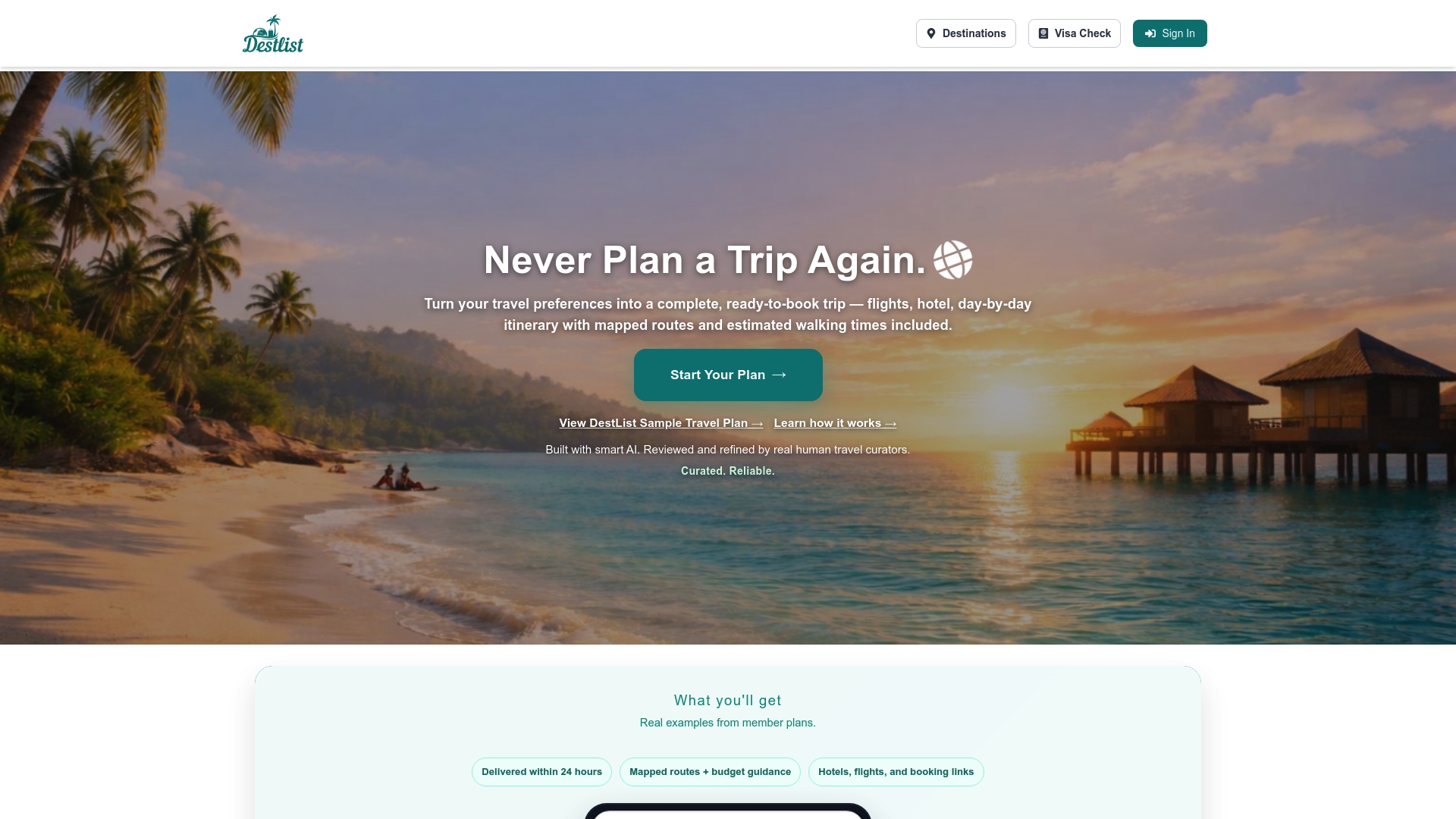
If you want a ready-to-use starting point for your next trip, browse Destlist's curated 7-day itineraries across dozens of destinations and travel styles. Or if your trip has specific requirements, the custom itinerary builder lets you input your preferences and get a complete, ready-to-book plan within 24 hours.
FAQ
What is a travel experience mapping list?
A travel experience mapping list is a structured document that organizes your trip into stages and tracks actions, emotions, touchpoints, and pain points for each phase. It helps you plan more intentionally and identify where your trip is likely to succeed or fall short.
How many stages should a travel map include?
Most experience mapping guides recommend 4 to 7 stages for a practical travel map. Fewer than four loses important nuance, while more than seven creates a document that's too complex to act on during actual travel.
What is the most important element of a travel experience map?
The emotional layer is the most revealing element. Tracking emotional highs and lows across trip stages shows you which moments need more planning attention and which activities genuinely deliver satisfaction versus just filling time.
Can I use a travel experience map for group trips?
Yes, and it's especially useful for groups. Map your ideal experiences individually before comparing with travel companions. This approach surfaces each person's priorities and prevents one traveler's preferences from overriding everyone else's without discussion.
Do I need special tools to build a travel experience mapping list?
No special tools are required. A spreadsheet or even a handwritten chart covers the basics. For collaborative or multi-destination trips, digital tools like Notion or Google My Maps add real value through sharing and real-time updates.