
TL;DR:
- A travel workflow combines AI automation with human review to create personalized, validated trip plans quickly.
- Structured stages reduce errors, improve customization, and increase traveler satisfaction by about 40 percent.
A travel workflow is a structured, step-by-step process that moves a trip from vague idea to confirmed itinerary, combining AI-powered automation with human judgment at each stage. Think of it as the planning equivalent of a recipe: every ingredient has a place, every step has a sequence, and nothing gets skipped. The core elements typically include:
- Inquiry handling: capturing your travel preferences, dates, and budget
- Destination research: matching your interests to real options
- Budget allocation: distributing spend across flights, hotels, and activities
- Route mapping: sequencing stops for logical, low-friction travel
- Itinerary validation: checking transport schedules, booking windows, and feasibility
- Plan delivery: presenting a ready-to-book trip with clear next steps
Platforms like Destlist apply exactly this kind of structured workflow, using AI to draft personalized itineraries and human curators to verify every detail before it reaches you.
Table of Contents
- What are the key components and benefits of a travel workflow?
- How does combining AI and human expertise improve your trip plan?
- How to create a travel workflow that actually works for your trip
- Travel workflows make personalized, stress-free trips possible
- What do personalized AI-powered travel workflows look like in practice?
- What challenges come up in travel workflow automation, and how do you solve them?
- How travel workflows change the way you experience trip customization
- Key Takeaways
What are the key components and benefits of a travel workflow?
A well-built travel workflow breaks planning into distinct, manageable stages rather than one overwhelming task. Each stage has a clear input and output, which is what separates a real workflow from a rough to-do list.
The components that matter most:
- Inquiry qualification: confirming budget realism, travel dates, and group needs before any research begins
- Destination and activity research: pulling options that genuinely match your preferences, not generic top-ten lists
- Budget allocation: distributing your total spend across categories so nothing gets crowded out
- Booking coordination: sequencing flights, hotels, and transfers in the right order to avoid conflicts
- Itinerary validation: cross-checking transport schedules and local conditions before finalizing
The benefits compound quickly. Workflow automation handles repetitive tasks like confirmation emails and payment reminders, freeing up time for the decisions that actually require your attention. Custom itineraries built through structured workflows yield approximately 40% higher traveler satisfaction compared to standard packages. Better budget management is another concrete gain: when allocation happens at the workflow stage, overspending on one category doesn't blindside you at checkout.
AI accelerates the research and drafting phases dramatically. A multi-agent AI structure assigns specialized tasks to different agents, producing validated, budget-aware itineraries far faster than any single generalist model could. Human oversight then catches what AI misses: a hotel that looks perfect on paper but sits in a noisy district, or a day schedule that's technically possible but exhausting.
How does combining AI and human expertise improve your trip plan?
The hybrid approach is where modern travel planning gets genuinely interesting. AI drafts an itinerary quickly, pulling from destination databases, pricing data, and your stated preferences. A human curator then refines it, handling the ambiguous preferences AI struggles with ("I want something relaxing but not boring") and verifying real-world feasibility.
Here's why that division of labor works:
- AI handles volume and speed: hundreds of options filtered to a shortlist in seconds
- Human review catches errors AI can't: outdated transport schedules, seasonal closures, local nuances
- Together, they preserve spontaneity while cutting planning time significantly
Most "AI travel planner" tools are actually a single mega-prompt that hallucinates fluently. Effective systems use multiple specialized agents with strict validation rules. Destlist's content creator Helen brings exactly this kind of on-the-ground expertise to the review stage, catching the gaps that a purely automated system would miss. For a deeper look at how this works in practice, the hybrid travel planning guide on Destlist's blog walks through the full model.
Pro Tip: Ask any AI travel tool how it validates transport schedules and booking availability. If it can't explain a real-time check, treat its itinerary as a first draft, not a final plan.

The first response after you submit a travel inquiry matters more than most travelers realize. Travel professionals consistently flag the first hour as critical: a quick acknowledgment, clear next steps, and a realistic timeline set the tone for the entire planning relationship. Destlist's workflow is built around this, delivering a ready-to-book itinerary within 24 hours of your initial request.
How to create a travel workflow that actually works for your trip
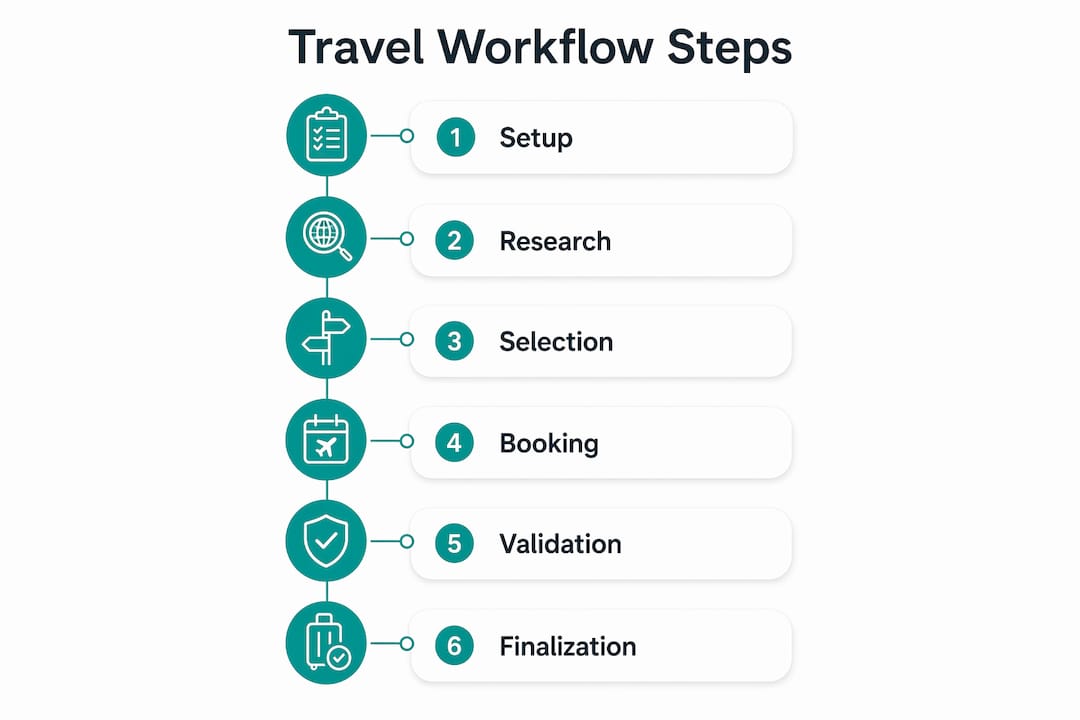
Building your own travel workflow doesn't require software. It requires a clear sequence and the discipline to follow it. Here's the practical structure:
- Define your preferences: travel style, must-have experiences, hard limits on budget and pace
- Research destinations and activities: use structured criteria, not just inspiration feeds
- Set a realistic budget: allocate by category before you fall in love with a specific hotel
- Map your route: sequence stops to minimize backtracking and transit fatigue
- Run a feasibility check: verify transport connections, booking windows, and seasonal conditions
- Finalize and confirm: lock bookings in the right order (flights first, then accommodation, then activities)
Structured trigger events and validation rules keep each stage consistent and reduce errors, especially when multiple bookings depend on each other. The itinerary planning workflow Destlist uses follows this same logic, saving travelers more than ten hours per trip on average.
Pro Tip: Set your budget before you research destinations, not after. Once you've seen a specific resort or flight option, anchoring bias makes it nearly impossible to evaluate alternatives fairly.
Common pitfalls worth avoiding: itinerary overload (too many activities per day), skipping the feasibility check, and treating the first AI draft as final. Each one is fixable with a single workflow rule.
Travel workflows make personalized, stress-free trips possible
The clearest benefit of a structured travel planning process is what it removes: the decision fatigue, the missed details, the budget surprises. When each planning stage has a defined output, nothing falls through the cracks.
Key benefits that compound across a well-run workflow:
- Time savings: automation handles research, confirmations, and reminders
- Better customization: structured preference capture means recommendations actually fit you
- Fewer errors: validation steps catch conflicts before they become problems at the airport
- Budget control: allocation happens early, not as an afterthought
Destlist combines AI-powered drafting with human curatorial review to deliver personalized travel plans that are ready to book within 24 hours. The platform handles the full workflow from preference intake through itinerary delivery, including flights, hotels, day-by-day activities, mapped routes, and estimated walking times.
Ready to skip the planning grind? Destlist's curated travel plans are built for travelers who want a great trip without spending weeks organizing it.
What do personalized AI-powered travel workflows look like in practice?
A few concrete examples show how the travel planning process plays out differently depending on the trip type.
A week in Bali: You submit your preferences (romantic, luxury, outdoor focus, mid-to-high budget). The AI pulls a shortlist of Uluwatu cliff villas and private pool options, sequences activities to avoid the tourist rush hours, and flags the rainy season window. A human curator checks that the specific properties are actually bookable and that the day flow makes physical sense. You receive a 7-day Bali itinerary with walking times, mapped routes, and weather alerts.
A family trip to Bangkok: Preference intake captures kids' ages, dietary needs, and pace preferences. The AI filters out adult-only venues and builds a day-by-day schedule mixing cultural stops with sensory-friendly breaks. Human review adds local logistics that AI databases often miss, like which floating market visits require advance booking.
A city break in Istanbul: The workflow matches your interest in history and food with a tight routing plan that keeps walking distances manageable. Weather alerts and local event flags get layered in automatically.
Each of these follows the same workflow structure. The output looks completely different because the preference data driving it is different.
What challenges come up in travel workflow automation, and how do you solve them?
Automation in travel planning runs into predictable friction points. Knowing them in advance makes them manageable.
Hallucinated itinerary details are the most common failure. A single-prompt AI system will confidently suggest a restaurant that closed two years ago or a train connection that doesn't exist on the dates you're traveling. The fix is a multi-agent validation layer that cross-checks outputs against real booking data, plus human review before delivery.
Preference ambiguity trips up even well-designed systems. "Relaxed but active" or "budget-conscious but not cheap" don't translate cleanly into database queries. Structured intake forms with specific questions (preferred daily walking distance, hotel star rating floor, cuisine preferences) produce far cleaner AI outputs than open-ended prompts.
Booking sequencing errors happen when automation confirms activities before flights are locked, creating conflicts that are expensive to unwind. A properly sequenced workflow books in dependency order: flights, then accommodation, then activities and transfers.
Over-packed itineraries are a human problem that AI amplifies. When a system optimizes for "maximum experiences," it often produces a schedule that looks great on paper and feels brutal in practice. Building rest periods and buffer time into the workflow template, not as an afterthought, solves this. Convenience in travel consistently ranks as a top priority for travelers, and a workflow that ignores pacing undermines it directly.
How travel workflows change the way you experience trip customization
A structured workflow doesn't just make planning faster. It changes what's possible in terms of personalization. When preference data is captured systematically at the intake stage, every downstream decision, from hotel selection to activity sequencing, reflects your actual priorities rather than generic defaults.
The trip customization process shifts from reactive (you browse options and pick) to proactive (the workflow surfaces options matched to your profile before you even ask). That's a fundamentally different experience. Travelers who use structured workflows report feeling more confident in their plans, partly because the validation steps make the itinerary feel real rather than aspirational.
Early inquiry handling shapes the entire experience. When a platform responds quickly, sets clear expectations, and delivers a structured plan, trust builds fast. That trust is what makes travelers willing to book rather than keep researching. Customer service quality at the inquiry stage is one of the strongest predictors of whether a traveler converts from interest to confirmed booking.
Destlist's workflow is designed around this principle. The platform's curated destinations and done-for-you planning model mean the customization happens inside the workflow, not as extra work you have to do yourself.
Key Takeaways
A travel workflow turns a chaotic planning process into a structured sequence that delivers personalized, validated itineraries faster and with fewer errors than manual planning alone.
| Point | Details |
|---|---|
| Structured stages reduce errors | Defined workflow steps with validation rules prevent booking conflicts and missed details. |
| AI plus human review outperforms either alone | AI drafts quickly; human curators verify real-world feasibility that automation misses. |
| Custom workflows drive satisfaction | Structured custom itineraries yield approximately 40% higher traveler satisfaction than standard packages. |
| Intake quality determines output quality | Specific preference capture at the inquiry stage produces far more accurate AI recommendations. |
| Early response builds trust | Responding quickly with a structured plan is what converts interest into a confirmed booking. |