
TL;DR:
- A structured workflow for luxury travel planning ensures a flawless experience that clients remember for decades. It involves deep client discovery, destination insights, VIP access, logistics, and risk management, often enhanced by AI tools and real-time communication apps. This systematic approach surpasses ad hoc booking by prioritizing privacy, flexibility, and contingency planning to deliver personalized, stress-free journeys.
A structured workflow for luxury travel planning is the difference between a forgettable trip and a flawlessly executed experience that clients remember for decades. Professional luxury travel planners treat each journey as a project with defined phases: deep client discovery, destination intelligence, VIP access engineering, logistics coordination, and real-time risk management. Tools like AI itinerary builders, concierge apps with WhatsApp and iMessage integration, and psychographic profiling platforms have made this process more precise than ever. Whether you are self-planning a high-end vacation or working with a specialist, following this framework produces results that ad hoc booking simply cannot match.
What are the essential components of a luxury travel planning workflow?
The foundation of any high-end travel planning process is a thorough client discovery phase. Professional planners conduct 90–120 minute deep-discovery consultations to capture psychographic preferences, travel goals, and lifestyle priorities. That depth of intake is what separates a personalized itinerary from a generic package. Without it, even the most expensive hotels and flights feel disconnected.
Beyond the consultation, you need the right tools in place before any planning begins. Itinerary software, private aviation contacts, and a reliable concierge communications platform are non-negotiable for high-end trips. Privacy considerations are equally critical, especially for ultra-high-net-worth (UHNW) travelers who require discreet transport and minimal public exposure. Skipping this setup phase creates gaps that surface at the worst possible moments, usually mid-trip.
Pro Tip: Before you book a single flight, write down your non-negotiables: privacy requirements, dietary restrictions, physical limitations, and the two or three experiences that would make the trip feel worth it. This list becomes your planning anchor.
Essential tools and prerequisites
| Tool or Requirement | Purpose |
|---|---|
| Psychographic intake form | Captures client values, pace preferences, and experience goals |
| Itinerary planning software | Organizes day-by-day flow, routes, and timing |
| Private aviation contacts | Enables Gulfstream G650ER or similar aircraft coordination |
| Concierge communications app | Supports real-time adjustments via WhatsApp or iMessage |
| Experience database | Stores vetted insider access options by destination |
| Privacy and security protocol | Protects client identity and minimizes public exposure |
How to execute the step-by-step luxury travel workflow
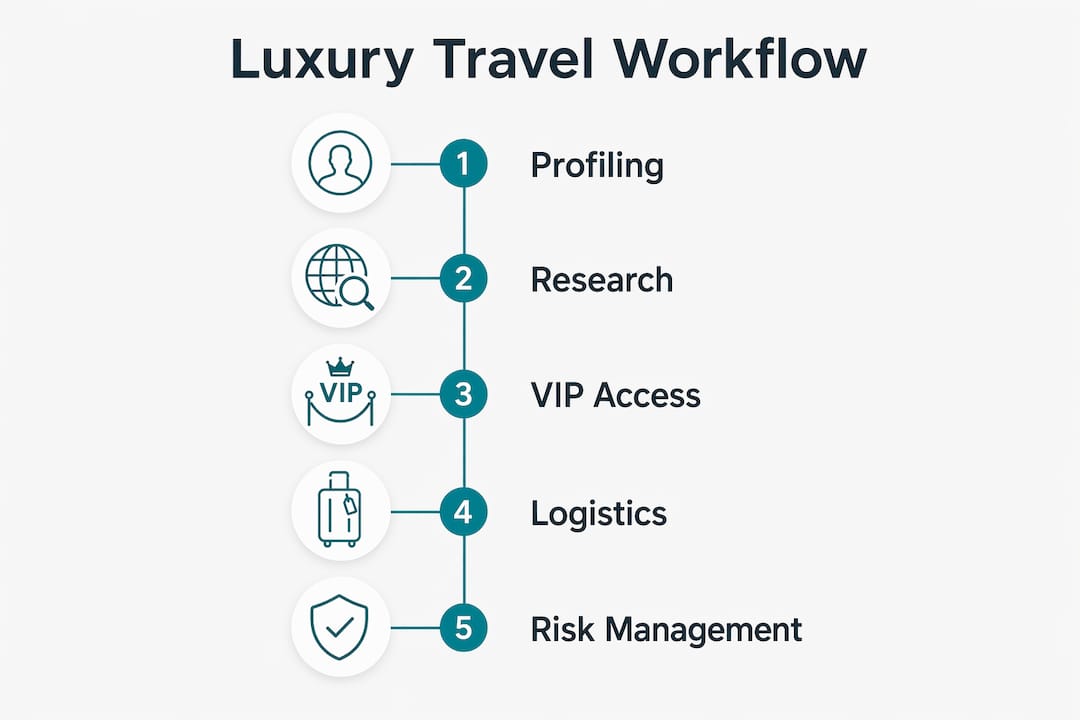
The luxury travel planning process follows five distinct phases. Each phase builds on the last. Skipping any one of them creates compounding problems later.
Step 1: Psychographic and logistical client profiling
Start by mapping who the traveler actually is, not just what they want to book. Psychographic profiling covers values, pace preferences, social energy, and the emotional outcome they want from the trip. Mood-based trip curation is one method that captures this effectively, aligning destination choices with the traveler's current mindset rather than a static wish list. Logistical profiling covers group size, mobility needs, dietary requirements, and budget parameters.

Step 2: Destination intelligence gathering
Generic destination research is not enough for luxury itinerary planning. Professional planners use proprietary databases and geopolitical tracking to assess micro-climate conditions, local event calendars, and political stability before committing to a destination. A private vineyard tasting in Burgundy in october is a different experience than the same visit in july, and the itinerary should reflect that. This phase also identifies which destinations align with the client's psychographic profile from Step 1.
Step 3: Engineering VIP access and insider experiences
True luxury is access that money alone cannot buy at the last minute. Private after-hours museum tours, exclusive restaurant reservations, and private vineyard tastings require relationships built over years and advance planning of weeks or months. This step involves contacting venue managers, private estate owners, and cultural institutions directly. The goal is to fill the itinerary with experiences unavailable to the general public.
Step 4: Multi-destination logistics and transport coordination
Coordinating private jets, helicopters, and chauffeured fleets across multiple destinations requires careful sequencing. A Gulfstream G650ER repositioning from Nice to Dubrovnik while a yacht is being provisioned in the same harbor demands precise timing across multiple vendors and time zones. Build a master logistics document that lists every transfer, its lead time, and its backup option. This document becomes the operational backbone of the entire trip.
Step 5: Risk engineering and contingency management
Risk engineering is where luxury planning separates from standard travel booking. Real-time weather routing algorithms and medical evacuation contracts with 4-hour response agreements are standard practice at the professional level. That level of preparation means a sudden storm over the Adriatic triggers a pre-planned reroute rather than a scramble. Build contingency options for every major transfer and at least one alternative activity per destination day.
Pro Tip: Build a 15–20% time buffer into every itinerary day. Luxury travel moves at a deliberate pace, and rushed transitions destroy the experience. Flexibility is not a weakness in a luxury itinerary. It is a design feature.
Traditional vs. AI-assisted workflow comparison
| Planning Phase | Traditional approach | AI-assisted approach |
|---|---|---|
| Client profiling | Manual intake forms and phone calls | AI-driven psychographic questionnaires |
| Destination research | Planner's personal knowledge base | Real-time data aggregation across databases |
| Itinerary building | Manual scheduling and document creation | Automated day-by-day flow with route mapping |
| Real-time adjustments | Phone calls to vendors | Concierge app notifications and instant pivots |
| Risk management | Experience-based contingency planning | Weather routing algorithms and live monitoring |
What pitfalls should you avoid in luxury travel planning?
The most common mistake in high-end travel planning is underestimating privacy requirements until they become a crisis. UHNW clients prioritize discretion above almost every other factor, and a single public exposure incident can damage trust permanently. Even self-planners benefit from thinking through which parts of their itinerary create unnecessary visibility. Private transfers, discreet hotel check-ins, and non-public dining reservations all reduce exposure.
The second major pitfall is building an itinerary with no room to breathe. Effective luxury itineraries allow room for spontaneity to accommodate weather changes, unexpected invitations, or simple fatigue. An over-scheduled trip feels like a corporate roadshow, not a vacation. The third pitfall is poor vendor communication across time zones, which causes missed transfers and lost reservations.
Pro Tip: Assign a single point of contact for every vendor relationship. Multi-party email chains across time zones are where luxury trips fall apart. One contact per vendor, one master document, one communication channel.
Common pitfalls and how to prevent them:
- Ignoring privacy protocols early: Build discreet transport and check-in procedures into the first draft of the itinerary, not as an afterthought.
- Over-scheduling each day: Leave at least two unstructured hours per day for rest or spontaneous decisions.
- Single-source vendor dependencies: Always have a backup provider for private aviation, ground transport, and key restaurant reservations.
- Neglecting time zone management: Use a world clock tool and assign local contacts in each destination to handle on-the-ground coordination.
- Skipping written contingency plans: Every major transfer needs a documented Plan B before the trip departs.
How do luxury planners integrate AI tools into their workflow?
AI tools now function as destination matchmakers and itinerary builders, matching client budgets and experience preferences to specific properties and activities with speed that manual research cannot replicate. Platforms like Destlist use AI to generate day-by-day itineraries with mapped routes and estimated walking times, then layer in human review to catch the nuances AI misses. That combination of speed and judgment is what makes AI-assisted planning genuinely useful rather than just fast.
Concierge apps integrating WhatsApp and iMessage enable instant itinerary pivots when conditions change. A flight delay, a restaurant closure, or a sudden weather event can be addressed in minutes rather than hours when the communication infrastructure is already in place. Security is a real consideration here. Client data, travel schedules, and property access details must be handled through encrypted channels, not standard email threads.
The future of luxury travel software points toward predictive personalization. AI systems will eventually anticipate client preferences based on past trip data and suggest itinerary adjustments before the client even notices a gap. For now, the most effective approach combines customization methods for busy travelers with AI-generated drafts that a human planner refines. Neither AI alone nor manual planning alone produces the best result.
- AI strengths: speed, data aggregation, budget matching, route optimization
- Human planner strengths: relationship access, cultural nuance, real-time judgment calls
- Best practice: use AI for the first 80% of itinerary construction, then apply human review for the final 20%
Key takeaways
A structured luxury travel workflow built on deep client profiling, destination intelligence, VIP access engineering, and real-time risk management produces results that unplanned booking cannot match.
| Point | Details |
|---|---|
| Start with deep discovery | A 90–120 minute intake session captures the psychographic data that drives every planning decision. |
| Build in contingency from day one | Every major transfer and activity needs a documented backup before the trip departs. |
| Privacy is a planning requirement | Discreet transport and check-in procedures must be designed into the itinerary, not added later. |
| AI accelerates but does not replace judgment | Use AI tools for speed and data, then apply human review to catch nuance and relationship-based access. |
| Flexibility is a design feature | Leave unstructured time in every itinerary day to accommodate spontaneity and prevent fatigue. |
Why the workflow matters more than the destination
After years of working with high-end travel plans, I have come to believe that most people obsess over the wrong variable. They spend weeks choosing between the Maldives and Bora Bora when the real differentiator is the quality of the planning process behind either choice.
The planners I respect most treat themselves as project managers focused on risk engineering, not booking agents. They think about medical evacuation contracts before they think about restaurant reservations. They build contingency plans before they finalize the primary itinerary. That mindset shift is what separates a trip that feels effortless from one that feels expensive but stressful.
The part that surprises most self-planners is how much the psychographic profiling phase matters. Knowing that a client values quiet mornings over late-night dinners changes every single scheduling decision downstream. Get that wrong and no amount of five-star hotels will fix the feeling that the trip was slightly off.
My honest advice: even if you are planning your own trip, run yourself through the same intake process a professional would use. Write down your pace preference, your privacy needs, your non-negotiable experiences, and your contingency tolerance. That document will save you more time and frustration than any booking tool on the market.
— Helen
Plan your next luxury trip with Destlist
Destlist builds custom travel itineraries using AI and human travel curators, delivering ready-to-book plans within 24 hours. Every plan includes day-by-day activities, mapped routes, flight and hotel matching, and weather alerts. For travelers who want the structure of a professional workflow without the hours of manual research, Destlist handles the heavy lifting. Explore curated travel plans built around your preferences and travel style, or start with a destination discovery session to find the right fit for your next trip.
FAQ
What is the first step in a luxury travel planning workflow?
The first step is a deep-discovery consultation that captures psychographic preferences, travel goals, and logistical requirements. Professional planners typically spend 90–120 minutes on this intake phase before any destination research begins.
How far in advance should I start planning a luxury vacation?
Most luxury itineraries require at least three to six months of lead time to secure private aviation, exclusive restaurant reservations, and after-hours venue access. High-demand destinations and peak seasons may require even longer.
What does risk engineering mean in luxury travel planning?
Risk engineering covers real-time weather routing, 24/7 itinerary monitoring, and pre-arranged medical evacuation contracts with defined response times. It treats safety and contingency planning as core deliverables, not optional add-ons.
How does AI improve the luxury travel planning process?
AI tools match client budgets and experience preferences to specific properties and activities faster than manual research allows. Platforms like Destlist combine AI-generated itineraries with human review to balance speed with the judgment that high-end travel requires.
What is the biggest mistake in planning a high-end vacation?
Underestimating privacy requirements and over-scheduling each day are the two most common errors. Both can be prevented by building discreet logistics and unstructured time into the itinerary during the first planning draft.