
A vacation blueprint is a high-level, personalized travel plan that captures your travel style, priorities, routing, and key bookings as a day-by-day skeleton. Think of it as the master document that turns a vague trip idea into a clear, actionable plan before you ever leave home. If you've ever arrived somewhere and realized you wasted two days figuring out logistics you could have sorted in an hour, a blueprint is the fix.
Every solid vacation blueprint covers three element groups:
- Travel profile: your style (adventure, relaxation, culture), group size, pace preference, and any hard limits like mobility needs or dietary requirements
- Priorities and logistics: the booked highlights, routing between destinations, accommodation bases, and estimated transit times
- Budget and timing: category-level cost estimates, reservation calendar, and contingency notes
Pro Tip: Build your blueprint around travel style first, not activities. A relaxation-focused traveler and an adventure traveler visiting the same city need completely different day structures. Locking in style before you pick activities prevents a schedule that looks full but feels wrong.
Key Takeaways
A vacation blueprint is a personalized, travel-style-first planning document that prevents costly mistakes and saves hours of on-trip decision-making.
| Point | Details |
|---|---|
| What a blueprint is | A high-level, day-by-day travel skeleton built around your travel style, priorities, and key bookings. |
| Core components | Includes travel profile, daily skeleton, routing notes, budget categories, accommodation base, and a contingency plan. |
| 3-phase workflow | Constraints first, then draft routing and highlights, then finalize reservations and deliverables 2–4 weeks out. |
| When to hire | Complex routing, groups of six or more, tight timelines, or special-access bookings justify a paid blueprint service. |
| Destlist option | Destlist delivers AI-assisted, human-verified itineraries with maps, packing lists, and booking links within 24 hours. |
Table of Contents
- What goes inside a vacation blueprint?
- Why a vacation blueprint saves more than just time
- The 3-phase process for creating a vacation blueprint
- How to build your own vacation blueprint step by step
- A compact 7-day sample vacation blueprint
- When should you buy a ready-made blueprint or hire a planner?
- The case for building your blueprint around travel style, not activities
- Destlist builds your vacation blueprint in under 24 hours
- Sources
What goes inside a vacation blueprint?
A blueprint is only as useful as its components. Miss one, and you'll feel it on the ground.
- Travel profile: documents who's traveling, pace preference, must-have amenities, and accessibility requirements. A personalized itinerary built without this is just a generic schedule.
- Priorities and booked highlights: the two or three non-negotiable experiences per destination, confirmed and time-slotted.
- Day-by-day skeleton: one booked highlight and one flexible slot per day. Not a minute-by-minute schedule — a framework.
- Routing and transit notes: the order destinations are visited, transfer times, and transport modes. Solo travelers can optimize for speed; families often need to factor in rest stops and luggage logistics.
- Accommodation base plan: where you sleep each night and why that location makes geographic sense. Vacation rentals suit large groups well, and vacation rentals suit large groups well and are popular among travelers, according to a Squaremouth survey.
- Budget categories and totals: flights, accommodation, food, activities, transport, and a contingency buffer.
- Timing and reservations calendar: confirmation numbers, check-in times, and cancellation deadlines in one place.
- Essential contacts and documents: embassy numbers, insurance policy details, and copies of visas or entry requirements.
- Accessibility and amenities: step-free routes, dietary options, or child-friendly facilities flagged per day.
- Contingency plan: one backup option per major booking in case weather, closures, or delays force a change.
For a solo traveler, most of these are quick to fill in. For a family of five or a group of twelve, the routing and contingency sections alone can save hours of on-trip negotiation.
Why a vacation blueprint saves more than just time
The clearest benefit is stress reduction. When every decision is made in advance, you spend your trip experiencing it instead of managing it. But the practical wins go further.
A blueprint protects your budget by forcing category-level estimates before you book anything. It improves on-the-ground flow because routing is already optimized. For groups, it replaces the endless "what do you want to do?" loop with a shared reference document everyone agreed to before departure. And when plans change — a canceled flight, a closed museum — a blueprint with contingency notes means you're rebooking from a position of knowledge, not panic.
The timing argument is concrete: Squaremouth's research found travelers typically plan several months in advance on average. Starting with a blueprint that early means better flight prices, more accommodation options, and first access to time-sensitive tours or restaurant reservations.
Planning stat: Travelers who start the process around 4–5 months out consistently get wider choice on flights, hotels, and excursions than last-minute planners.
A weekender benefits from even a lightweight blueprint — a single-page document with two booked highlights, a hotel, and a restaurant reservation is enough to prevent the Sunday-afternoon scramble. A two-week international trip without one is a different story: routing errors alone can cost you a full day of travel time.
The 3-phase process for creating a vacation blueprint
Most good blueprints follow the same three-phase workflow, whether you're building it yourself or handing it to a planner.
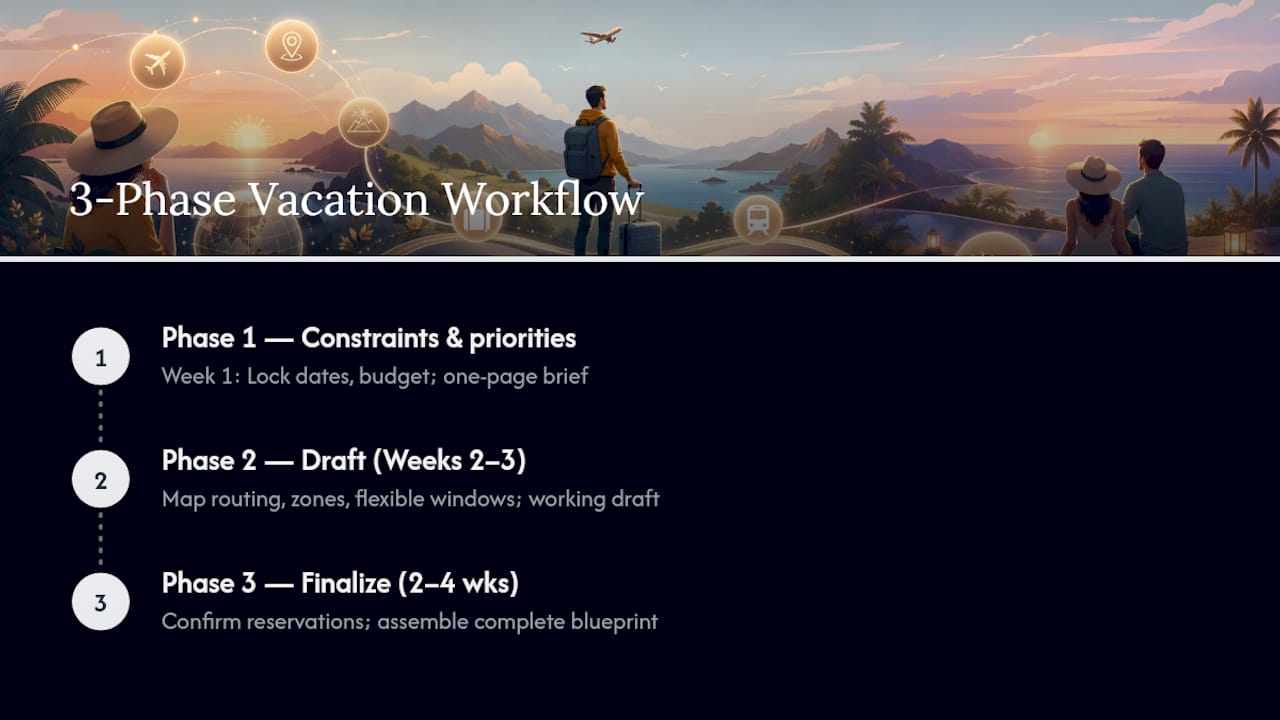
Phase 1: Constraints and priorities (Week 1 of planning)
Lock in the basics before anything else: who's traveling, exact dates, total budget, travel style, and any hard limits. WikiHow's planning sequence recommends this constraints-first approach because every downstream decision — destination, routing, accommodation — flows from it. Deliverable: a one-page brief.
Phase 2: Draft blueprint (Weeks 2–3)
Map the routing, choose accommodation zones, slot your booked highlights, and leave deliberate flexible windows. This is where the day-by-day skeleton takes shape. Deliverable: a working draft with daily structure and preliminary booking links.
Phase 3: Finalize (2–4 weeks before departure)
Confirm all reservations, assemble the full document (downloadable itinerary, maps, packing list, contingency notes), and set a process for mid-trip updates. A pre-trip checklist run one to two weeks before departure should verify documents, entry rules, weather, and connectivity. Deliverable: the complete, shareable blueprint.
How to build your own vacation blueprint step by step
This sequence works for any trip length. Follow it in order and you won't miss anything critical.
- Define goals and constraints. Who's going, when, for how long, and what's the hard budget ceiling? WikiHow's planning guide puts this first for good reason.
- Choose your destination(s) and check travel seasons. Confirm entry requirements, weather windows, and any visa needs. Lonely Planet's trip planning guide recommends booking early while keeping refundable options for long lead-time purchases.
- Create a category budget. Split your total into flights, accommodation, food, activities, transport, and a 10–15% contingency buffer. A smart budgeting approach assigns real numbers to each category before any booking happens.
- Choose your base(s) and routing. For multi-city trips, sequence destinations to minimize backtracking. For a single destination, pick an accommodation zone that puts you near your priorities.
- Reserve time-sensitive items first. Popular tours, restaurant reservations, and peak-season accommodation sell out months ahead. Book these before filling in the rest of the skeleton.
- Build the daily skeleton. One booked highlight per day, one flexible slot. That's the whole structure. Vacation Planner Blog's 12-step guide specifically recommends this format to prevent over-scheduling.
- Add logistics. Transfer times, opening hours, estimated walking distances, and any pre-booking requirements for each day.
- Create contingencies and a pre-departure checklist. One backup per major booking. Run your final checklist one to two weeks out.
- Save a master planning document and share it. A single spreadsheet or file with separate sections for bookings, costs, addresses, and cancellation terms keeps everything findable. TravelBlog's planning guide recommends this reusable system for any trip with more than a few moving parts.
Pro Tip: Anchor every day around one booked highlight and protect the flexible slot. The moment you fill every slot, you've built a schedule, not a blueprint. Schedules break; blueprints bend.
Planning lead time: According to Squaremouth's survey data, the average traveler starts planning several months out. For international trips or peak-season travel, that window is a floor, not a ceiling.
A compact 7-day sample vacation blueprint
Here's what a finished blueprint looks like for a city-based trip with one day excursion. This format works for most 7-day itineraries.
Deliverables you'd expect from a paid blueprint at this level:
- Editable day-by-day itinerary file (PDF or spreadsheet)
- Routing map with estimated transit times
- Booking links and confirmation placeholders
- Packing list tailored to destination and season
- Visa and entry requirements summary
- Emergency contacts and insurance reference
Adapting this sample: A family traveling with young children should compress Day 4's excursion to a half-day and add a rest window in the afternoon. A solo traveler can swap the flexible slots for solo-friendly activities like food tours or photography walks. For group trips, the family travel planning guide from Wild Foodz covers group-specific logistics in useful detail.
When should you buy a ready-made blueprint or hire a planner?
DIY works well for straightforward trips: one destination, a familiar region, a small group, and enough planning time. The calculation shifts when any of these apply:
- Multi-destination routing across three or more cities or countries
- Groups of six or more, especially with mixed ages or accessibility needs
- Corporate retreats, milestone celebrations, or honeymoons where execution has to be right
- Special-access bookings (private tours, exclusive restaurants, remote lodges) that require local contacts
- Less than four weeks of planning time for a complex trip
What a paid blueprint typically delivers:
- Personalized day-by-day itinerary with routing logic explained
- Map with transit times and transfer notes
- Booking links and vendor contacts
- Packing and visa checklist
- Emergency contacts and insurance guidance
- Editable master file for mid-trip adjustments
Turnaround for digital drafts runs from same-day to 48 hours for most services. Revision rounds are usually one to two included cycles. Cost varies widely by complexity: a simple 7-day single-destination plan sits at the lower end of the market; a multi-country itinerary with special-access bookings commands a premium.
Pro Tip: Ask any paid service what format the deliverable comes in before you buy. A PDF you can't edit is far less useful mid-trip than a shared Google Doc or editable spreadsheet.
The case for building your blueprint around travel style, not activities
Most planning mistakes come from the same place: people pick activities before they've decided what kind of trip they actually want. You end up with a schedule that looks impressive on paper but exhausts you by Day 3.
Travel-style-first planning flips that. When you know whether you're optimizing for rest, culture, adventure, or food, every subsequent decision — pace, accommodation zone, activity density — aligns with that goal. The result is a blueprint that feels coherent rather than crammed.

Destlist's AI-assisted, human-verified approach builds itineraries this way by design. The platform matches your travel profile to routing and activity choices before generating a day-by-day plan, which is why the output tends to hold up better on the ground than a generic template would. That combination of algorithmic efficiency and human judgment is what separates a real blueprint from a list of things to do.
Destlist builds your vacation blueprint in under 24 hours
Planning a trip from scratch takes most people 8–10 hours across multiple browser tabs, spreadsheets, and booking sites. Destlist cuts that to a single request.
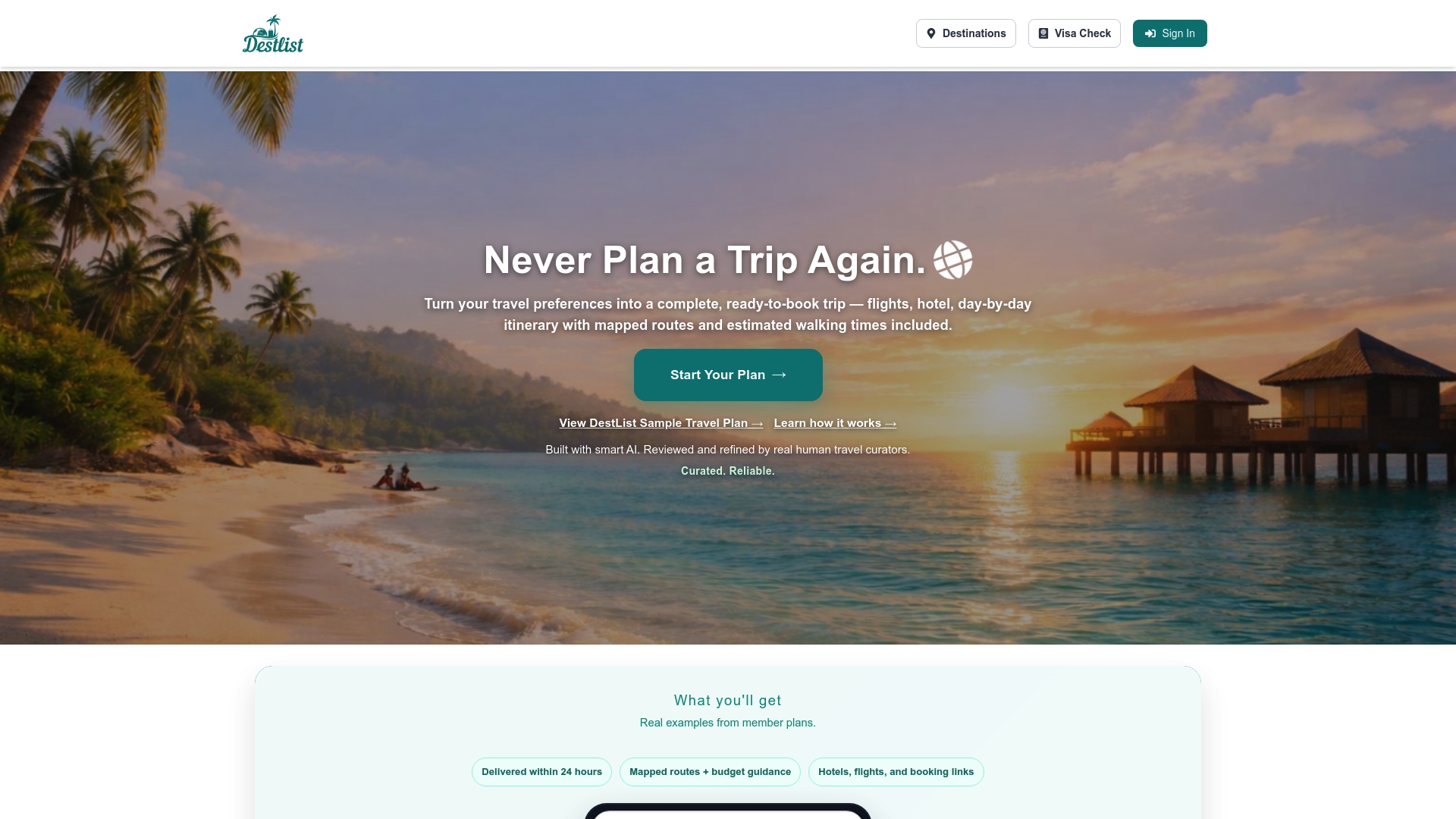
You describe your travel style, group, dates, and budget. Destlist's AI builds a personalized, human-verified itinerary with routing maps, booking links, a packing list, and weather alerts, delivered as an editable file within 24 hours. The custom travel itinerary service is the fastest route from "we should go somewhere" to a blueprint you can actually use. Or browse 50 ready-made 7-day itineraries by city and travel style if you want a finished plan right now.
Sources
- Trip Planning 101: How to Plan a Vacation
- How to Plan a Vacation
- Guide to trip planning
- Complete Trip Planning Guide: Plan a Vacation
- How to Plan a Vacation Step by Step: 12-Step Guide | Vacation Planner Blog