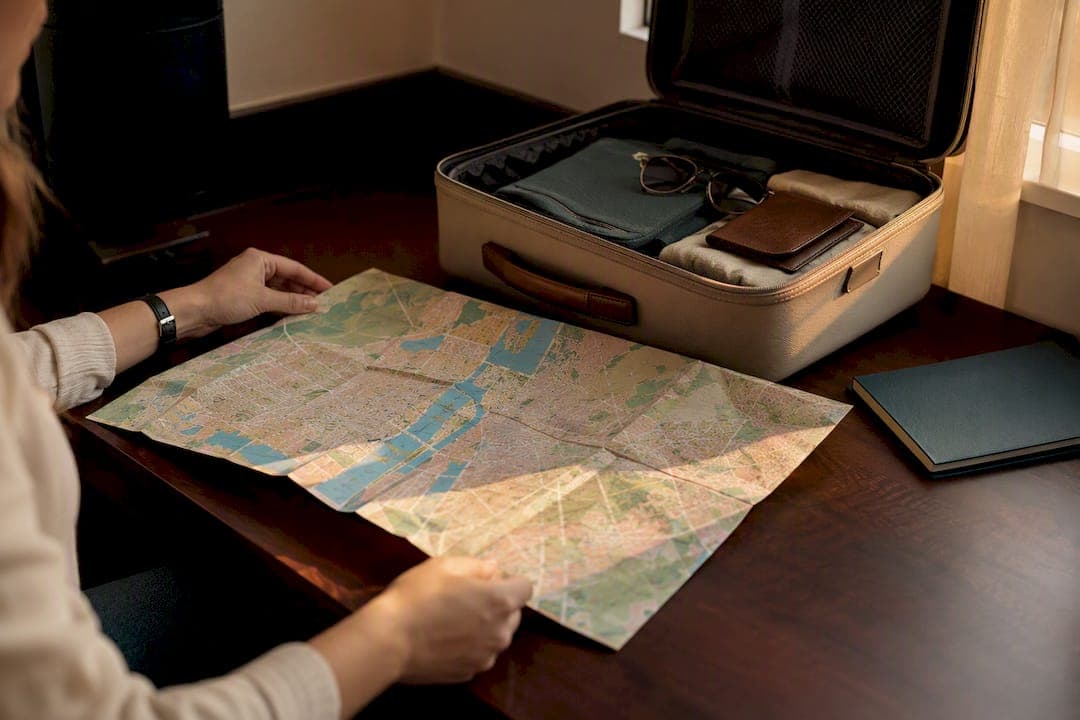
A leisure traveler is someone who travels for personal enjoyment, relaxation, or recreation rather than for work. The trip is paid for out of the traveler's own pocket, and the schedule bends around what the person wants to do, not what a client or employer needs.
Picture a couple lying on a beach in Cancún with zero meetings on the calendar. Or a family cramming into a minivan for a national park road trip. Or a retiree booking a Mediterranean cruise just because the itinerary looked good. All three are leisure travelers.
- Beach vacation with no work obligations
- Multi-generational cruise booked months in advance
- A weekend trip home to visit family
Knowing this distinction matters once you start comparing costs, expense reports, or company travel policy, because leisure and business travel get treated very differently by airlines, hotels, and HR departments alike.
Key Takeaways
A leisure traveler pays their own way, sets their own schedule, and travels for personal enjoyment rather than work obligations.
| Point | Details |
|---|---|
| Core definition | A leisure traveler funds their own trip and travels for relaxation, recreation, or personal enrichment. |
| Bleisure is a gray zone | Business trips extended with personal days require separate expense tracking and clear policy. |
| Segments shape booking | Family, solo, couple, adventure, luxury, and budget travelers each plan and book differently. |
| Booking skews digital | Online channels handle over two-thirds of global travel revenue, led by OTAs and direct booking. |
| Curated planning saves time | Destlist delivers matched flights, hotels, and full itineraries within 24 hours for busy leisure travelers. |
Table of Contents
- What Defines a Leisure Traveler?
- Leisure vs. Business vs. Bleisure: What's the Difference?
- Common Types of Leisure Travelers
- How Do Leisure Travelers Plan and Book Trips?
- Why the Leisure vs. Business Distinction Matters
- Quick Checklist: Is Your Trip Leisure Travel?
- How a Curated Planning Service Helps Leisure Travelers
- Why Getting the Persona Right Changes the Trip
- Plan Your Next Leisure Trip Without the Guesswork
- Frequently Asked Questions
- Sources
What Defines a Leisure Traveler?
Motivation is the giveaway. Leisure travelers move toward relaxation, recreation, personal growth, sightseeing, or reconnecting with friends and family, according to the BCD Travel glossary, which frames these trips as traveler-funded and disconnected from any employer mandate.
The behavior pattern follows the motive. Leisure trips tend to run longer than a standard business trip, often stretch across a weekend or full week, and get booked around package deals, all-inclusive resorts, or bundled flight-and-hotel offers. Nobody's expensing this to a corporate account. The traveler books it, pays for it, and plans it on their own timeline through consumer channels like Expedia, Booking.com, or a travel agent.
A few everyday examples make the pattern obvious:
- A honeymooning couple picking an overwater bungalow in Bora Bora
- A family of four splitting a week between Disney World and the beach
- A solo traveler backpacking through Southeast Asia with no fixed return date
Pro Tip: If you're paying for the trip and picking the dates around your own life instead of a client's calendar, you're already looking at a leisure trip, no matter how the itinerary looks on paper.
Leisure vs. Business vs. Bleisure: What's the Difference?
The lines blur more than people expect, with convenience playing a key role in how travelers perceive and manage these differences, as detailed in convenience priorities in business travel. A "bleisure" trip, business travel stretched to include personal time, has become common enough that companies now write policies just to handle it, according to Navan. Academic comparisons of the two categories confirm they carry genuinely different economic and behavioral profiles, not just different price tags, per a comparative analysis published on ResearchGate.
| Dimension | Leisure travel | Business travel | Bleisure travel |
|---|---|---|---|
| Primary purpose | Personal enjoyment | Work tasks, meetings | Work extended with personal time |
| Who pays | Traveler | Employer | Split between employer and traveler |
| Trip length/flexibility | Flexible, often longer | Fixed, often short | Fixed core trip plus flexible extension |
| Work tasks during trip | None | Constant | Present during the business portion only |
| Booking channel | OTAs, direct, travel agents | Corporate travel program | Corporate booking plus personal add-ons |
Consider three quick scenarios. A consultant flying in for a two-day audit and flying straight home is pure business travel. That same consultant tacking on a Saturday to see a museum before flying home turns it into bleisure. A retired couple booking a river cruise through a travel agent, with zero work involved, sits squarely in leisure territory.
The expense-report headache shows up right at that seam. Once personal days enter a business trip, someone has to separate which hotel nights, meals, and flight costs the company covers versus what the traveler pays out of pocket. That's exactly why more employers now write bleisure clauses into travel policy instead of treating every trip as one category or the other.
Common Types of Leisure Travelers
Hotels and tour operators don't market to "leisure travelers" as one blob. They build personas around specific segments, because a solo backpacker and a family of five book completely different rooms, rates, and add-ons.
- Family travelers plan around school calendars and kid-friendly amenities, often booking resorts with kids' clubs.
- Solo travelers prioritize flexibility and safety, frequently choosing hostels or boutique hotels over big resorts.
- Couples lean toward romantic packages, all-inclusives, or milestone trips like honeymoons and anniversaries.
- Adventure travelers chase activities like trekking, diving, or wildlife tours over sightseeing checklists.
- Luxury travelers pay a premium for private guides, five-star property, and door-to-door convenience.
- Budget travelers hunt for deals, off-peak pricing, and flexible dates to stretch every dollar.
Niche variants keep multiplying inside these buckets, too. Eco-travel, wellness retreats, and slow travel (fewer stops, longer stays) have all grown into their own booking categories that hotels now target with dedicated packages. If you want a deeper breakdown of these personas, this guide to travel personas walks through how each one plans differently.
How Do Leisure Travelers Plan and Book Trips?
Booking behavior separates leisure travelers from almost every other traveler type. Online sales channels account for more than two-thirds of global travel and tourism revenue, and leisure travelers drive a huge share of that volume through OTAs, direct hotel sites, and comparison tools.

Planning windows vary by trip type. A weekend getaway might get booked ten days out. A two-week international trip often gets locked in three to six months ahead, especially around peak season or holiday travel. Because they're spending their own money, leisure travelers tend to research harder before committing: comparing prices across sites, reading reviews obsessively, and weighing package deals against building an itinerary piece by piece.
Price sensitivity runs deeper here than in business travel, and it pushes leisure travelers toward heavy pre-trip research and reliance on peer reviews before they'll commit to a booking, per Navan's analysis of traveler behavior.
- Use self-service OTAs for simple, single-destination trips with flexible dates
- Use a curated planning service or travel agent for multi-stop trips, special occasions, or when time is tight
- Book flights and hotels early for peak season, later for shoulder season flexibility
Why the Leisure vs. Business Distinction Matters
Hoteliers, travel managers, and marketers segment these two groups differently because the buying behavior diverges at almost every step: booking window, price sensitivity, loyalty triggers, and even the amenities that close the sale.
Leisure travel isn't a side category, either. It represents roughly 65% of total tourism spending in the United States, with even higher shares in some international markets. That scale forces travel brands to build products and marketing specifically for personal trips rather than repurposing corporate travel tools.
- Hotels design leisure-focused packages (family suites, romance packages) separate from corporate rate plans
- Airlines market flexible fare classes differently to leisure shoppers versus corporate accounts
- Travel platforms build curated, personalized tools because leisure demand rewards personalization over bulk efficiency
Quick Checklist: Is Your Trip Leisure Travel?
Run through these questions:
- Are you paying for the trip yourself?
- Is the main goal relaxation, sightseeing, or personal enjoyment?
- Can you shift the dates without asking anyone's permission?
- Will you do zero work tasks during the trip?
If you answered "yes" to most of these, you're planning a leisure trip. If work tasks sneak into an otherwise personal trip, or vice versa, you're likely in bleisure territory, and it's worth tracking those travel expenses separately from the start.
How a Curated Planning Service Helps Leisure Travelers
Once you know you're planning a leisure trip, the next problem is usually time, not motivation. Destlist builds ready-to-book itineraries that handle the parts leisure travelers dread: matching flights and hotels to a budget, mapping daily routes, and flagging weather before it ruins a beach day.
- Curated day-by-day itineraries with realistic pacing and walking times
- Budget-matched flight and hotel picks instead of endless tab-switching
- Packing lists and weather alerts built around the specific destination
- Full trip plans delivered within 24 hours
Take a busy professional with one week of vacation and zero bandwidth to compare twelve hotel options. They fill out preferences, and within a day they have a finished itinerary, flights matched, hotel booked, activities mapped, ready to go. That's the AI-plus-human model in practice: software builds the draft, a person reviews it for fit. For solo leisure travelers specifically, this planning guide covers how to structure a trip built entirely around one person's pace.
Pro Tip: If your leisure trip involves more than two destinations or a tight window to plan it, a curated service saves more hours than any OTA filter ever will.
Why Getting the Persona Right Changes the Trip
Travel personas aren't rigid boxes. Most travelers drift between them: a "budget traveler" on a work trip and a "luxury traveler" on their honeymoon can be the same person. Treating leisure traveler as a spectrum, not a label, produces better itinerary suggestions and fewer mismatched recommendations.
Getting this right isn't academic. It's the difference between a suggested itinerary that fits your actual pace and budget and one that clearly missed the mark.
Plan Your Next Leisure Trip Without the Guesswork
Destlist is built for exactly the traveler this article describes: someone paying their own way, short on planning hours, who wants a real itinerary instead of forty open browser tabs.
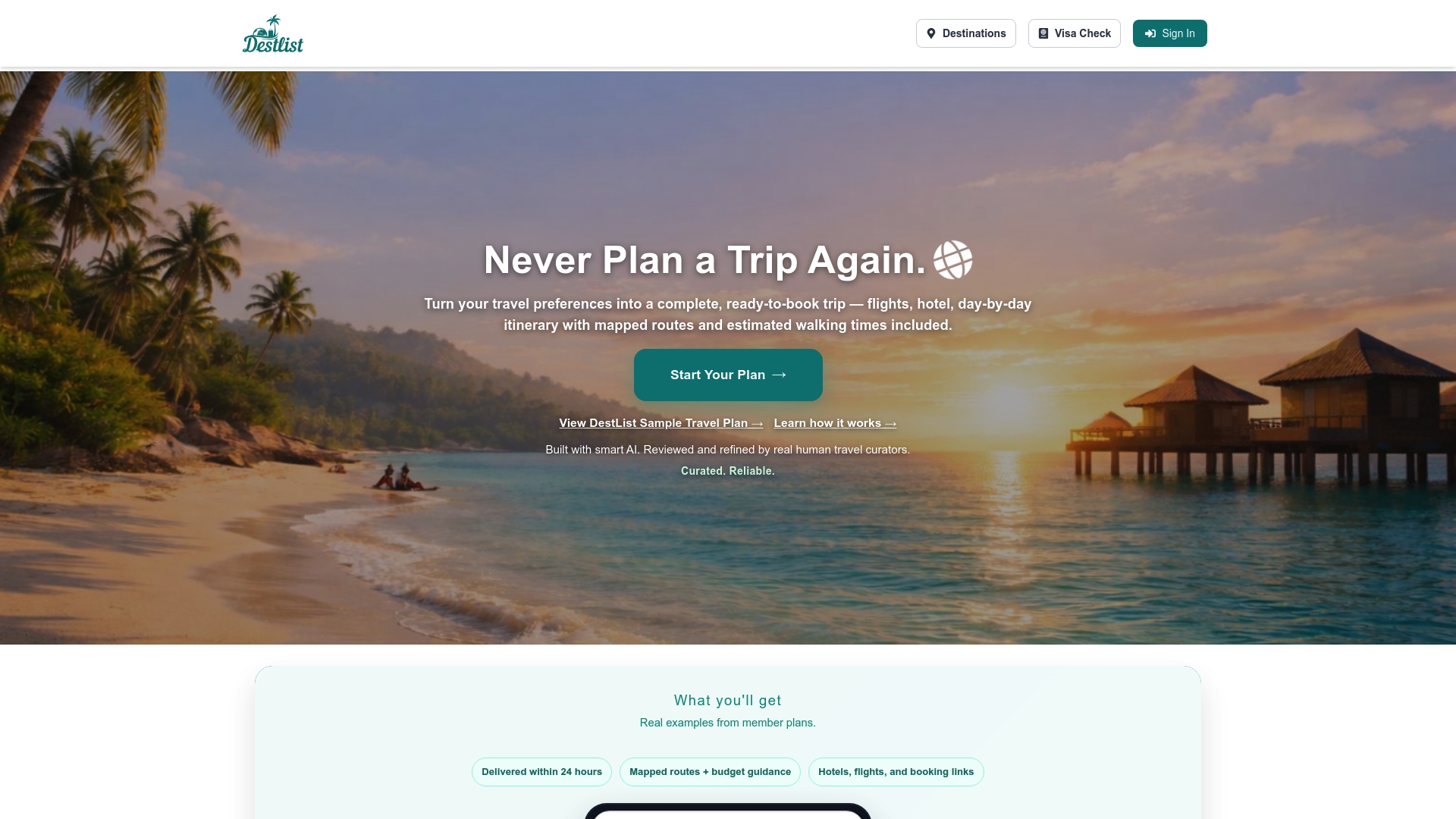
The custom travel itinerary service delivers a complete plan, flights, hotels, day-by-day activities, mapped routes, within 24 hours. Every plan runs through AI matching first, then gets reviewed by a human curator before it lands in your inbox. If you'd rather start from a finished example, browse a ready-made Bali itinerary built for exactly this kind of trip, then submit your own preferences to get a plan built around your dates and budget.
Frequently Asked Questions
What is the simplest definition of a leisure traveler? Someone who travels for personal enjoyment, relaxation, or recreation, paying for the trip themselves rather than an employer covering the cost.
What's the difference between leisure travel and bleisure travel? Leisure travel involves zero work obligations. Bleisure travel starts as a business trip and gets extended with personal days tacked on before or after the work portion.
Do leisure travelers always book through OTAs? Not always, but online channels dominate. Many leisure travelers also use travel agents or curated planning services for complex, multi-stop, or special-occasion trips.
Is visiting family considered leisure travel? Yes. Trips to visit friends or family fall under leisure travel as long as the traveler funds the trip and there's no work component attached.
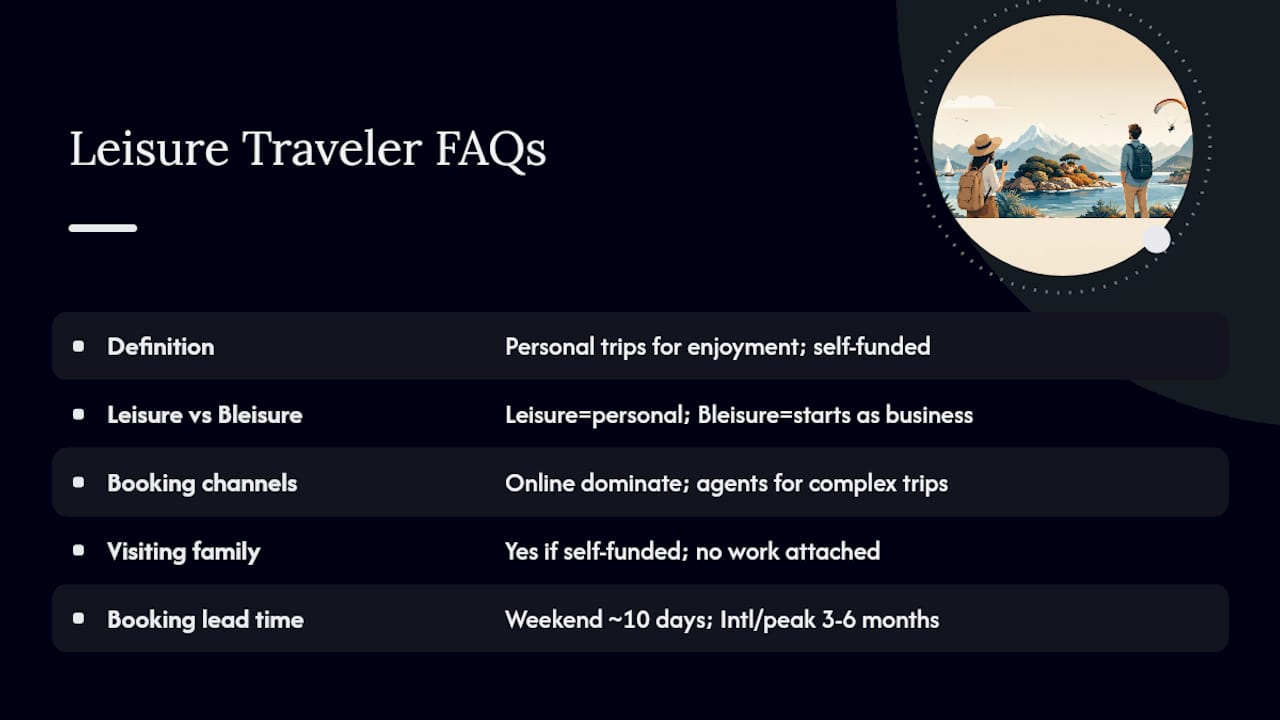
How far in advance do leisure travelers typically book? It varies by trip complexity. Simple weekend trips might get booked ten days out, while international or peak-season trips often get locked in three to six months ahead.
Sources
- Leisure Travel | Statista
- What is the difference between leisure and business travel | Navan
- Leisure travel | BCD Travel glossary