
The fastest way to get accessible trip planning done is an AI-assisted, human-verified itinerary that arrives ready to book, no spreadsheet marathon required. You have two real paths here. Option A: order a done-for-you plan from a service like DestList, where AI drafts the options and a human curator checks every detail before it lands in your inbox. Option B: run a 10 to 30 minute DIY workflow using tools like Gemini, Google Flights, and Google Maps to build a near-ready plan yourself.
Nearly three quarters of U.S. travelers already use AI somewhere in their trip planning, according to Amadeus's Tailored Horizons research, but that same research found trust drops fast once AI is asked to spend money unsupervised. That gap is exactly why human verification matters before anything gets booked.
- Done-for-you: Skip the busywork entirely and let a curator confirm the final plan.
- DIY: Use AI to generate options fast, then verify prices and availability yourself.
Key Takeaways
Accessible trip planning works best as a hybrid process where AI generates fast options and a human curator verifies every detail before booking.
| Point | Details |
|---|---|
| Definition matters | "Accessible" here means easy, fast, ready-to-book planning, not physical accessibility features. |
| AI handles speed | Tools like Gemini generate options and sequencing in minutes using live flight and hotel data. |
| Humans catch errors | Curators verify connection times, visa flags, and cancellation terms before marking a plan ready-to-book. |
| Brief quality drives speed | Complete inputs (dates, budget, loyalty numbers, constraints) prevent back-and-forth delays. |
| DestList as the done-for-you option | DestList delivers AI-drafted, human-verified itineraries with express 24-hour turnaround. |
Table of Contents
- What Accessible Trip Planning Actually Means
- How Do AI and Human Curators Build a Ready-to-Book Itinerary?
- What Should You Expect From an Accessible Trip Planning Service?
- What Do You Need to Share to Get a Fast, Accurate Plan?
- Can You Build Your Own Accessible Itinerary in 30 Minutes?
- Why DestList Is the Faster Way to a Ready-to-Book Trip
- Frequently Asked Questions
- Sources
What Accessible Trip Planning Actually Means
Here, accessible trip planning means one thing: making the planning process easy, fast, and low-friction for people who don't have hours to burn comparing flight times and hotel cancellation policies. It's AI-assisted and human-verified, producing a ready-to-book itinerary instead of a pile of open browser tabs.
The payoff shows up in a few concrete ways:
- Time saved: hours of comparison shopping collapse into a single review pass.
- Fewer booking errors: a human checks dates, connections, and fine print before you commit.
- Cost optimization: AI surfaces budget-aware flight and hotel combinations you'd likely miss manually.
- Disruption handling: contingency options get built in instead of scrambled together mid-trip.
- Calendar and policy compliance: business trips align with meeting windows and expense rules automatically.
Picture a consultant who needs to land in Denver by 9 AM Tuesday for a client meeting, with zero time to shop fares, reflecting the common needs of a business traveler guest. Or a couple squeezing a long weekend into three days off. Both need the same thing: a plan that's already correct, not a set of options to sort through.
How Do AI and Human Curators Build a Ready-to-Book Itinerary?
The hybrid model works in a fairly predictable sequence, and knowing the steps helps you understand where your input actually matters.
- Brief ingestion. You provide dates, budget, preferences, and constraints (more on this below).
- Option generation. AI processes that brief against live flight, hotel, and activity data to draft a full day-by-day sequence in minutes rather than hours.
- Human verification. A curator checks real-time availability, flags visa or documentation issues, and adjusts for special requests AI tends to miss.
- Traveler approval and booking. You review the finished plan and confirm before anything is purchased.
AI is genuinely excellent at speed, option generation, and sequencing routes so you're not zigzagging across a city. The Workplace AI Institute notes that AI reliably structures itineraries and rebuilds schedules on the fly, but it's weaker on live pricing accuracy and nuanced judgment calls. That's the exact gap human curators close, and it's the core argument JournoHQ makes for combining AI speed with human judgment rather than picking one or the other.
Pro Tip: Before an itinerary gets marked "ready-to-book," a good curator always double-checks four things: transit connection times, visa or entry requirements for each leg, whether the room type actually matches accessibility or bedding requests, and any special occasion notes you flagged in the brief.
What Should You Expect From an Accessible Trip Planning Service?
A solid accessible trip planning service delivers a specific set of things, not a vague "personalized experience." Expect:
- A full day-by-day itinerary with logical geographic flow
- Booking links or booking scaffolding for flights, hotels, and rental cars
- Mapped routes with realistic walking or drive times between stops
- A packing list tuned to your destination and season
- Weather alerts and simple contingency suggestions for each day
Delivery speed varies by complexity. Express plans often land within 24 hours, standard requests within 72 hours, and multi-city or multi-week trips can take longer simply because there's more to verify.
Pricing tends to split two ways: subscription models for frequent travelers who plan often, and one-off plans for a single trip. Premium tiers usually add real-time rebooking during disruptions and concierge-level extras like private perks or dining reservations. Think about ROI in plain terms: if a plan saves you five hours of research and booking errors, and costs less than what those five hours are worth to you professionally, it's an easy call.
Look for real trust signals before you pay anyone. That means explicit human verification (not just an AI disclaimer), clear privacy and consent controls over what data gets used, sample itineraries you can review before committing, and a transparent refund or revision policy. A side-by-side comparison from Platinum Flyer found AI alone returns fast, usable drafts, but human-verified plans came out ahead on contingency planning and personalization depth. That's the exact combination DestList builds its process around.
What Do You Need to Share to Get a Fast, Accurate Plan?
The single biggest speed factor isn't the tool, it's how complete your brief is. Vague requests create back-and-forth, and back-and-forth kills the whole "fast" premise.
- Travel dates and purpose (business, leisure, celebration).
- Budget range for flights, hotels, and daily spend.
- Must-see items and any non-negotiables.
- Loyalty program numbers so points and status get applied.
- Calendar availability, especially for business trips with fixed meetings.
- Dietary, mobility, or comfort preferences.
- Passport and visa details, if traveling internationally.
Pro Tip: Set consent scope deliberately. Calendar read-only access is usually enough for scheduling around meetings; only grant booking access if you want confirmations to happen without you clicking each one, and set a clear spend limit either way.
A few things to avoid: don't submit a one-line brief and expect magic, don't withhold a real constraint like a connecting flight you must catch, and don't assume any tool, AI or human, will auto-book without your final approval.

Can You Build Your Own Accessible Itinerary in 30 Minutes?
Yes, and it's genuinely workable for a straightforward trip. Here's a compact version:
- Write a tight brief (5 minutes). Dates, budget, must-sees, constraints, all in one paragraph.
- Generate options with AI (5 to 10 minutes). Gemini can pull from Google Maps, Flights, and Hotels to draft a synthesized itinerary using your saved preferences.
- Cluster stops geographically (5 minutes). Use Google Maps to check that your day-by-day plan doesn't have you crisscrossing a city needlessly.
- Verify before booking (10 minutes). Cross-check flight times and connection margins on Google Flights, and read the actual cancellation terms on any hotel before confirming.
For more on tightening this process further, the same AI-plus-verification logic applies whether you're doing it yourself or paying someone else to.
Why DestList Is the Faster Way to a Ready-to-Book Trip
If the DIY workflow sounds like one more thing on your to-do list, that's the exact problem DestList solves. Instead of juggling Gemini, Google Flights, and Google Maps yourself, you submit one brief and get back a complete, human-checked plan.
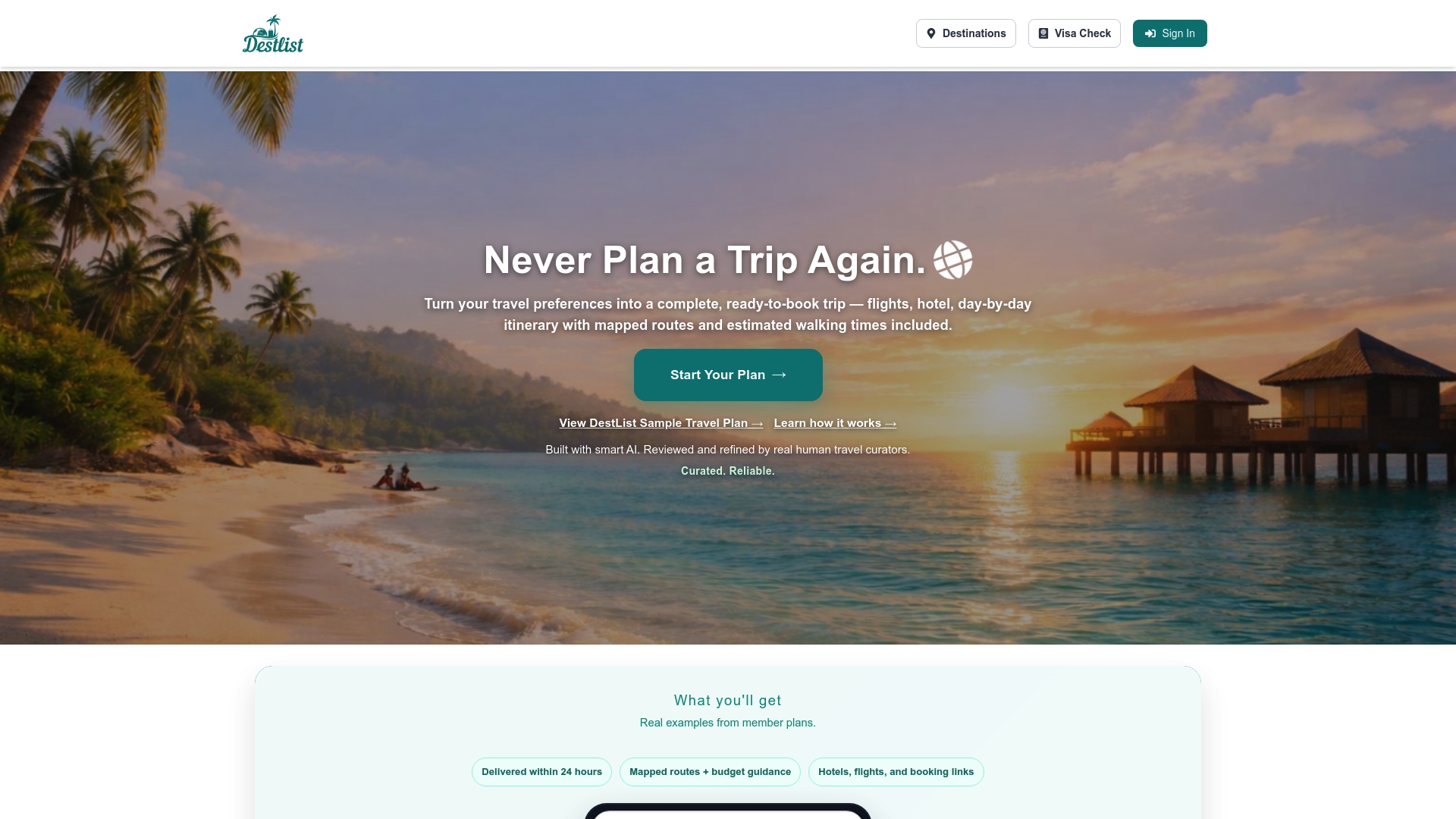
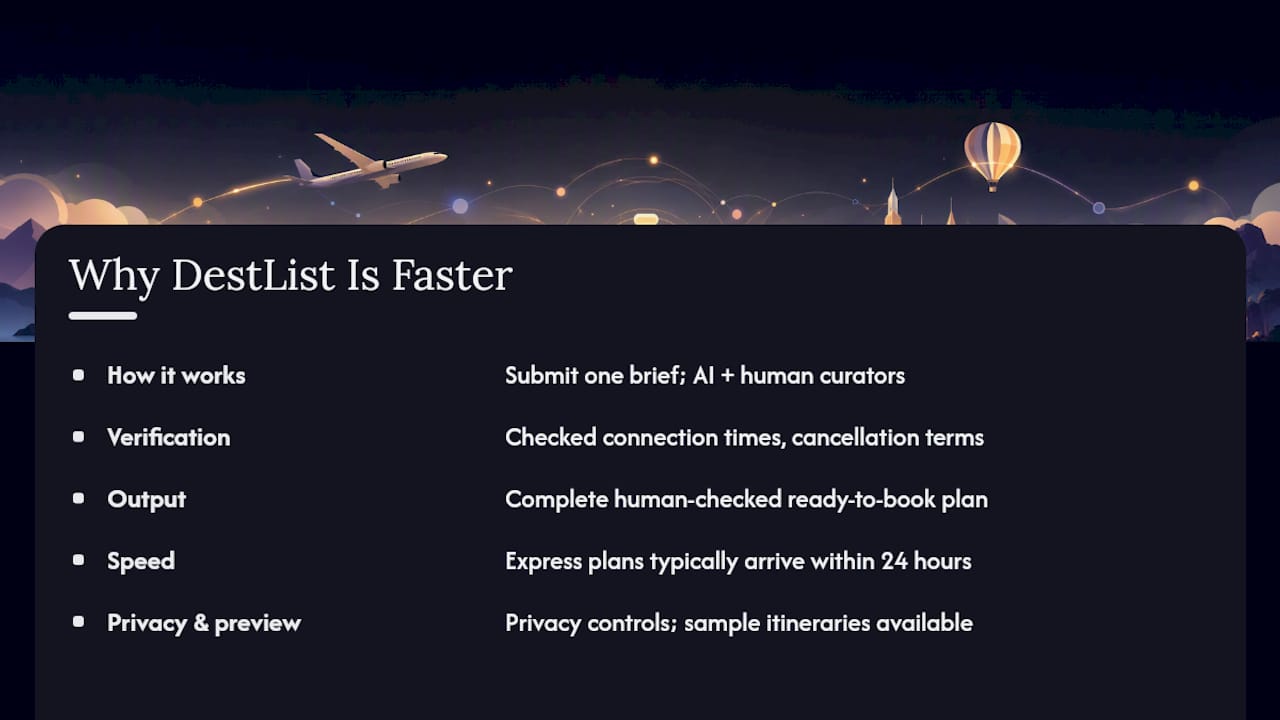
DestList pairs AI-generated flight and hotel matching with real human curators who verify every leg before it's marked ready-to-book. That means checked connection times, confirmed cancellation terms, and a day-by-day flow that's already mapped, not a list of links you still have to compare. Express plans typically arrive within 24 hours, and the process includes privacy controls over what preferences and data get used. You can browse sample itineraries like a 7-day Bali escape or a week in Bangkok built for families to see the level of detail before you commit anything. If you want to see how the full AI-plus-human process works, that page walks through pricing and what each tier includes.
Ready to skip the tab-juggling? Start a custom itinerary and get a ready-to-book plan back without touching a single flight comparison site yourself.
A Quick Note on What Actually Saves Time
I've watched enough travelers try the full DIY route to notice a pattern: the AI draft is rarely the problem. The problem is the 40 minutes spent re-verifying a connection time that turned out to be wrong, or noticing too late that a "refundable" rate had a 48-hour cutoff. A hybrid workflow catches that before it costs you anything.
If your trip is simple and familiar, the DIY method above works fine. If it involves multiple cities, tight business windows, or international travel, hand it to a service where a human checks the fine print before you book. That single verification step is usually what separates a smooth trip from a stressful one.
Frequently Asked Questions
Is accessible trip planning the same as travel planning for people with disabilities? No. In this context, accessible trip planning refers to easy, low-effort, ready-to-book planning for any traveler, not physical accessibility accommodations.
How long does it take to get a ready-to-book itinerary? Express services generally deliver quickly, while standard requests can take several days, and complex multi-city trips can require more time.
Can AI book my flights and hotels automatically? Most reputable services require your final approval before booking, even when AI generates the options, because trust in fully autonomous spending remains low among travelers.
What's the difference between a DIY AI workflow and a paid service like DestList? DIY tools like Gemini and Google Flights get you a usable draft in under 30 minutes, but you handle verification yourself. A paid service adds human review of every detail before it's marked ready-to-book.
What information should I provide to get the fastest, most accurate plan? Share your dates, budget, must-see items, loyalty numbers, calendar availability, and any dietary or mobility preferences upfront to avoid delays from back-and-forth clarification.
Sources
- Tailored Horizons — Amadeus research report
- Why AI is becoming the ultimate travel partner for executive assistants — Workplace AI Institute
- Human Curated Travel: Why It Beats AI Alone — JournoHQ
- AI travel agents vs. a human travel advisor — Platinum Flyer