
TL;DR:
- Family travel curation involves creating personalized trip plans tailored to a family's ages, interests, and budget, reducing planning time and stress. It uses professional or AI tools to build flexible itineraries that improve family experiences and save costs through bundled tickets and tailored activities. Starting with curated trips helps families enjoy more present moments and less decision fatigue during vacations.
Family travel curation is defined as the deliberate, personalized design of a family vacation, where every activity, hotel, and transition is chosen to fit your family's ages, interests, and budget. This is the industry's answer to a real problem: families spend 16–20 hours planning a single vacation on average, with affordability ranking as the top challenge. Curation, whether handled by a professional travel advisor, an AI platform like Destlist, or a hybrid of both, replaces that grind with a ready-to-use plan. The result is less stress, fewer wasted days, and more time actually enjoying the trip.
What is family travel curation and how does it work?
Family travel curation is the professional or AI-assisted process of building a trip plan around your family's specific needs, not a generic template. The industry term for this practice is personalized itinerary design, and it covers everything from flight timing to snack breaks between museum visits.

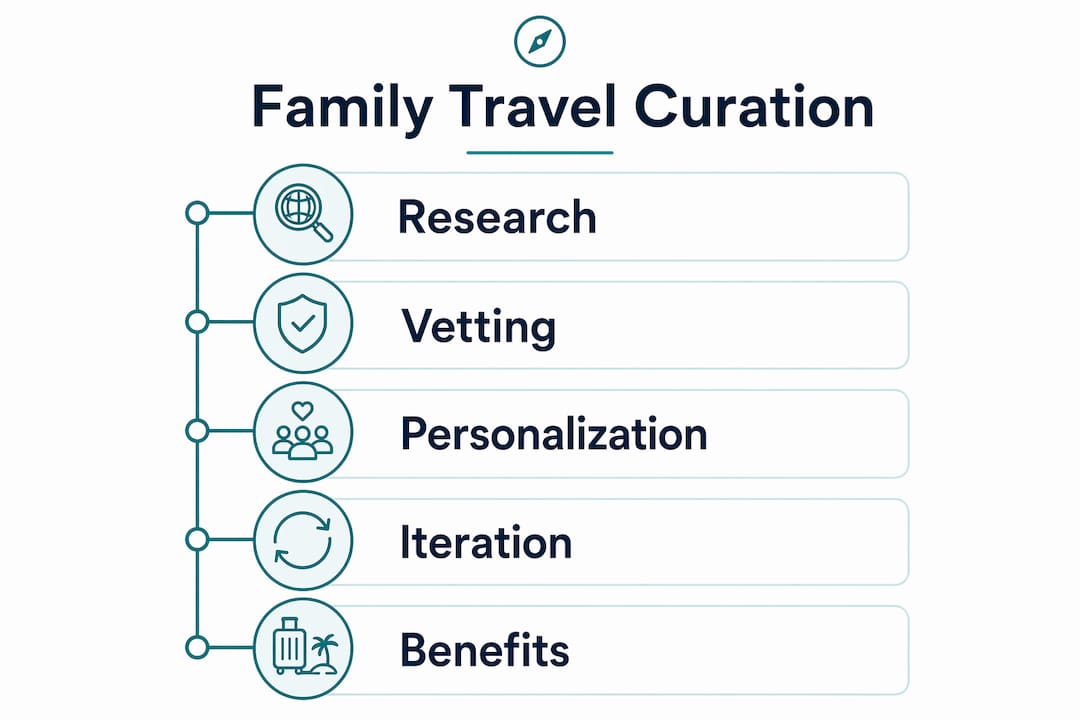
The curation process follows four core steps: research, vetting, personalization, and iteration. A curator first identifies destinations and experiences that match your family's profile. They then vet those options for quality, safety, and age-appropriateness. Next, they personalize the sequence and pacing to fit your children's energy levels and your adults' preferences. Finally, they refine the plan based on your feedback before you ever pack a bag.
Curated itineraries balance family member preferences and age-appropriate pacing as a core design principle. That means a plan for a family with a toddler and a teenager looks nothing like one for a family of adults. Pacing is everything: too many back-to-back attractions cause meltdowns; too much downtime wastes the trip.
Pro Tip: When evaluating a curation service, ask whether their team has physically visited the hotels and restaurants they recommend. In-person vetting of venues is the clearest sign of a serious curator, not just someone pulling from a generic database.
What are the main benefits of family travel curation?
The benefits of curated travel go well beyond convenience. They touch budget, family dynamics, and the quality of memories you bring home.
Here are the five benefits families report most:
- Time savings. Families spend 16–20 hours planning a vacation. A curated plan cuts that to a single conversation or a short online questionnaire.
- Stress reduction. Curated trip plans reduce family travel planning stress by 38%, improving overall vacation quality. Less stress before the trip means more energy during it.
- Budget control. Curators know where to find real savings. CityPASS bundled tickets, for example, save families up to 50% compared to buying attraction tickets individually. That kind of savings adds up fast across a week-long trip.
- Richer experiences. Families choose curated travel to access exclusive child-friendly experiences and avoid generic tourist traps. A good curator knows which aquarium has a behind-the-scenes tour and which one is just a crowded hallway.
- Better family dynamics. When logistics run smoothly, families stop arguing about what to do next and start enjoying each other. That shift is the real return on investment.
"Professionally curated family travel involves thoughtful pacing, practical transitions, and snack breaks to accommodate children's needs. Expertise in child-friendly details improves the trip experience and reduces meltdowns."
The stress reduction benefit alone justifies the cost for most families. A vacation that starts with a fight over a missed reservation is not a vacation. It is a project gone wrong.
How to choose the right family travel curation service
Not every curation service fits every family. The right choice depends on your budget, how much control you want, and how complex your trip is.
Three main service types exist in the market today:
| Service type | Best for | What you get |
|---|---|---|
| DIY curation tools | Budget-conscious families | Digital tools, templates, and AI suggestions with no human review |
| AI-driven platforms | Busy parents who want speed | Full itineraries built with AI, often reviewed by human curators |
| Expert travel advisors | Complex or luxury trips | Fully personalized plans with direct human communication and in-person vetting |
Destlist sits in the middle tier, combining AI-built itineraries with human curator review. That hybrid approach delivers speed without sacrificing the personal touch that generic tools miss.
Before you commit to any service, ask three questions. First, can the plan be adjusted after delivery? Rigid itineraries break the moment a flight changes. Second, does the service account for your children's specific ages and interests, or does it offer one plan for "families"? Third, is pricing transparent, or do fees appear after you have already invested time in the process?
Pro Tip: Book curated plans with flexible hotel and activity reservations whenever possible. Tailoring your itinerary for last-minute changes is far easier when your bookings allow free cancellation up to 48 hours before each activity.
Families planning stays should also think about accommodation style. A holiday home often gives families more space, a kitchen for early breakfasts, and a base that feels less rushed than a hotel. A good curator factors accommodation type into the overall plan, not just the activities.
What practical tools support family travel curation in 2026?
The right tools make the difference between a plan that works on paper and one that holds up on the road. Several digital resources now integrate directly with professional curation services.
- AI itinerary platforms. Services like Destlist use AI to build day-by-day plans with mapped routes, estimated walking times, and weather alerts. The AI itinerary process cuts planning time dramatically while keeping the plan personalized.
- Google My Maps. This free tool lets families visualize their route, pin hotels and restaurants, and share the map with everyone in the group. AI and digital tools like Google My Maps make curated travel more accessible and efficient for families who want to stay oriented.
- CityPASS. This bundled ticket service covers major attractions in cities like New York, Chicago, and San Francisco. Families save up to 50% and skip the ticket line, which matters enormously with young children.
- Downloadable packing checklists. A good curation service includes these as part of the package. They reduce the pre-trip scramble and prevent the "we forgot the sunscreen" moment on day one.
- Self-catering guides. For families who prefer apartment or cottage stays, resources on self-catering stays help maximize the experience and plan meals around local markets.
| Tool | Primary use | Cost |
|---|---|---|
| Destlist | Full AI-curated itinerary with human review | Paid |
| Google My Maps | Route visualization and group sharing | Free |
| CityPASS | Bundled attraction tickets with up to 50% savings | Paid per city |
| Packing checklists | Pre-trip preparation | Free (via curation services) |
These tools work best when they connect. A Destlist itinerary, for example, pairs naturally with a Google My Maps export and a CityPASS bundle for the destination's top attractions. That combination covers planning, navigation, and savings in one coordinated system.
Key Takeaways
Family travel curation saves time, cuts stress, and produces better trips by replacing generic planning with itineraries built around your family's specific ages, interests, and budget.
| Point | Details |
|---|---|
| Curation saves planning time | Families spend 16–20 hours planning vacations; curated services reduce this to a single intake process. |
| Stress drops significantly | Curated plans reduce travel planning stress by 38%, leading to better vacation quality. |
| Budget goes further | Tools like CityPASS save up to 50% on attractions when bundled into a curated plan. |
| Pacing is the hidden key | Age-appropriate scheduling prevents fatigue and meltdowns, especially for mixed-age families. |
| Service type should match your needs | DIY tools, AI platforms, and expert advisors each serve different budgets and complexity levels. |
Why I think most families underestimate what curation actually does
Most families think of travel curation as a luxury. They picture a high-end travel agent booking a private villa and charging a fee that rivals the trip itself. That picture is wrong, and it costs families real enjoyment every year.
What curation actually does is remove the decision fatigue that ruins vacations before they start. When you have researched 40 hotels, compared 12 activity options, and cross-checked school holiday dates, you arrive at the airport already exhausted. The trip has not started, and you are already depleted.
The families I have seen get the most out of curated travel are not the ones with the biggest budgets. They are the ones who handed off the logistics and showed up present. A parent who is not staring at Google Maps during dinner is a parent who is actually at dinner.
The future of this space is hybrid curation, where AI handles the data-heavy work (flight timing, hotel proximity, weather patterns) and a human curator handles the judgment calls (this restaurant is worth the wait; that museum is not worth it with kids under seven). Destlist already operates this way, and the results show in the curated trip examples families share after their trips.
My advice: start with one curated trip, even a short weekend. You will not go back to building spreadsheets.
— Helen
How Destlist builds curated family trips for you
Destlist combines AI-powered planning with real human curator review to produce family itineraries that are ready to book within 24 hours.
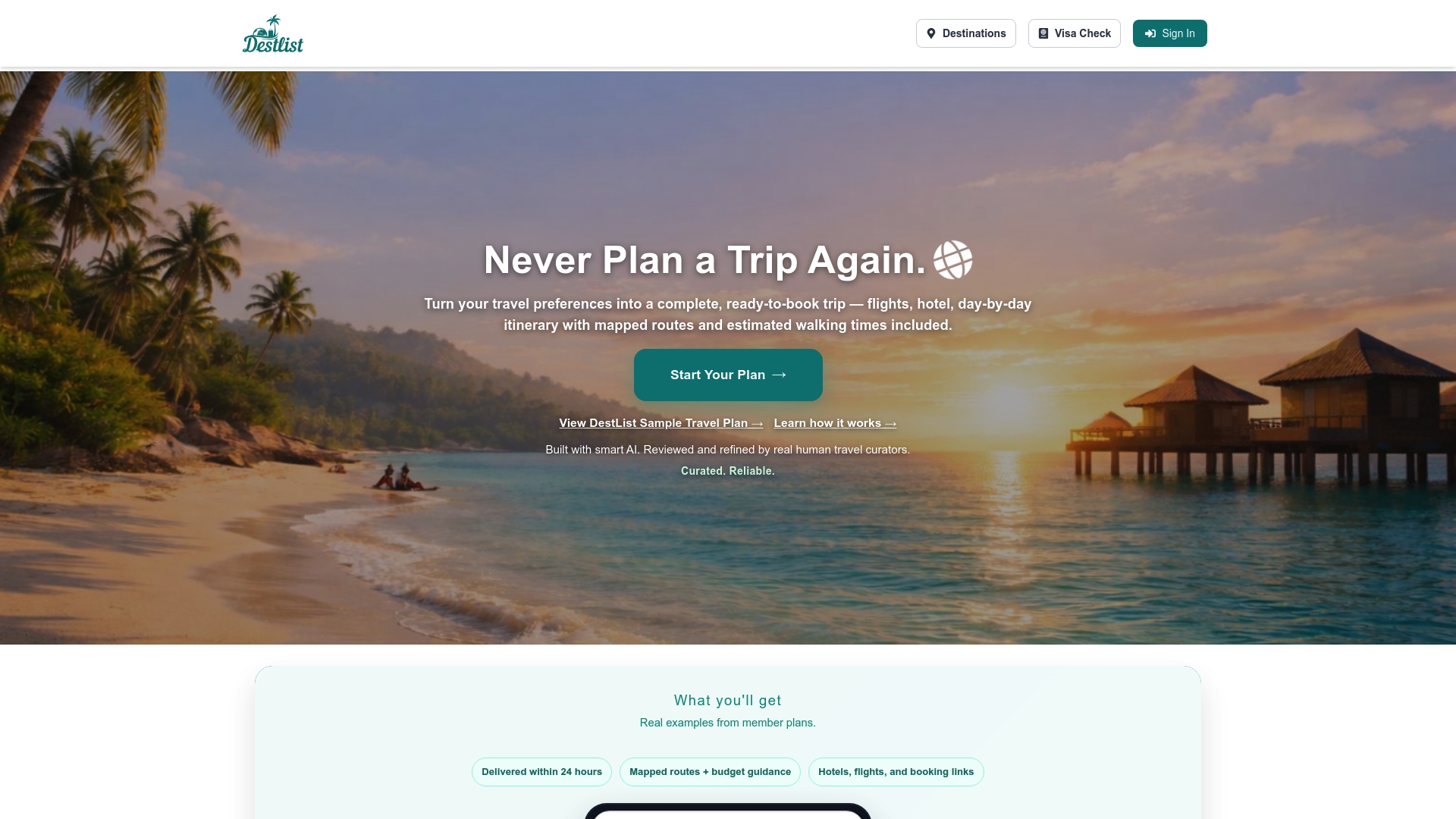
Every plan from Destlist includes day-by-day activities, mapped routes, estimated walking times, hotel recommendations matched to your budget, and weather alerts for your travel dates. Busy parents get a complete, vetted trip plan without spending a weekend buried in browser tabs. You can start with a custom family itinerary built around your family's ages and interests, or browse curated travel plans by destination to find your next trip. Either way, the planning is done for you.
FAQ
What is family travel curation in simple terms?
Family travel curation is the process of designing a personalized vacation plan for your family, covering activities, hotels, and daily logistics based on your ages, interests, and budget. It replaces hours of independent research with a ready-to-use itinerary.
How much time does family travel curation save?
Families typically spend 16–20 hours planning a vacation on their own. A curated service compresses that into a single intake process, often delivering a full plan within 24 hours.
Is curated family travel more expensive than planning yourself?
Not necessarily. Curated plans often include savings tools like CityPASS bundled tickets, which cut attraction costs by up to 50%, and hotel matching that avoids costly booking mistakes. The net cost is frequently comparable to or lower than unguided planning.
What makes a curated family itinerary different from a generic tour package?
A curated itinerary is built around your family's specific profile, including children's ages, energy levels, and interests. Generic tour packages use fixed schedules that rarely account for the real needs of mixed-age groups.
Can I adjust a curated plan after I receive it?
Most professional curation services and AI platforms allow revisions after delivery. Destlist, for example, builds plans that families can adjust before booking, and recommends flexible reservations to handle last-minute changes.