
TL;DR:
- On-demand itinerary creation generates personalized travel plans quickly based on user inputs and live destination data. Human review and live inventory connections are essential for reliable, bookable itineraries, especially for complex trips. Destlist offers AI-assisted, human-verified plans delivered within 24 hours, including mapped routes and booking links.
On-demand itinerary creation is the process of generating a personalized, day-by-day travel plan in real time, triggered by a traveler's specific inputs rather than pulled from a pre-built template. The system takes your dates, budget, interests, and party size, then assembles a complete trip plan, often within minutes or hours, using a combination of AI, live destination data, and, in the best implementations, a human reviewer.
The bottom line: if you want a trip plan that fits your actual constraints without spending a weekend researching, on-demand itinerary creation is the right tool. It works best for travelers who know roughly what they want but need the logistics sorted fast.
- Speed: AI pipelines can produce hundreds of personalized itineraries per hour, while a manual travel agent typically generates 8–12 personalized itineraries per day.
- Personalization: Outputs reflect your stated preferences, not a generic "top 10 things to do" list.
- Readiness-to-book: The best services, including Destlist, deliver plans with live booking links, mapped routes, and confirmed availability, not just suggestions.
- Human-in-the-loop: A human curator reviews the AI draft before delivery on complex or multi-day trips, catching the local nuances that pure automation misses.
Table of Contents
- What on-demand itinerary creation actually delivers
- How on-demand itinerary systems actually work
- Key features travelers and travel pros should expect
- What service models exist and which one fits your trip
- Real benefits, practical limits, and common failure modes
- How to request a usable on-demand itinerary, step by step
- Typical delivery timelines and pricing models in the U.S.
- How to choose an on-demand itinerary provider
- How Destlist delivers on-demand itineraries in practice
- Key Takeaways
- The gap between "AI-generated" and "actually usable"
- Destlist turns your preferences into a ready-to-book plan
- Useful sources and further reading
What on-demand itinerary creation actually delivers
The phrase covers a wide range of products, and the differences matter. At the basic end, you get a one-shot draft: a text-based schedule the system generates once, with no live data behind it. Step up and you get an editable itinerary, where you can swap a museum for a food tour without rebuilding the whole day. At the top tier, you get a fully bookable, end-to-end plan with confirmed availability, pricing, and direct booking links.
Typical deliverables from a solid service include a day-by-day schedule with timed activity slots, mapped routes with estimated walking or transit times, real-time booking links for hotels and activities, a packing list tailored to your destination and season, weather alerts, and a shareable format, usually PDF, an interactive dashboard, or both. Some platforms also include visa information and accessibility notes.
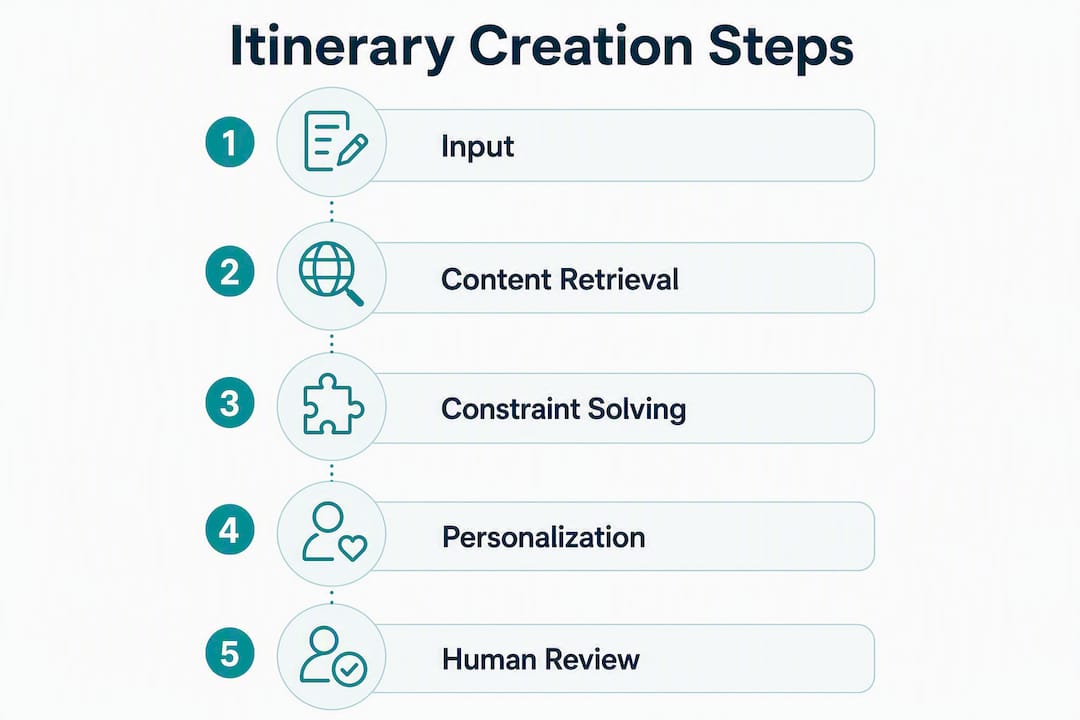
The work happens in three places simultaneously: your inputs (dates, budget, interests), a destination content layer (supplier data, opening hours, capacity), and the system that connects them. Understanding that three-part structure is what separates a useful on-demand plan from a hallucinated one.
How on-demand itinerary systems actually work
The pipeline behind a production-grade AI itinerary planner has four core components: a natural-language input parser, a queryable inventory layer, a constraint solver, and a personalization engine. Each one does a specific job, and skipping any of them is where things go wrong.
Input parsing converts your free-text or form-based preferences into structured data fields: destination, travel dates, party composition, budget range, accessibility needs, travel style, and any must-see items. This structured record then triggers a CRM or preference query if the system has your past booking history.

Destination content retrieval pulls live supplier data: hotel availability, attraction opening hours, restaurant capacity, and the latitude/longitude coordinates needed for routing. The metadata fields that matter most are opening hours, cancellation policies, and amenities, because those are what the constraint solver checks next.
The constraint solver is where most of the engineering effort lives. It validates that the proposed sequence is actually feasible: travel times between venues, whether a site is open on the day you're visiting, whether the budget holds across the full plan, and whether accessibility requirements are met throughout. Without this step, an AI draft can confidently schedule a museum visit on its weekly closing day.
The personalization engine ranks and re-orders options based on your stated preferences and, where available, behavioral data from past trips. The final output goes through a delivery queue, often with a human reviewer in the loop for complex itineraries, before reaching you.
Pro Tip: When evaluating any on-demand itinerary service, ask specifically whether human verification is part of the workflow for multi-day or international trips. A service-level agreement that mentions "human-reviewed" or "curator-approved" deliverables is a meaningful trust signal, not just marketing language.
Key features travelers and travel pros should expect
Not every itinerary tool delivers the same capabilities. Here is what a genuinely useful on-demand travel planning service should include:
- Personalized day-by-day timelines with timed slots, not just a list of suggestions.
- Single-day swap functionality so you can replace one activity without rebuilding the whole schedule.
- Mapped routes with estimated walking or transit times between each stop.
- Real-time booking links that check live inventory, not cached data from last month.
- Pricing estimates for activities, meals, and transport so the plan stays within your stated budget.
- Accessibility filters covering mobility, dietary, and sensory needs.
- Group and party handling that accounts for traveling with children, seniors, or mixed-interest groups.
- Export and share formats: PDF download, interactive web dashboard, calendar sync, and mobile push notifications.
The booking links deserve special attention. A link that routes to a supplier's homepage is not the same as a link that checks live availability and holds a reservation. The former is a suggestion; the latter is a deliverable. When a provider says "bookable itinerary," ask exactly which of those two they mean.
Pro Tip: Look for itinerary tools that sync with your phone's calendar and send push alerts for weather changes or venue closures. Static PDFs are fine for reference, but a live-updating plan saves real headaches on the ground.
What service models exist and which one fits your trip
| Service model | Typical user | Typical deliverable |
|---|---|---|
| DIY planner app | Independent traveler, short city break | Self-built schedule; AI suggestions; no human review |
| Agent-assisted hybrid | Travel professional, mid-complexity trip | AI draft reviewed and edited by an agent before delivery |
| Done-for-you curated | Busy professional, complex multi-day or group trip | Fully curated, human-verified, ready-to-book plan |
DIY tools work well for a weekend trip where you already know the destination and just need the logistics organized. You input the details, the AI generates a draft, and you edit it yourself. The trade-off is time: you are still doing the validation work.
Agent-assisted tools are where most travel agencies operate today. Travel agents use AI drafts as starting points, approve or swap activities quickly, and share polished itineraries with clients in minutes instead of hours. The AI handles volume; the agent handles nuance.

Done-for-you services handle everything. You submit your preferences, a system builds the plan, and a human curator reviews it before it reaches you. This model fits complex multi-day trips, group travel, or anyone who simply does not want to think about logistics. It costs more and takes longer than a DIY draft, but the output is genuinely ready to act on.
Real benefits, practical limits, and common failure modes
The benefits of on-demand itinerary creation are real and well-documented. Speed is the obvious one: where a travel agent typically produces 8–12 personalized plans in a full workday, a properly configured AI pipeline handles hundreds per hour. For agencies, that throughput translates directly into faster client turnaround and higher conversion rates. For individual travelers, it means a complete trip plan in the time it takes to drink a coffee.
Personalization quality improves significantly when the system has good input data. Structured, real-time inventory sources produce far more reliable results than LLM predictions alone. The more specific your preferences, the better the output.
The limits are just as real. The most common failure mode is hallucinated availability: an AI confidently schedules a restaurant that closed six months ago, or a tour that runs only on weekends. A constraint solver that validates opening hours, capacity, and routing catches most of these, but only if it is connected to live data. Systems without live inventory connections are producing educated guesses, not confirmed plans.
Unrealistic pacing is another common problem. An AI that does not account for transit fatigue, local crowding at peak hours, or the actual walking distance between venues will produce a schedule that looks clean on paper and exhausts you by noon. Human-in-the-loop review catches this kind of issue because a person who knows the destination recognizes when a plan is physically unreasonable.
Watch for these provider red flags: no mention of live inventory connections, no human review option for complex trips, no stated delivery timeline, and no clear revision or refund policy.
Pro Tip: Spot-check any itinerary before you commit to booking add-ons. Verify three things: confirm the opening hours for one attraction directly on the venue's website, check the transit time between two consecutive stops on Google Maps, and click one booking link to confirm it shows live availability. If any of those three fail, the plan needs revision before you pay for anything.
How to request a usable on-demand itinerary, step by step
Getting a good first result depends almost entirely on what you put in. Here is the process:
- Prepare your inputs. Gather travel dates, party composition (ages, accessibility needs), total budget, must-see items, preferred pace (relaxed, moderate, packed), and any booking flexibility (fixed flights vs. flexible dates).
- Select a service model. Match the complexity of your trip to the right tier: DIY for a simple weekend, agent-assisted for a mid-range trip, done-for-you for anything complex or time-sensitive.
- Submit your request. Use the platform's form or prompt field. The more structured your input, the better the output.
- Review the draft. Check the pacing, confirm the routing makes geographic sense, and flag any activities that do not match your preferences.
- Request edits. Use the swap or revision feature to replace specific days or activities. A good service handles this without rebuilding the whole plan.
- Confirm and upgrade to bookable. Once the plan looks right, activate the booking links or request the service to confirm reservations on your behalf.
Example request template you can adapt:
That level of detail gives any on-demand system enough to produce a genuinely personalized plan on the first pass. Vague inputs produce generic outputs. For more on tailoring trip itineraries with specific preference data, the approach scales to any destination.
Typical delivery timelines and pricing models in the U.S.
| Delivery tier | Typical timeline | What's included |
|---|---|---|
| Instant automated draft | Under 5 minutes | AI-generated schedule; no live inventory check; editable |
| Curated, ready-to-book | Within 24 hours | AI draft + human review; live booking links; maps; packing list |
| Complex multi-day, human-curated | — | Full curation; group handling; confirmed reservations; detailed routing |
The throughput gap between manual and AI-assisted planning is significant. A single travel agent produces roughly 8–12 personalized itineraries per day; AI pipelines generate hundreds per hour when properly configured. That scale is why the 24-hour promise is achievable even for complex trips: the AI handles the volume, the human handles the review.
On pricing, U.S. market models generally fall into four categories:
- Free or basic tier: AI-generated draft with no live inventory check; suitable for inspiration, not booking.
- Per-trip flat fee: A one-time charge for a single curated plan; typical for done-for-you services.
- Monthly or annual subscription: Unlimited or high-volume plans; best for frequent travelers or travel professionals.
- Enterprise or agency licensing: Volume pricing with API access, white-label options, and dedicated support.
Add-ons typically include bookable-ticket handling (the service confirms reservations on your behalf) and premium upgrades like airport transfers or travel insurance through partner links.
Pro Tip: When evaluating price against deliverable, "ready-to-book" should mean live booking links with confirmed availability, mapped routes, and a revision window, not just a formatted PDF. If a service charges a per-trip fee but cannot confirm whether venues are open on your travel dates, you are paying for a draft, not a plan.
How to choose an on-demand itinerary provider
The checklist that matters most when comparing providers:
- Live inventory API connections (not cached or scraped data)
- Constraint validation for routing, opening hours, and budget
- Human-in-the-loop option for complex or multi-day trips
- Sample itinerary available before purchase
- Clear SLA for delivery time and number of revisions included
- Explicit refund or revision policy if the plan contains errors
- Data privacy policy covering how your preference data is stored and used
Ten questions worth asking any provider directly:
- Do you validate availability via live supplier APIs, or do you use cached data?
- What is your revision policy if an activity turns out to be unavailable?
- Can I see a sample itinerary for my specific destination before I pay?
- Is there a human reviewer on complex or international trips?
- What is your stated delivery time, and what happens if you miss it?
- How do you handle accessibility requirements in the routing?
- What export formats do you support (PDF, calendar sync, mobile)?
- Do booking links check live inventory or route to a homepage?
- What data do you store from my trip preferences, and how is it used?
- Is there a subscription option, or is pricing per trip only?
Red flags to walk away from: a provider that cannot show you a sample deliverable, one that describes availability as "generally accurate" without mentioning live data, or any service with no stated revision workflow. A vague answer to question 2 above is usually enough to disqualify a provider.
For proof, verify a sample itinerary before committing to booking add-ons. Confirm one venue's opening hours directly, check one transit time independently, and click one booking link to confirm it shows real availability. Three checks, two minutes, and you will know whether the plan is real or a polished guess.
Pro Tip: Ask for a sample itinerary for a destination you already know well. You will immediately spot whether the pacing is realistic, whether the routing makes geographic sense, and whether the suggested venues are actually open and bookable. A provider confident in their product will send one without hesitation.
How Destlist delivers on-demand itineraries in practice
Destlist is a concrete example of the done-for-you model working as described. A traveler submits their preferences, and Destlist's system builds a plan using AI-assisted generation followed by human curator review, with the finished product delivered within 24 hours.
The deliverables are specific: a day-by-day timeline with timed activity slots, mapped routes with estimated walking times, live booking links for flights and hotels, a packing list matched to the destination and season, and weather alerts. The plan is built around your stated budget, party size, and interests, not a generic template.
The human-in-the-loop step is what separates Destlist's output from a raw AI draft. A curator reviews the plan for pacing, local accuracy, and booking feasibility before it reaches you. For travelers who want to see what a finished deliverable looks like before committing, examples of personalized trip plans show the format and depth of a completed itinerary.
Travelers who want the full done-for-you experience can access Destlist's custom travel itinerary service directly, with options for a one-time trip plan or a subscription for frequent travel.
Key Takeaways
On-demand itinerary creation delivers personalized, ready-to-book trip plans fast, but output quality depends entirely on live inventory connections, constraint validation, and human review for complex trips.
| Point | Details |
|---|---|
| Definition and best use | On-demand itinerary creation generates personalized trip plans from your inputs in minutes to 24 hours; best for travelers who need logistics handled quickly. |
| Validate a provider quickly | Check three things: confirm one venue's opening hours, verify one transit time, and click one booking link to confirm live availability. |
| Timeline and cost expectations | Automated drafts take minutes and are free or low-cost; curated, ready-to-book plans typically deliver within 24 hours at a per-trip or subscription fee. |
| Human review matters | For complex or multi-day trips, a human-in-the-loop step catches pacing errors and local nuances that pure automation misses. |
| Destlist | Destlist delivers AI-assisted, human-verified itineraries within 24 hours, including mapped routes, booking links, packing lists, and weather alerts. |
The gap between "AI-generated" and "actually usable"
The travel industry has moved fast on AI itinerary tools, and most of the conversation focuses on speed and personalization. Both are real advantages. But the more interesting question is what separates a plan that sounds good from one you can actually use.
The answer is almost never the AI model itself. It is the system around it: whether the tool connects to live inventory, whether a constraint solver checks that your 10 AM museum visit is not on a Tuesday when it is closed, whether a human reviewer catches the itinerary that schedules three hours of walking in 95-degree heat with no shade. Those are engineering and operational decisions, not AI decisions.
What this means practically: when you are evaluating any on-demand itinerary service, the questions about live data, constraint validation, and human review are not technical details you can skip. They are the difference between a polished document and a plan that holds up on the ground. The role of data-driven trip ideas in producing reliable outputs is consistently underestimated by travelers who assume the AI handles everything.
The other thing worth saying: the 24-hour ready-to-book promise is achievable and meaningful when a service is built correctly. It is not a marketing claim if the infrastructure behind it includes live APIs, a constraint solver, and a human review queue. It is just what the product does. The question is whether a given provider has actually built that, or whether they are calling a formatted AI draft "ready to book."
Destlist turns your preferences into a ready-to-book plan
Travelers who want the done-for-you experience without the back-and-forth of a traditional travel agent have a direct option in Destlist. The platform takes your preferences, dates, and budget, builds a complete itinerary using AI-assisted planning, and has a human curator review it before delivery, all within 24 hours.
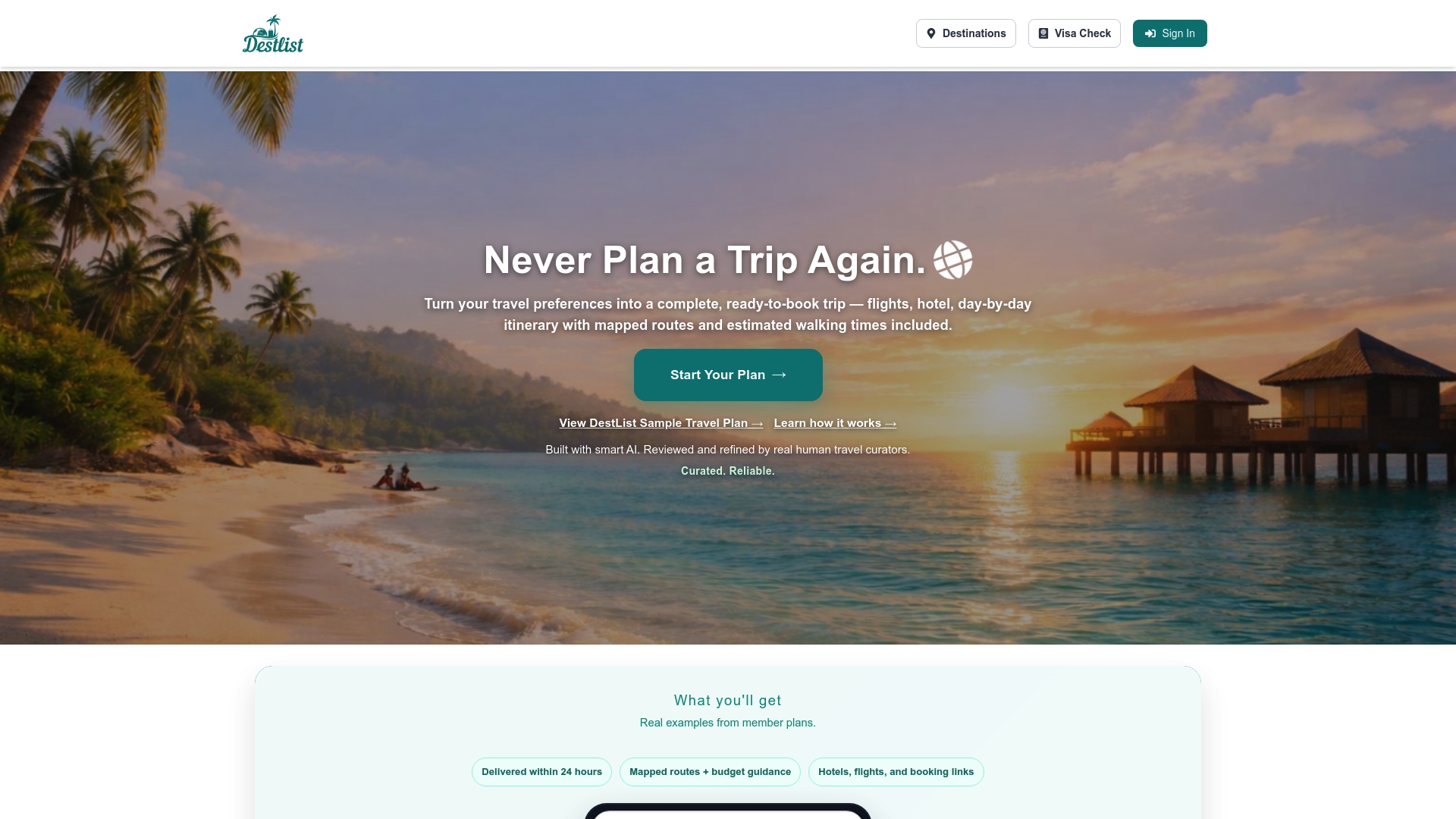
What you get is specific: a day-by-day schedule, mapped routes with walking times, live booking links, a packing list matched to the destination and season, and weather alerts. Pricing is available as a one-time trip plan or a subscription for travelers who plan frequently. There is no long research process, no generic template, and no plan that falls apart when you check the first booking link.
See what a finished plan looks like and start your done-for-you travel planning with Destlist directly.
Useful sources and further reading
- AI-powered Itinerary Planner: How to build one that travelers actually use — Technical breakdown of the four-component architecture (input parser, inventory layer, constraint solver, personalization engine) behind production-grade itinerary systems.
- Auto-Generate AI Travel Itineraries in Minutes | LOW/CODE — Step-by-step generation pipeline and throughput statistics comparing manual agent output to AI-assisted production.
- AI Itinerary Builder Explained: How It Works & Who Uses It — Practical overview of how travel agencies use AI drafts to accelerate agent workflows and improve client turnaround.
- Building a human-in-the-loop travel agent with LangGraph.js — Practitioner case for why human verification remains critical for complex and international itineraries.
- Done For You Travel Planning | DestList — Destlist product page describing the AI-assisted, human-verified 24-hour itinerary service and its deliverables.
- Travel Itinerary Builder Software: Features and Use Cases — Industry overview of itinerary builder software categories, features, and agency use cases.
- Luxury Travel Trends 2026: What Discerning Travelers Need — Analysis of high-end traveler preferences in 2026, useful for understanding how on-demand personalization fits premium travel expectations.
- Streamline your travel itinerary process with AI tips — Practical guidance for travel teams on automating personalized trip planning and reducing agent time per booking.
- Itinerary planning workflow: save 10+ hours per trip — Workflow examples showing time savings for busy travelers and travel professionals using on-demand planning tools.