
TL;DR:
- Optimizing a solo trip involves detailed planning that reduces stress, safety gaps, and costs before departure.
- Using AI for itinerary drafting and route grouping speeds up preparation, but safety and personal judgment remain essential.
Solo trip optimization is a repeatable planning process that reduces friction, closes safety gaps, and maximizes the quality of your experience as a solo traveler. Run it before every trip and you'll arrive calmer, spend less, and make better decisions on the ground.
TL;DR — what you get from optimizing:
- A safer arrival with pre-booked transport and a daylight landing window
- Lower costs by avoiding last-minute decisions and single-supplement traps
- Fewer decision points on day one, so you can actually enjoy the place
Three things to do right now:
- Set your arrival window to daylight hours (before 4 PM local time)
- Pre-book your airport-to-hotel transfer before anything else
- Share your full itinerary with one trusted contact at home
Table of Contents
- Why does optimizing a solo trip actually pay off?
- What problems does solo travel actually create?
- How do AI tools actually help you plan a solo trip?
- What does a step-by-step solo trip optimization workflow look like?
- What safety protocols should every solo traveler have in place?
- How do you build social moments into a solo itinerary?
- What does an AI-driven solo trip workflow look like in practice?
- Your reusable solo trip skeleton and packing checklist
- Key Takeaways
- The part of solo trip optimization most guides skip
- Destlist builds this workflow into a ready-to-book plan for you
- Useful sources
Why does optimizing a solo trip actually pay off?
Solo travel is one of the fastest-growing travel formats for a reason. You set the pace, change plans without negotiating, and follow your curiosity instead of a group agenda. But that freedom comes with a real planning cost: every decision lands on you alone.
Investing two to three focused hours before departure pays back many times over. You arrive knowing exactly where you're going, which removes the most stressful part of any trip. You've already locked your best flight price by booking at the right window. And you've built a skeleton itinerary that keeps the day moving without over-scheduling it.
The emotional payoff is just as real. Travelers who start small and choose an accessible destination report that the first trip is the hardest, and every subsequent one gets easier. Confidence compounds. By trip three, you're not optimizing to reduce anxiety; you're optimizing to get more out of the experience.
Booking window stat: According to The Points Guy, domestic flights are best booked 1–3 months ahead and international flights 2–6 months ahead for the best balance of price and seat availability.
What problems does solo travel actually create?
Understanding the friction points is half the battle. Here's what tends to derail solo trips, and what optimization directly fixes.
The planning burden. Every task falls on one person. Flights, hotels, transfers, activities, safety research — there's no one to split the workload with. Without a system, this becomes exhausting and leads to either over-planning or under-planning.
Arrival stress. Landing in an unfamiliar city alone, especially at night, is when most solo travelers feel most vulnerable. Pre-booking your airport transfer and arriving during daylight removes most of that stress before it starts.
Safety gaps. No one automatically knows where you are. A missed check-in or a lost document can escalate quickly when there's no travel companion to notice.
The single supplement. Tour operators and cruise lines routinely charge solo travelers a premium for rooms built for two. That surcharge can add a significant premium to your accommodation cost on guided trips. Watch for it on any package tour, river cruise, or all-inclusive booking.
Loneliness, especially at mealtimes. Dinnertime is when solo travelers most often feel the absence of company. It's not inevitable, but it needs to be planned around.
Pro Tip: When comparing tour packages, always ask for the single-supplement figure before you book. Some operators waive it for last-minute solo bookings or offer a roommate-matching program. Check cost-balancing strategies before committing to any guided package.
How do AI tools actually help you plan a solo trip?
AI won't replace your judgment, but it will cut your planning time significantly. Here's where it genuinely earns its keep.
Itinerary drafting. Feed an AI tool your destination, dates, budget, and interests, and you'll get a rough day-by-day plan in under two minutes. That draft isn't final, but it's a far better starting point than a blank page.
Route grouping. AI can cluster activities by neighborhood so you're not zigzagging across a city. This alone saves hours of walking and transit time.

Local safety research. Tools like ChatGPT or Perplexity can summarize neighborhood safety notes, public transit hours, and common tourist scams for a specific city. Treat this as a starting point, not a verdict. Always cross-check with a current government travel advisory.
Packing optimization. Describe your trip type, climate, and bag size, and an AI can generate a tailored packing list in seconds. Far more useful than a generic checklist.
Language and logistics. AI translation tools handle menus, signs, and basic conversations. For transit-heavy cities, they can also decode local app interfaces that don't have English versions.
Where human judgment still matters: Safety nuance is the big one. An AI might tell you a neighborhood is "generally safe" without knowing that conditions have changed recently, or that safety varies significantly by time of day. Your own comfort level, mobility needs, and risk tolerance can't be automated.
Pro Tip: Never paste your full passport number, home address, or financial details into a public AI chat. Use a private or incognito session, and store your document copies in an encrypted cloud folder like Google Drive or iCloud with two-factor authentication enabled.
What does a step-by-step solo trip optimization workflow look like?
This is the timeline that removes most of the guesswork. Adjust the windows based on your trip length and destination.
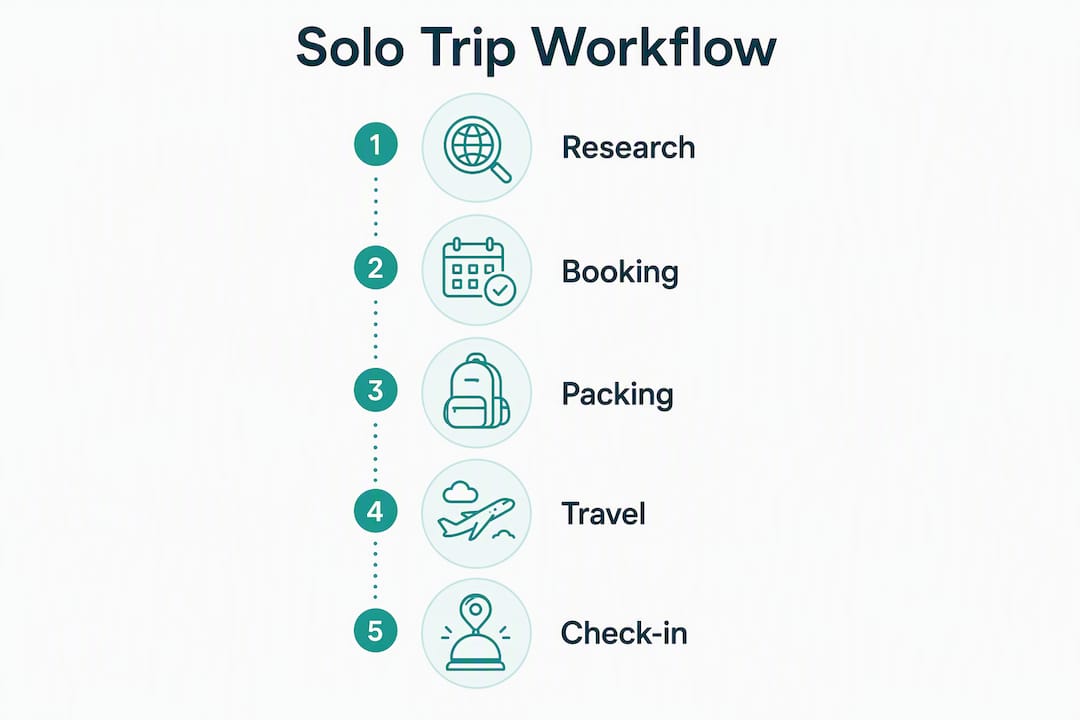
The booking timeline
| Stage | Domestic trip | International trip | What to lock in |
|---|---|---|---|
| Idea to research | 4–6 weeks out | 3–6 months out | Destination, rough dates, budget |
| Flights | 1–3 months out | 2–6 months out | Outbound and return flights |
| First two nights | Same as flights | Same as flights | Hotel or hostel near arrival point |
| Activities | 2–3 weeks out | 4–6 weeks out | Any timed entry, tours, or classes |
| Final logistics | 1 week out | 1–2 weeks out | Transfer, SIM card, insurance, packing |
For city-specific timing, NYC is a useful benchmark: booking your hotel early in a high-demand market like New York can mean the difference between a central location and a long commute every morning.
Pre-trip essentials checklist
- Passport valid for at least six months beyond return date
- Travel insurance purchased (ideally before your first booking)
- Airport transfer pre-booked and confirmed
- Digital and physical copies of passport, insurance, and hotel confirmation
- Emergency contacts written down, not just stored in your phone
- Local emergency number for your destination saved offline
Pro Tip: Leave your itinerary as flexible as possible after the first 24 hours. Buffer days and open afternoons aren't wasted time — they're where the best solo travel moments actually happen. Over-scheduling is the most common mistake first-time solo travelers make.
A solid solo travel planning guide will walk you through each of these stages in more detail, but the table above gives you the skeleton.
What safety protocols should every solo traveler have in place?
Safety for solo travelers isn't about paranoia. It's about having a system so that if something goes wrong, the response is automatic rather than panicked.
Before you leave
- Share your full itinerary (flights, hotels, daily plans) with one trusted person at home.
- Establish a check-in cadence: a quick message when you arrive somewhere new, and a daily or every-other-day check-in time. If they don't hear from you, they should know exactly who to call.
- Upload color copies of your passport, visa, travel insurance, and credit cards to a secure cloud folder. Leave physical copies with your trusted contact.
- Write down emergency contacts on paper: your destination country's emergency number, your country's embassy or consulate, and your travel insurance's 24-hour line.
- Pre-book your airport transfer. Arriving in a new city and negotiating transport while tired and disoriented is avoidable.
- Research your destination's safety profile using a government travel advisory before departure.
During the trip
Arrive during daylight whenever possible. The difference between a 2 PM arrival and a midnight arrival in an unfamiliar city is enormous in terms of how safe and confident you feel navigating to your accommodation.
Establish check-in times with your contact at home and stick to them. Share your hotel room number once you have it — some hotels will only confirm a guest's presence to a caller who already has the room number.
If something goes wrong
For a lost or stolen passport: contact your nearest embassy or consulate immediately. Your cloud-stored copy speeds up the replacement process significantly. For a missed connection: contact your airline first, then your travel insurance provider. For a medical emergency: call the local emergency number (saved offline before you left) and contact your insurer's 24-hour line.
Pro Tip: Buy travel insurance before you make any other bookings. If a medical issue arises between booking your flight and your departure date, insurance purchased after the fact may not cover it. It's the one purchase that costs almost nothing relative to what it protects.
How do you build social moments into a solo itinerary?
Loneliness on a solo trip is almost always a planning problem, not a personality problem. The fix is building low-effort social touchpoints into the schedule rather than hoping they happen organically.
The most reliable options are communal dining, single-day group tours, and social accommodation. Eating at the bar instead of a table for one is a small shift that changes the entire dynamic of a meal. Bartenders talk, other solo diners talk, and the setting makes conversation feel natural rather than forced. A cooking class or food tour does the same thing in a more structured way, and you leave with both a skill and a story.
For a three-to-seven-day trip, four touchpoints tend to be enough:
- Day 1 evening: Eat at the bar of a well-reviewed local spot near your hotel. No agenda, just presence.
- Day 2 or 3: Book a half-day group walking tour or food tour. These attract other solo travelers and are easy to find through platforms like Viator or GetYourGuide.
- Mid-trip: Find a co-working café or a social hostel common area for an afternoon of work or reading. You don't need to force conversation; just being in the right environment does most of the work.
- Last evening: Join a meetup or a class (photography walk, language exchange, cooking session). Meetup.com has active groups in most major cities worldwide.
If you're staying in a hostel, book a private room. You get the social infrastructure of a hostel (common areas, organized events, other solo travelers) without sacrificing sleep quality.
Pro Tip: When meeting people through apps or informal meetups, apply basic safety common sense: meet in public, tell your trusted contact where you're going, and trust your instincts. Most solo travel social encounters are genuinely positive, but the same judgment you'd use at home applies abroad.
What does an AI-driven solo trip workflow look like in practice?
Here's a concrete example you can copy. The inputs, the prompt structure, and the expected output are all here.
Example inputs
- Destination: Lisbon, Portugal
- Dates: 5 nights
- Budget: $150/night accommodation, $60/day activities and food
- Mobility: No restrictions
- Safety preferences: Arrive in daylight, central neighborhood, walkable
- Social goals: One group activity, open to communal dining
Prompt template (paste and adapt)
What a usable Day 1 output looks like
Day 1 — Arrival
- 2:30 PM: Land at Lisbon Humberto Delgado Airport. Pre-booked transfer to Baixa/Chiado neighborhood (approx. 20 minutes).
- 4:00 PM: Check in, drop bags, short walk to orient yourself.
- 7:00 PM: Dinner at the bar of a tasca in Alfama. Budget: $20–25.
- 9:00 PM: Early night. No agenda.
That output is a starting point, not a finished plan. The AI gets the structure right; a human check verifies that the transfer company is reputable, the neighborhood is appropriate for your comfort level, and the restaurant actually exists and is currently open.
This is exactly where Destlist adds value. The platform pairs AI-generated itinerary drafts with human curator review, verifying logistics, flagging alternatives, and producing a ready-to-book plan that includes mapped routes, walking times, and weather alerts. You get the speed of AI and the reliability of a person who has actually checked the details. For solo travelers who want the workflow done for them, Destlist's done-for-you planning service delivers a complete plan within 24 hours.
Pro Tip: The more specific your prompt, the more useful the output. Vague inputs ("I like culture and food") produce generic itineraries. Specific inputs ("I want to visit one major art museum, one local market, and one neighborhood outside the tourist center") produce something you can actually use. Specificity is the difference between a draft and a plan.
Your reusable solo trip skeleton and packing checklist
Copy this skeleton for any short solo trip (3–7 days) and fill in the specifics.
Three-part trip skeleton
Part 1: Arrival (Day 1)
- Pre-booked transfer from airport to accommodation
- Check-in, orientation walk, first meal at the bar
- Early night, no major plans
Part 2: Exploration (Days 2–N-1)
- One anchor activity per morning (museum, tour, market, class)
- Afternoons left open or lightly planned
- One social touchpoint built in (group tour, communal dining, meetup)
- One buffer afternoon with no fixed plans
Part 3: Buffer and departure (Last day)
- Morning free for anything you missed or want to revisit
- Luggage stored at hotel if checkout is before flight
- Transfer pre-booked for departure
Minimalist packing list for solo travelers
- One carry-on bag (no checked luggage if possible — you carry it alone)
- Three to four versatile outfit combinations, not individual outfits
- Portable charger and universal adapter
- Offline maps downloaded before departure (Google Maps or Maps.me)
- Physical list of emergency contacts and document copies
- Travel insurance card and insurer's 24-hour phone number
- Small first-aid kit: pain reliever, blister pads, antihistamine
- Lightweight day bag or fanny pack for daily use
For a more detailed approach to packing efficiently, the travel planning hacks guide covers bag selection and packing sequences that work specifically for solo travelers.
First-24-hours check-in mini-checklist
- Arrived safely, transfer completed
- Phone charged and local SIM or data plan active
- Route from hotel to nearest transit stop confirmed
- Emergency contacts notified of arrival
- Hotel room number shared with trusted contact at home
Key Takeaways
Solo trip optimization works because it front-loads the decisions that cause the most stress, leaving you free to be present once you actually arrive.
| Point | Details |
|---|---|
| Define goals before booking | Know your budget, comfort level, and social needs before choosing a destination or dates. |
| Lock the first 24 hours | Pre-book your transfer, set a daylight arrival, and plan your first meal — this removes most first-day anxiety. |
| Use AI for drafts, humans for safety | AI speeds up itinerary drafting and route grouping; always verify safety details with a current government advisory. |
| Book at the right window | Domestic flights: 1–3 months ahead. International: 2–6 months ahead. Buy travel insurance before your first booking. |
| Destlist handles the full workflow | Destlist pairs AI-generated itineraries with human curator review, delivering a ready-to-book solo plan within 24 hours. |
The part of solo trip optimization most guides skip
Most solo travel advice focuses on what to do. Pack light. Arrive in daylight. Book a hostel. That's all correct, but it misses the deeper point: the real value of optimizing a solo trip is that it shifts your mental state before you even leave home.
When you've pre-booked your transfer, shared your itinerary, and locked your first 24 hours, you board the plane differently. You're not running through worst-case scenarios; you're already thinking about what you want to eat when you land. That psychological shift is what makes the trip feel like freedom rather than an endurance test.
The workflow also has a compounding effect that most guides don't mention. The first time you run it, it takes a few hours. By the third trip, you have a template, a packing list that already works, and a check-in protocol your contact at home already understands. The optimization cost drops toward zero while the quality of each trip keeps rising.
One more thing worth saying plainly: AI tools are genuinely useful for solo trip planning, but they're a first draft, not a finished plan. The travelers who get the most out of them treat AI output as a starting point to interrogate, not a recommendation to follow. Feed it specific inputs, check its safety claims against a real government advisory, and add the personal details it can't know — your pace, your comfort with crowds, your actual budget. That combination of AI speed and human judgment is what the best solo trip planning actually looks like.
Destlist builds this workflow into a ready-to-book plan for you
Planning a solo trip well takes real time, and most of the friction comes from the same three tasks: drafting an itinerary that actually flows, verifying that the logistics hold up, and making sure the safety details are right. Destlist handles all three.
The platform uses AI to generate a personalized day-by-day itinerary based on your destination, budget, travel dates, and preferences, then a human travel curator reviews and refines it. The result includes mapped routes, walking times, flight and hotel matching, weather alerts, packing lists, and visa tools. For solo travelers specifically, that means a first-24-hours plan that's already been checked, not just drafted.
Destlist is built for busy travelers who want a complete, ready-to-book plan without spending a weekend on research. Plans are delivered within 24 hours. If you want to see what a finished plan looks like before committing, browse the curated destination plans to get a sense of the format and depth.
Useful sources
- Safety tips for solo travellers — Smartraveller: Australian government travel advisory with destination safety guidance, check-in protocols, and emergency contact recommendations.
- How to Plan a Solo Trip — TravelInsured: Practical 12-step planning guide covering arrival logistics, buffer days, and insurance timing.
- How to Travel Alone — Citi Travel Tips: Covers check-in protocols, document sharing, cost management, and social strategies for solo travelers.
- Solo travel tips for beginners — World of Wanderlust: Beginner-focused guide with insurance advice, social accommodation tips, and safety mindset.
- How to travel solo — The Points Guy: Booking window guidance, award seat strategy for solo travelers, and destination selection tips.
- Want a trip of a lifetime? Try traveling solo — NPR: Evidence-backed case for starting small and choosing an accessible first destination.
- Single supplement — Wikipedia: Clear explanation of the single-supplement charge and where it applies in guided travel and cruises.
- Destlist custom travel itinerary: Primary product page for Destlist's AI-assisted, human-verified solo trip plans.