
TL;DR:
- Most travelers spend hours managing complex bookings across multiple platforms, resulting in unnecessary stress. Integrated travel planning consolidates flights, hotels, activities, and updates into a single, AI-driven system that saves time and enhances trip quality. By automatically handling disruptions and personalizing itineraries, it transforms travel management for busy professionals and leisure travelers alike.
Most travelers spend an average of five to ten hours piecing together a single trip across a dozen different tabs, apps, and email confirmations. You're cross-referencing flight times, hotel check-ins, restaurant reservations, and activity windows, all while praying nothing conflicts. It's exhausting, and it's completely unnecessary in 2026. 97% of travelers surveyed want a single, integrated platform to handle all of it. Integrated travel planning is that solution, and once you understand how it works, you'll never go back to the spreadsheet method again.
Table of Contents
- What integrated travel planning means today
- How integrated travel platforms work
- Benefits for busy professionals and time-pressed travelers
- Real-world applications and expert strategies for seamless trips
- The uncomfortable truth: Not all integrations solve real travel pain
- Take the next step: Experience seamless travel with DestList
- Frequently asked questions
Key Takeaways
| Point | Details |
|---|---|
| Unified travel management | Integrated planning brings all trip elements into one seamless dashboard for maximum convenience. |
| Massive time savings | Automation and AI reduce hours of manual work and minimize errors for every itinerary. |
| Personalized experiences | AI-driven platforms adapt plans to your preferences, delivering better trips with less stress. |
| Business and leisure ready | Top solutions serve both work and vacation travelers by balancing efficiency and customization. |
What integrated travel planning means today
Integrated travel planning is exactly what the name suggests: one platform that handles every part of your trip, from discovery and booking to daily itinerary management and real-time updates. Instead of bouncing between a flight aggregator, a hotel booking site, a maps app, and a notes file, everything lives in a single, connected system.
The core components of a truly integrated system include:
- Flight and hotel APIs that pull live pricing and availability
- Real-time weather data layered into your day-by-day plan
- AI personalization engines that match options to your stated preferences and budget
- Automated itinerary generation that creates a logical, flowing schedule
- A centralized dashboard where you review, edit, and manage your entire trip
These aren't just nice features bundled together. As AWS explains in their agentic workflow research, the mechanics involve API integrations for real-time data covering flights, hotels, and weather, combined with automated itinerary generation and AI-driven personalization under centralized management. That's a fundamentally different architecture than apps that simply display options side by side.
"True integration means the system thinks for you, not just alongside you."
For busy professionals, this distinction matters enormously. If you're managing a complex multi-city business trip or planning a family vacation with specific dietary restrictions, age-appropriate activities, and a tight budget window, manual reconciliation is a serious time sink. Integrated platforms eliminate that overhead entirely by connecting the dots automatically.
Pro Tip: Before committing to any planning platform, check whether it uses live API connections or cached data. Cached data looks integrated but can show outdated pricing and availability, which defeats the entire purpose.
You can go deeper on the practical side with travel itinerary AI tips or brush up on travel planning terminology if any of the technical language feels unfamiliar.
How integrated travel platforms work
Think of an integrated travel platform as a live operations center for your trip. Rather than static booking pages, these systems maintain active connections to dozens of data sources and update your plan as conditions change.
Here's how the process typically flows:
- You input your preferences. Travel dates, destination, budget range, activity interests, dietary needs, accommodation type. The more specific, the better.
- The AI engine queries multiple APIs simultaneously. Flights, hotels, local transit options, weather forecasts, popular activities, and current pricing all feed in at once.
- An automated itinerary is generated. The system maps out a day-by-day plan with logical geographic flow, estimated travel times between locations, and budget tracking.
- You review and refine. The AI presents options ranked by fit. You swap, adjust, or approve.
- The platform monitors in real time. If a flight changes or rain is forecast on your hiking day, the system flags it and suggests alternatives proactively.
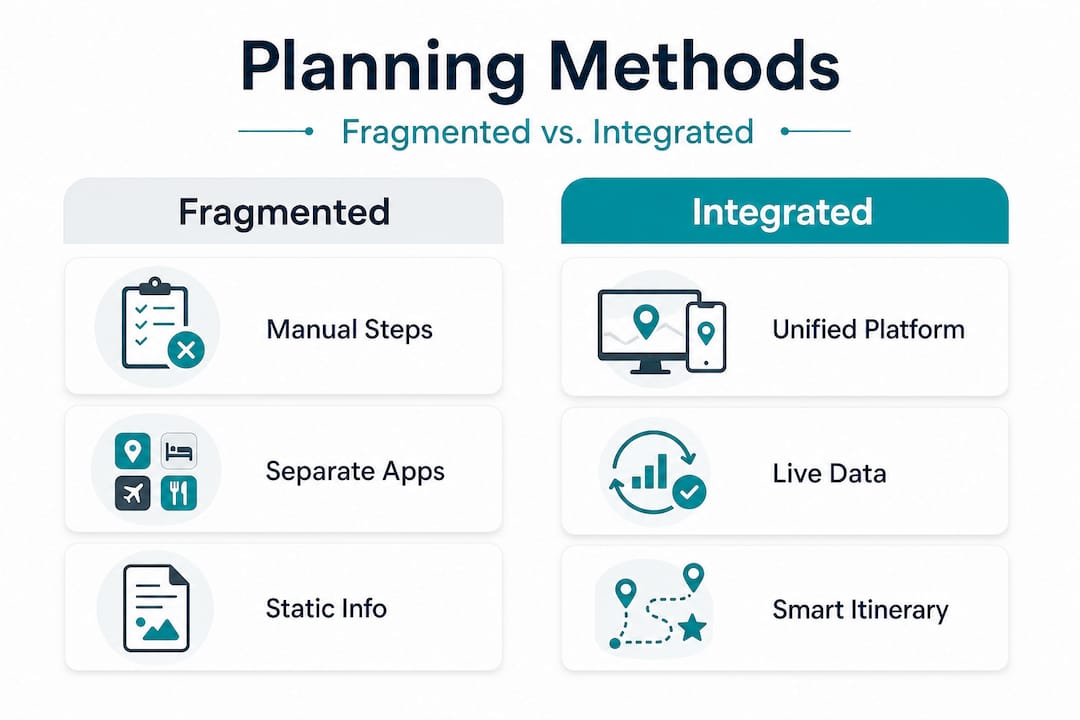
To make the contrast concrete, here's how the two experiences compare:
| Factor | Fragmented planning | Integrated planning |
|---|---|---|
| Time to build itinerary | 5 to 10+ hours | Under 30 minutes |
| Real-time updates | Manual checking required | Automatic alerts |
| Budget tracking | Spreadsheet or memory | Built-in, live total |
| Disruption handling | You find out at the airport | Proactive rerouting |
| Consistency across bookings | Often mismatched | Unified and verified |
| Personalization | Generic search results | Preference-matched |
The numbers behind this shift are significant. Structured itineraries drive 42% revenue growth for travel platforms, while API and AI-driven tools deliver massive time savings and substantially higher booking value per user. That's not a coincidence. When planning is easier and more confident, people book more and book better.
Pro Tip: Look at personalized trip plan examples to get a feel for what a well-structured, AI-generated itinerary actually looks like before you commit to a platform.
One often overlooked feature is the smart packing list function some integrated platforms offer. It's a small thing, but having your packing checklist automatically populated based on your destination's weather, planned activities, and trip length removes yet another friction point from your pre-travel routine.
Benefits for busy professionals and time-pressed travelers
With the mechanics clear, it's time to address the central question: what does integrated travel planning actually help you do better than old-school methods?

The benefits cluster into four categories that matter most to time-pressed people.
Time savings are the most immediate win. Integrated AI systems cut 90% off package creation time compared to manual planning. For a professional who values their time at even a modest hourly rate, saving eight hours of itinerary research translates directly into dollars recovered. Multiply that across three or four trips a year and it becomes a meaningful number.
Higher trip quality follows naturally from better information. When your itinerary is generated from live data and matched to your actual preferences, you get recommendations that fit your trip, not generic tourist lists. The difference between a "things to do in Lisbon" Google search and an AI that knows you prefer walkable neighborhoods, local restaurants under $40 per person, and museums that are open on Mondays is enormous.
Stress reduction is real and measurable. According to research on structured itinerary workflows, structured itineraries reduce stress, improve focus on strategic tasks, and ensure compliance for work travel. For anyone who has landed in a foreign city with a dead phone, a printed itinerary that no longer matches reality, and a meeting in two hours, this point needs no further elaboration.
Work travel compliance becomes automatic. Integrated platforms built for corporate use can enforce spending caps, preferred vendor agreements, and approval workflows within the booking flow itself. No more submitting expenses and discovering you booked a hotel outside the approved network.
Here's what integrated planning consistently delivers for frequent travelers:
- Fewer booking errors and mismatched dates
- Faster recovery when disruptions happen
- Better use of layover time and transit windows
- Accurate pre-trip budget visibility
- Personalized activity recommendations that actually fit the schedule
For the experience of saving time in a practical, day-to-day sense, the article on saving time with custom itineraries is worth a read. And if you want a more tactical approach, efficient trip customization for busy travelers covers the specific workflow steps that make the biggest difference.
Real-world applications and expert strategies for seamless trips
Knowing the benefits, here's how you can start using integrated planning tools, with insights from leading experts on what actually works in practice.
The basic workflow for getting the most from an integrated platform is straightforward:
- Define your priorities first. Before touching any platform, write down your non-negotiables. Budget ceiling, travel dates, must-see locations, preferred pace (relaxed vs. packed). This takes five minutes and saves hours of filtering.
- Auto-generate your options. Let the AI do the first pass. Resist the urge to micro-manage at this stage. The system often surfaces combinations you wouldn't have thought to look for.
- Review AI recommendations critically. Check the geographic logic. Does the itinerary require you to cross town twice in one afternoon? Is there enough buffer between activities? Good platforms build this in, but a quick review catches edge cases.
- Add manual tweaks for personal context. The AI doesn't know your colleague prefers dinner at 7pm or that you want to skip any attraction with more than a 45-minute wait. These are easy to add once the structure is in place.
- Activate real-time monitoring. Before departure, confirm your platform's alert settings are live. You want proactive notifications, not reactive ones.
Advanced users take this further. Savvy travelers build in disruption buffers: an extra 90 minutes on connection flights, a backup restaurant option for each dinner, and a note about alternative hotel neighborhoods in case of overbooking. Integrated platforms with strong AI can suggest these buffers automatically based on historical disruption rates for your specific routes.
The research on what genuinely moves the needle is striking. Neuro-symbolic AI agents increase traveler satisfaction by 37%, with optimal results coming from feasibility-first approaches and staged optimization. In plain terms: systems that check whether a plan is actually achievable before presenting it dramatically outperform systems that just generate attractive-looking itineraries. Meanwhile, staged retrieval-planning-governance frameworks ensure constraint satisfaction in complex multi-city or multi-preference trips, which is exactly the scenario where most manual planners give up and accept a mediocre result.
"The best integrated systems don't just show you options. They show you options that are actually possible given your full set of constraints."
Pro Tip: When using any AI-powered platform, input your hard constraints first (flight times, budget, must-visit locations) and your soft preferences second (cuisine type, activity level, accommodation style). The AI performs significantly better with this ordering because it filters by feasibility before optimizing for preference.
For a deeper look at how customization within integrated tools reshapes the actual trip experience, the guide on customization in travel planning is genuinely useful. And if comfort is a priority for your work travel specifically, comfort-driven trip strategies covers how to configure itineraries that don't just get you there, but actually leave you rested and ready to perform.
The uncomfortable truth: Not all integrations solve real travel pain
Here's the perspective that most platform reviews won't give you: a significant number of tools marketed as "integrated" are actually just well-designed aggregators with a thin layer of AI branding on top. They pull data from the same sources, present it on one screen, and call it integration. It isn't.
True integration means the platform acts on information, not just displays it. If your outbound flight delays by two hours, a genuinely integrated system should automatically check whether your hotel check-in window is affected, flag any activities that need to be rescheduled, and offer alternatives before you even land. Most tools don't do this. They notify you of the delay and leave the rest to you.
The way to tell the difference is simple: judge by outcomes, not features. Ask how much time, stress, and error risk a platform actually removes from your specific travel patterns. A tool with 50 features that requires you to manually re-link bookings after any change isn't saving you anything. A simpler tool that handles disruptions automatically and delivers a conflict-free itinerary in 20 minutes is genuinely valuable.
The other trap worth naming is over-customization. Some platforms let you tweak every micro-detail, which sounds great but actually reintroduces the cognitive load you were trying to escape. The best systems handle the 90% automatically and let you tune the remaining 10% with minimal friction. If you're spending two hours personalizing an AI-generated itinerary, the AI didn't do its job.
For complex travel patterns, the guide on streamlined multi-trip planning cuts through a lot of the noise about what actually works when you're juggling multiple destinations or back-to-back travel weeks.
Take the next step: Experience seamless travel with DestList
If the research and frameworks above resonate, the logical next step is trying a platform that actually delivers on the integrated planning promise rather than just describing it.
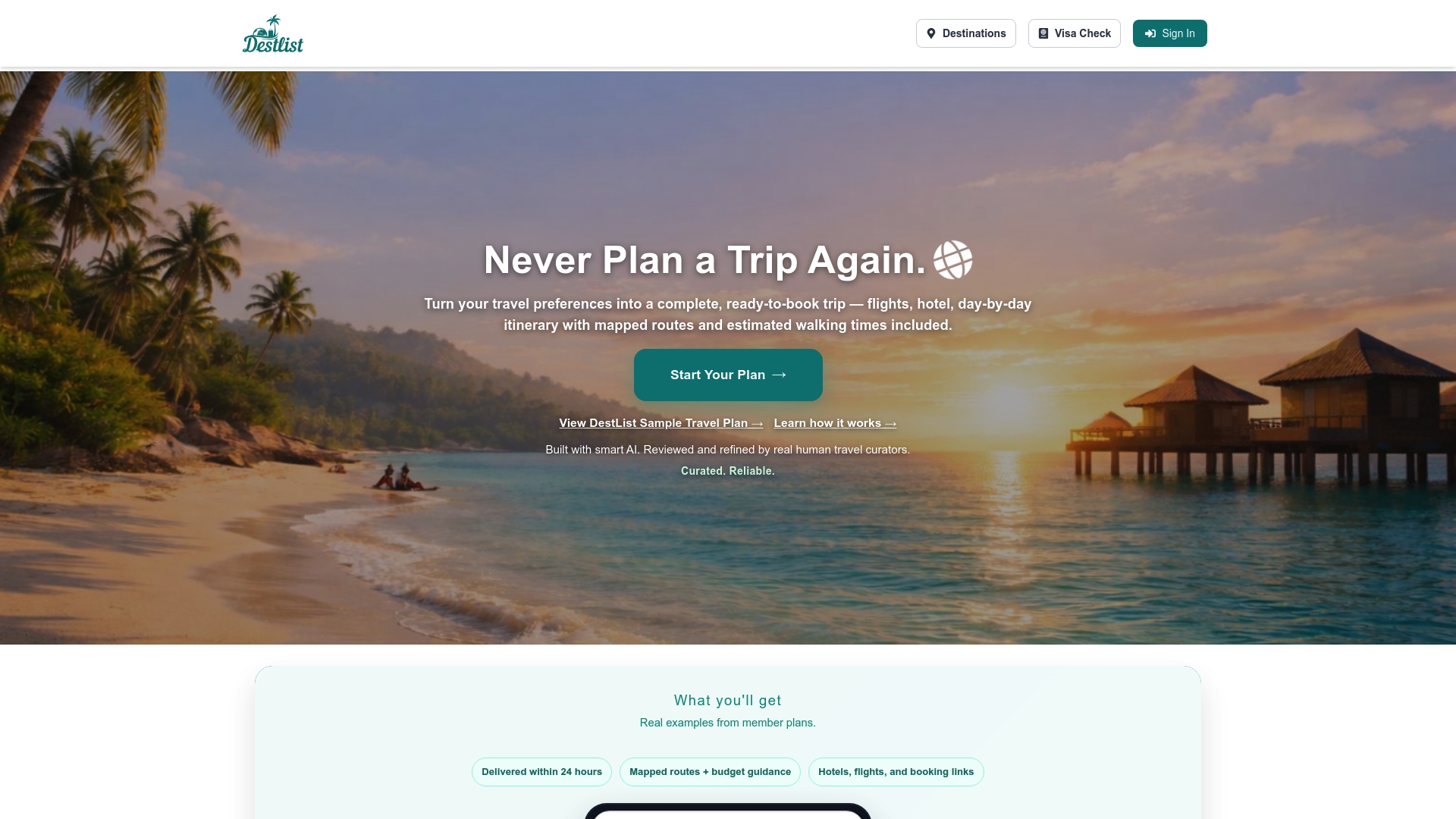
DestList combines AI-powered itinerary generation with human travel expertise to produce ready-to-book trip plans within 24 hours. Whether you're browsing curated travel plans for inspiration or want a fully done-for-you travel planning experience, the platform handles flights, hotels, day-by-day activities, mapped routes, weather alerts, and packing lists in one place. For travelers who want full control over the starting point, a custom travel itinerary lets you input your exact preferences and receive a structured, conflict-free plan tailored to your budget and pace. Less planning, more actual traveling.
Frequently asked questions
What is integrated travel planning?
It's a single platform that combines all your booking, itinerary, and trip management into a unified, automated experience. As AWS research confirms, integrated planning unifies multiple travel services through a connected technology layer.
How does integrated travel planning save time?
It automates itinerary creation and updates by pulling real-time data from flights, hotels, and activities, eliminating manual entry and cross-checking. Integrated AI systems cut 90% off package creation time compared to traditional planning methods.
Is integrated travel planning suitable for both business and leisure?
Yes. These platforms handle compliance requirements for work trips while personalizing experiences for vacationers. Research on AI travel agents confirms that corporate travel focuses on compliance while consumer platforms optimize for personalization, and the best tools address both modes.
What features should I look for in an integrated travel planning tool?
Prioritize real-time updates, AI-driven suggestions, disruption management, and a centralized dashboard. AWS's agentic travel workflow research identifies these as the defining features of tools that deliver genuine time and stress savings for travelers.